 Cirius Petpedia
 How to Stop Destructive Chewing: A Cause-by-Cause Dog Training Guide
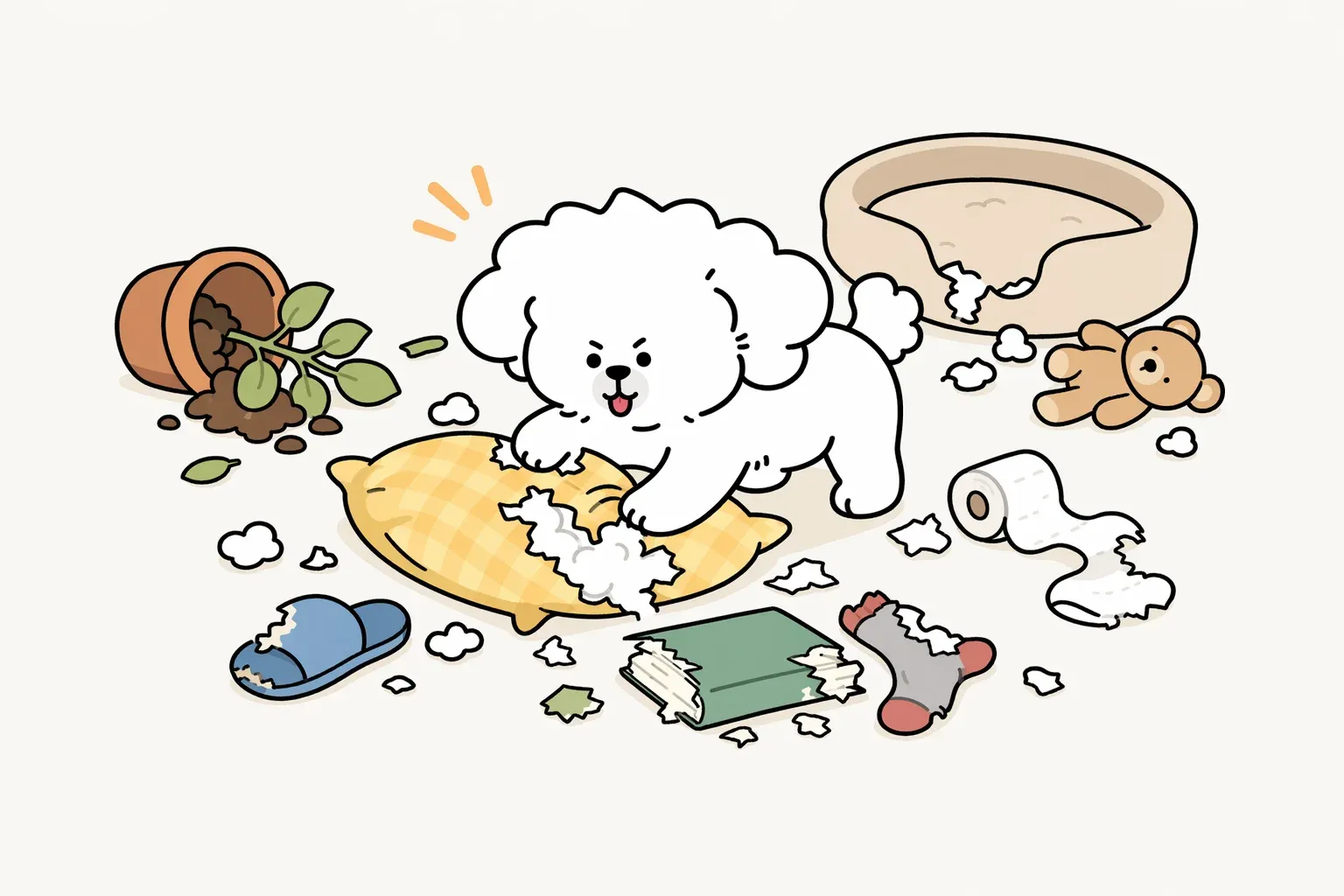
You come home to find a baseboard gnawed to splinters, a couch cushion disemboweled across the living room, or your favorite pair of shoes reduced to scraps. If you’re reading this, you’ve probably already Googled “how to stop dog from chewing everything” — and gotten a list of generic tips that didn’t stick.
Here’s why those generic tips fail: dog destructive chewing is not a single problem. It’s five different problems that happen to look the same from the outside. A teething four-month-old Labrador, a separation-anxious rescue with a chewing habit, and a bored adult Border Collie are all “chewing destructively” — but they need completely different interventions.
This guide walks you through identifying which of the five causes applies to your dog, then applying the solution matched to that specific cause.
Why Dogs Chew: Normal Behavior vs. Destructive Chewing
Chewing Is Natural — Here’s When It Becomes a Problem
Chewing is a species-typical behavior in dogs. It serves biological functions throughout a dog’s life: teething puppies use it to relieve gum discomfort, adolescent dogs use it to explore their environment, and adult dogs use it as a stress-relief and jaw-strengthening activity.
The ASPCA notes that chewing is one of the most common “problem behaviors” reported by owners — yet the behavior itself is normal. The problem is target and intensity. A dog working through a Kong stuffed with frozen food is doing exactly what dogs do. The same dog destroying your drywall or swallowing cloth from a couch cushion is a dog whose chewing drive has no appropriate outlet.
Normal chewing:
- Directed at appropriate objects (chew toys, raw bones, dental chews)
- Self-limiting — dog chews for a while and stops
- Occurs when the dog is relaxed or mildly stimulated
- Leaves items visibly chewed but largely intact
Destructive chewing:
- Directed at household items, furniture, flooring, walls, or clothing
- Escalating — the dog returns repeatedly to the same targets
- Often occurs during specific contexts (alone, bored, stressed)
- Results in partial or complete destruction of items
How to Tell the Difference
The distinction that matters for training purposes is context. When does your dog chew? What does it chew? Is the chewing getting worse over time or staying stable?
Keep a simple log for one week: write down every chewing incident, the time it happened, whether you were home, and what the dog chewed. This record will tell you which of the five causes (below) is most likely and which interventions to prioritize.
What Happens When You Ignore Destructive Chewing
Most owners cycle through frustration — scolding, putting the dog outside, trying a new spray — without a systematic approach. Meanwhile, three things compound the problem.
Safety Risks: Electrical Cords, Toxic Materials, Intestinal Blockages
Dog destructive chewing creates real medical emergencies. Electrical cord chewing causes electrocution and severe oral burns. Ingested foam rubber from couch cushions, fibers from carpet, or splinters from baseboards can cause intestinal obstruction requiring emergency surgery. Some paints and treated wood surfaces are toxic when ingested.
According to VCA Hospitals, foreign body ingestion from chewing is a leading cause of emergency veterinary visits in dogs under three years of age.
The Behavioral Spiral: How Chewing Becomes a Habit
Chewing provides dogs with direct neurological reward — the act of chewing releases endorphins and reduces cortisol. This means every successful chewing episode reinforces the behavior, regardless of whether you punish it afterward. Punishment after the fact (when you come home to destruction) does not reduce chewing; it only creates anxiety around your return, which can actually increase chewing driven by separation distress.
The longer destructive chewing goes unaddressed, the more embedded it becomes as a self-soothing or habitual behavior. What starts as teething or boredom can solidify into a fixed pattern by 12–18 months.
The Human Side: Frustration, Rehoming, and Broken Trust
Destructive chewing is one of the top reasons dogs are surrendered to shelters. The financial cost (furniture, flooring, household items) combines with the emotional cost (feeling like the relationship is failing) to push owners toward giving up. This outcome is almost always preventable — but only when the correct cause is identified early.
The 5 Causes of Destructive Chewing (Self-Diagnosis Checklist)
Use this framework to identify which cause applies to your dog before choosing a solution. Most cases fall into one primary cause with one secondary contributing factor.
Teething (3–6 Months): Red Gums, Lost Baby Teeth, Everything Goes in the Mouth
Who it affects: Puppies between approximately 3 and 7 months old.
Puppies have 28 baby teeth that are replaced by 42 adult teeth, with the most intense teething period between 4 and 6 months. During this window, gum inflammation causes real discomfort, and chewing relieves pressure. Everything — baseboards, table legs, shoes, remote controls — functions as a teething ring.
Behavioral markers:
- Dog is under 8 months old
- You may find small baby teeth around the house (this is normal)
- Gums appear redder than usual, may be slightly swollen
- Dog chews anything and everything regardless of context
- Chewing does not dramatically increase when left alone
Checklist: If your dog is under 7 months and chews opportunistically throughout the day, teething is the primary cause.
Separation Anxiety: Destruction Only When You’re Gone
Who it affects: Dogs with a significant bond to one or more people; more common in rescues, velcro breeds, and dogs with inconsistent schedules.
Dogs with separation anxiety do not simply prefer company — they experience genuine panic when isolated. Chewing during absences is a displacement behavior and anxiety-relief mechanism. The destruction is almost always concentrated near exit points (doors, windows) or in areas associated with the owner (bedroom, laundry, personal items).
Behavioral markers:
- Destruction happens exclusively or primarily when the dog is alone
- Dog follows you from room to room when you’re home
- Distress behaviors before you leave: pacing, panting, whining
- Neighbors report vocalization when you’re out
- Dog is extremely subdued or overly excited when you return (not normal calm greeting behavior)
- You find destruction near doors, windows, or your personal belongings
Boredom vs. Anxiety — Diagnostic Comparison:
| Feature | Boredom Chewing | Separation Anxiety Chewing |
|---|---|---|
| Trigger | Under-stimulation | Being alone |
| Location of damage | Opportunistic (wherever interesting) | Near exits, owner’s items |
| Occurs when owner is home? | Yes, if dog is ignored | Rarely |
| Other anxiety signs? | Usually absent | Yes (vocalization, pacing, GI upset) |
| Responds to more exercise? | Significant improvement | Partial at best |
| Responds to alone-time training? | Minimal effect | Significant improvement |
This table represents the single most important distinction in treating dog destructive chewing. Getting it wrong means months of failed intervention.
Boredom and Under-Stimulation: The Under-Exercised Dog
Who it affects: High-energy breeds (Huskies, Border Collies, Vizslas, Weimaraners, young Labradors and Retrievers), adolescent dogs, and any dog receiving less exercise and mental stimulation than its breed requires.
Boredom chewing is the most common cause of dog destructive chewing in adult dogs in the US and UK. The dog has energy, no productive outlet, and chewing is stimulating enough to fill the gap.
Behavioral markers:
- Chewing happens whether you are home or away
- Dog is generally hyperactive, easily distracted, hard to settle (if this pattern is pervasive, see the calming protocol for hyperactive dogs)
- Chewing escalates in bad-weather periods when walks are reduced
- Dog is under 3 years old or is a working/sporting breed
- Dog also steals objects, gets into trash, or engages in other attention-seeking behaviors
Checklist: If your dog’s chewing increases during low-activity periods regardless of your presence, boredom is the primary driver.
Stress and Environmental Change: New Home, New Baby, New Routine
Who it affects: Any dog experiencing a significant change — moving house, a new baby or pet, loss of a household member, change in work schedule, or any disruption to established routine.
Dogs are creatures of routine. Cortisol (the stress hormone) elevates during environmental disruption, and chewing functions as a self-soothing behavior. Unlike separation anxiety, stress-related chewing may occur even when you are present and tends to peak in the weeks immediately following a change, then gradually decrease as the dog adjusts.
Behavioral markers:
- Chewing onset correlates with a specific life event or change
- Dog appears generally unsettled: hiding, not eating normally, sleeping more or less than usual
- Chewing may occur even when you are in the room
- Gradually improving over weeks (unlike separation anxiety, which persists)
Pain or Medical Issues: Sudden Chewing in Adult Dogs
Who it affects: Any adult dog that develops destructive chewing suddenly with no prior history.
This is the cause most commonly missed because owners assume behavior problems are always behavioral. Dental pain (fractured teeth, periodontal disease, tooth root abscess) causes dogs to chew on hard surfaces seeking counter-pressure or distraction. Gastrointestinal discomfort triggers grass-eating and sometimes compulsive chewing. Nutritional deficiencies can drive pica-like behaviors.
Behavioral markers:
- Dog has no prior destructive chewing history
- Onset is abrupt — within days to weeks
- Dog may also show other physical signs: lethargy, changes in appetite, pawing at the face, bad breath
- No obvious environmental trigger
Checklist: If your adult dog starts chewing everything suddenly, see a veterinarian before assuming a behavioral cause. A dental exam and basic bloodwork can rule out medical contributors within a single visit.
How to Fix It: Cause-Specific Solutions
Teething: Frozen Toys, Safe Chew Alternatives, and What to Avoid
The goal during the teething period is not to stop chewing — it’s to redirect it to appropriate objects and protect household items during a phase that will naturally resolve by 7–8 months.
Effective interventions:
- Frozen chew toys: Rubber toys (Kong-style) stuffed with peanut butter, wet food, or broth and frozen solid provide cooling relief for inflamed gums. Freeze multiple so you always have one ready.
- Chilled washcloths: A wet washcloth twisted and frozen makes an inexpensive teething aid. Supervise use to prevent ingestion of cloth fibers.
- Hard rubber chews: Appropriately sized rubber chews designed for puppies provide safe chewing resistance without splintering risk.
- Supervision and confinement: During teething, your puppy should be either directly supervised or in a puppy-proofed confinement area. This is not punishment — it’s developmental management.
What to avoid:
- Ice cubes: can crack developing adult teeth
- Rawhide: ingestion risk is high for unsupervised puppies
- Old shoes or socks: teaches the dog that clothing is an appropriate chew target — it cannot differentiate your worn-out shoe from your good one
Also read: How to Stop Puppy Biting for the overlap between teething, mouthing, and nipping behavior in puppies.
Separation Anxiety: Gradual Alone-Time Training
Separation anxiety chewing requires a systematic desensitization program, not a quick fix. The core principle is to build the dog’s tolerance for alone time incrementally so that isolation no longer triggers panic.
Foundation steps:
- Departure cue desensitization: Practice picking up keys, putting on shoes, and grabbing your bag — then sitting back down without leaving. Repeat until these cues no longer trigger anxiety.
- Short absences only: Begin with departures of 30–60 seconds. Return before the dog escalates. Gradually increase duration over days and weeks, never pushing past the dog’s current threshold.
- Independence building at home: Encourage the dog to settle away from you while you’re in the house. Baby gates, tethers, or crate training (introduced positively) help the dog learn that separation is safe and temporary.
- Pre-departure exercise: A 30-minute walk or play session 30–60 minutes before you leave reduces baseline arousal, making the dog more likely to rest during your absence.
Severe separation anxiety — where the dog panics even at brief absences — benefits from guidance from a certified applied animal behaviorist (CAAB) or a veterinary behaviorist. Medication (prescribed by a vet) may be appropriate in moderate to severe cases as a bridge during training.
Boredom: Exercise, Enrichment, Puzzle Toys, and Nose Work
The formula for boredom chewing is simple: increase physical exercise + increase mental stimulation + provide appropriate chew outlets. The math matters — most owners underestimate how much stimulation a healthy adolescent or working-breed dog actually requires.
Physical exercise:
- Aim for the exercise level your breed requires, not just a 15-minute walk. High-energy breeds may need 60–90 minutes of vigorous activity daily.
- Vary routes, surfaces, and social exposure to maximize mental engagement during walks.
- Swimming, fetch, flirt poles, and dog sports (agility, flyball) are efficient energy outlets.
Mental enrichment:
- Nose work and scent training provides some of the deepest mental fatigue possible — a 20-minute nose work session tires a dog more than an hour of walking.
- Puzzle feeders and Kongs stuffed with food replace the dog’s meal in a bowl with a 10–20 minute cognitive challenge.
- Rotating toy selection (rotate in/out every 2–3 days) maintains novelty and reduces habituation.
For days when outdoor exercise is limited, see indoor enrichment activities for dogs for structured play alternatives.
Appropriate chew provision: Always have at least one approved chew available. Long-lasting chews (bully sticks, raw beef trachea, elk antler appropriate to jaw strength, Kongs stuffed with frozen food) give the dog a legal chewing outlet. Appropriate chew toys do not eliminate the need for enrichment — they work alongside it.
Stress: Environmental Stabilization and Routine Building
Stress-related chewing resolves most reliably when the stressor is either removed (if possible) or when the dog is given structure and predictability that buffers the disruption.
What helps:
- Predictable routine: Feed, walk, and play at consistent times every day. Predictability lowers cortisol in dogs going through transitions.
- Safe space: Ensure the dog has an undisturbed retreat — a crate, a covered bed, or a quiet room — where it can decompress. Do not force interaction during this period.
- Gradual introductions: If the stressor is a new pet or family member, manage introductions in a controlled, positive way rather than forcing immediate cohabitation.
- Pheromone diffusers: Dog-appeasing pheromone (DAP) products (available in collar, diffuser, and spray formats) have moderate evidence for reducing anxiety-related behaviors during transitions. They are not a standalone solution but can reduce baseline arousal while other interventions take effect.
If the stressor is ongoing (a neighbor’s dog that’s been added next door, chronic noise exposure, ongoing construction), management strategies become more important than waiting for habituation to occur naturally.
Medical Chewing: When to See Your Vet
If your adult dog has developed sudden-onset destructive chewing with no prior history, schedule a veterinary appointment rather than attempting behavioral intervention first.
At minimum, ask your vet to:
- Perform a full oral exam (dental disease is significantly underdiagnosed in dogs)
- Check for GI signs that might indicate discomfort (bloating, changes in defecation, vomiting)
- Run a basic metabolic panel if the behavior change is accompanied by other health changes
Once medical causes are ruled out or treated, reassess the chewing behavior. In many cases, it resolves once the pain trigger is addressed.
Setting Up Your Home to Prevent Chewing
Prevention is not about eliminating your dog’s chewing instinct. It’s about making sure destructive chewing fails while appropriate chewing succeeds.
Puppy-Proofing and Management Strategies
Management means controlling the dog’s access to chewable items until the dog’s impulse control has matured and it has been reliably redirected to appropriate chew objects.
Practical steps:
- Use baby gates, exercise pens, or closed doors to limit access to rooms with valuable or dangerous items
- Secure electrical cords with cable management sleeves or run them behind furniture
- Keep laundry in closed hampers; shoes in closed closets
- Remove throw rugs and accessible pillows during unsupervised periods
- Never leave a dog under 18 months unsupervised with free run of the house for extended periods
Management buys time while training and maturation do their work. It is not a permanent solution, but it prevents reinforcement of destructive habits during the critical learning window.
Bitter Sprays and Physical Barriers: Do They Work?
Bitter deterrent sprays (bitter apple formulations are the most widely used) are applied to surfaces to make them taste unpleasant. They work best on dogs that are sensitive to bitter taste and on surfaces that are not the primary target of anxiety-driven chewing.
Realistic expectations:
- Some dogs are unbothered by the taste and continue chewing
- Most dogs habituate to the spray within 2–4 weeks if the root cause isn’t addressed
- Effective on furniture legs and baseboards during teething or mild boredom chewing
- Generally ineffective for separation anxiety chewing (the dog’s distress overrides taste aversion)
Anti-chew sprays work best as one layer in a multi-component strategy, not as a standalone fix. Apply consistently (respray every 1–2 days), and combine with providing an appropriate chew alternative in the same area.
Physical barriers — furniture corner guards, cable covers, even double-sided tape on surfaces — are more reliable than taste deterrents for high-value target areas.
How to Choose Safe Chew Toys (What Vets Actually Recommend)
Not all chew toys are equally safe. The ASPCA and veterinary dental guidelines offer clear criteria:
The “thumbnail test” for hardness: If you press your thumbnail firmly into a chew and it leaves a mark, it’s probably safe. If it doesn’t yield at all (real bones, antlers that are too large, nylon toys marketed as “indestructible”), it’s hard enough to fracture molar teeth — one of the most common dental injuries in dogs.
What to look for:
- Rubber toys (Kong-style): durable, fillable, washable — excellent for all ages
- Rope toys: appropriate for supervised play, not for unsupervised chewing (can be ingested)
- Bully sticks: long-lasting, fully digestible, good for moderate to heavy chewers — limit to one per day due to caloric density
- Edible chews appropriate to the dog’s size and chewing strength
What to avoid:
- Real cooked bones (chicken, pork, rib): splinter and can cause intestinal perforation
- Rawhide: varies widely in quality and digestibility; choking risk if large pieces are swallowed
- Toys smaller than the dog’s muzzle: immediate choking hazard
- Toys with small squeakers or button batteries that could be accessed and swallowed
What NOT to Do: Corrections That Backfire
Knowing what not to do is as important as knowing what works. Several commonly used corrections actively make dog destructive chewing worse.
Why After-the-Fact Punishment Doesn’t Work
When you come home to destruction and scold your dog — verbal reprimand, showing the dog the chewed item, rubbing their nose in it — you are not communicating anything useful about chewing.
Dogs live in the present. A dog’s “guilty look” (the flattened ears, the averted gaze, the cowering posture) is a stress response to your body language and tone, not evidence that the dog knows what it did wrong. Research by animal behaviorist Alexandra Horowitz (Barnard College) demonstrated that the “guilty look” appears just as reliably in dogs that didn’t chew anything — if the owner approaches with an angry demeanor. The dog is reading you, not processing cause-and-effect.
After-the-fact punishment:
- Does not reduce chewing
- Creates anxiety around your return home (which can increase chewing driven by that anxiety)
- Damages the owner-dog relationship
- Delays identifying and addressing the actual cause
Muzzling, Crating as Punishment, and Other Mistakes
Muzzling to prevent chewing is not a long-term solution. A basket muzzle prevents chewing but does nothing to address the underlying drive, anxiety, or pain. Extended muzzle use without addressing the cause creates frustration and can escalate other problem behaviors.
Crating as punishment — putting the dog in the crate after you’ve found destruction — teaches the dog that the crate is an unpleasant consequence, undermining its value as a safe management tool and safe space. If you want to use crate training as part of your management strategy, the crate must be introduced and maintained as a positive, comfortable den, never as punishment.
Loud noises to startle chewing: Throwing cans, clapping, shouting — these may interrupt a chewing episode in the moment but do not transfer to situations where you’re not present, and they increase general anxiety without providing the dog with any information about what it should do instead.
Positive redirection is the only correction that works in real time: If you catch your dog chewing something inappropriate, calmly interrupt (“ah-ah” or a neutral sound), immediately offer an appropriate chew toy or redirect to a known behavior (sit, go to bed), and reward compliance. This teaches the dog what is acceptable, not just what isn’t.
If possessive behavior around chewed objects is a concern — growling or snapping when you try to retrieve items — see managing resource guarding in dogs for a safety-first approach to object possession.
References
FAQ
What age do dogs stop destructive chewing?
Does my dog chew furniture out of spite?
Is anti-chew bitter spray effective?
My adult dog suddenly started chewing everything — what's wrong?
Should I crate my dog to stop destructive chewing?
Related Articles
Dog Separation Anxiety Guide: Symptoms, Training, and Help
Learn how to identify dog separation anxiety symptoms, follow a vet-backed step-by-step training plan, and know when medication or a specialist is needed.

How to Crate Train Your Dog: A Step-by-Step Guide from First Introduction to Calm Alone Time
Learn how to crate train a dog with a 5-step protocol, age-based time limits, and troubleshooting for crying, crate aversion, and accidents.

How to Start Nose Work with Your Dog: A Step-by-Step Beginner's Guide
Learn how to start nose work with your dog using a 5-stage progressive protocol. From palm treat finds to outdoor scent detection — start today with no special equipment.