 Cirius Petpedia
 4 Common Mistakes That Make Your Dog's Hyperactivity Worse
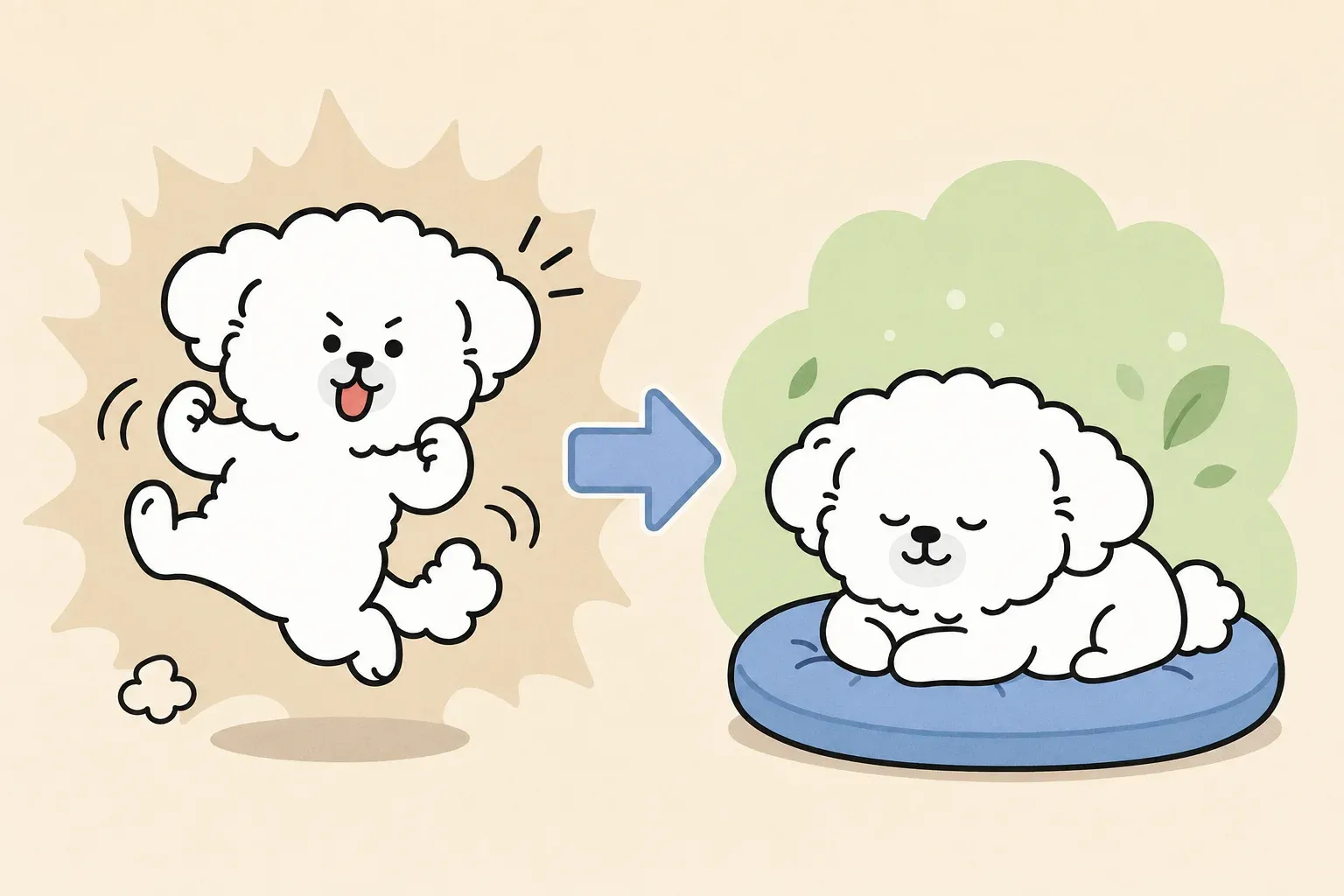
You’ve tried saying “No.” You’ve tried the spray bottle. You’ve tried just ignoring the chaos. And still, the moment you open the front door, your dog ricochets off the walls like he’s been caffeinated.
Figuring out how to calm a hyperactive dog is one of the most common — and most frustrating — challenges dog owners face. The bad news: most popular advice online is generic and misses the behavioral science behind why hyperactivity persists. The good news: there’s a structured approach that works, and it starts with understanding what you’re actually dealing with.
Dog Overexcitement: Normal Zoomies or a Real Problem?
Before trying any training technique, it helps to know whether your dog is having normal energy bursts or showing signs of a genuine arousal regulation problem. These two situations require different responses.
What Zoomies (FRAPs) Actually Are
Zoomies — formally called Frenetic Random Activity Periods (FRAPs) — are short, intense bursts of running, spinning, and leaping that dogs (and many other animals) exhibit as a way to release pent-up energy or tension. They’re almost always brief, typically lasting under two minutes, and tend to happen in predictable situations: right after a bath, first thing in the morning, when greeting a familiar person, or after a period of restraint.
FRAPs are normal dog behavior. A puppy having zoomies around the backyard at dusk isn’t a problem dog — it’s a dog doing exactly what dogs do. Trying to suppress normal zoomies can actually increase frustration and anxiety.
Chronic overexcitement is different. The dog who can’t settle after guests leave after an hour, who can’t walk calmly past a squirrel, who jumps and mouths every time you come home regardless of how long you’ve been gone — that dog is showing signs of an arousal regulation problem.
The key distinction: duration and context. Zoomies end on their own. Chronic overexcitement doesn’t resolve without intervention and affects behavior across multiple contexts throughout the day.
5 Root Causes of Chronic Overexcitement
Understanding why a dog is chronically overexcited helps you target the right intervention.
1. Energy surplus without appropriate outlets. High-energy dogs who aren’t getting adequate physical and mental stimulation will self-generate excitement. Boredom is a primary driver of hyperactive behavior, particularly in working breeds.
2. A low arousal threshold. Some dogs, through genetics or early development, reach peak arousal with very little stimulation. These dogs tip into overexcitement quickly and take longer to return to baseline. This is common in herding breeds and some terriers.
3. Owner reinforcement patterns. This is the most common — and most easily fixed — cause. If your dog has learned that jumping, barking, or zooming around gets him attention (even negative attention like being pushed away or yelled at), he’ll keep doing it. Every “Off! No! Stop!” delivered with eye contact and physical engagement is, to your dog, a reward.
4. Under-socialization. Dogs who weren’t exposed to varied environments, people, and other animals during their critical socialization window (roughly 3–14 weeks) often have poorly developed impulse control. New stimuli trigger a flood of excitement that they haven’t learned to modulate. Proper dog socialization training during and after this window significantly reduces adult hyperactivity.
5. Medical causes. A subset of hyperactive dogs have underlying health issues contributing to their behavior. Hypothyroidism, hyperthyroidism, certain neurological conditions, chronic pain (which can manifest as restlessness), and even dietary factors can drive overexcitement. If your dog’s hyperactivity onset was sudden, or if it seems unrelated to environmental triggers, a veterinary workup is warranted before starting behavior modification.
4 Mistakes That Make Your Dog’s Hyperactivity Worse
Here’s where most dog owners unintentionally derail their own progress. These four mistakes are backed by behavioral science — and they’re also the most common patterns seen in homes with chronically overexcited dogs.
Mistake 1: Matching Their Energy with Yelling or Excitement
When your dog launches into frantic jumping, the instinctive response is to react — loudly. “OFF. SIT. STOP.” Raising your voice, making direct eye contact, and physically engaging with the dog.
The problem: from a behavioral standpoint, you’ve just delivered a burst of social attention exactly when the dog was most overexcited. Your dog doesn’t process “Stop that” — he processes “Excitement = my owner engages with me fully.” You’ve reinforced the very behavior you wanted to extinguish.
The same applies in the opposite direction: if you greet your dog with matching excitement (“Who’s a good boy?! Yes you are!”), you’re setting the emotional tone for the entire interaction. Greeting an overexcited dog with excitement tells him that high arousal is the correct emotional state for this moment.
Mistake 2: Rewarding Overexcitement with Attention or Treats
A subtler but equally powerful mistake. Some owners, frustrated with jumping and barking, try to “distract” their dog with treats or toys during overexcited states. Others give in and pet the dog just to make the behavior stop.
Both responses teach the dog a clear lesson: being frantic produces resources. According to the AVSAB’s position on humane training, operant conditioning works whether or not we intend it to — behaviors that produce outcomes the animal values will increase in frequency.
Giving a sit cue to an already-frantic dog and then rewarding the sit after several failed attempts can also backfire. If the dog offers frantic behavior for 30 seconds before sitting, the sit gets reinforced — but so does the 30 seconds of chaos that preceded it.
Mistake 3: Using Punishment to Force Calmness
Punishment-based methods for hyperactivity (correction collars, alpha rolls, spray bottles, physical pressing down) create a specific problem: they suppress the visible behavior without addressing the underlying arousal. The dog learns to inhibit the external display of excitement while still being internally activated.
Research by Herron et al. (2009) found that confrontational training methods including hitting, alpha rolls, and forced downs were associated with increased aggression in a significant proportion of dogs. Even non-physical punishment like yelling or spray bottles showed negative side effects in some dogs.
More practically: a dog who is punished for excitement often redirects that arousal into anxiety, hypervigilance, or eventually leash reactivity — problems that are harder to treat than the original hyperactivity.
Mistake 4: Restricting Movement Without Providing Outlets
Crating or confining a hyperactive dog when you can’t supervise is reasonable management. But using restriction as the primary strategy — without also providing adequate exercise, mental enrichment, and training time — reliably makes hyperactivity worse.
Restriction raises arousal. When the crate door opens or the leash comes off, a dog who has been confined without sufficient outlets explodes with stored energy. This is why some owners report that their dog “goes crazy” every time they come home: the dog has been building arousal for hours and the owner’s arrival is the trigger that releases it.
The solution isn’t less restriction — it’s pairing restriction with adequate energy outlets so arousal stays manageable.
What Happens When Overexcitement Goes Unchecked
Chronic overexcitement isn’t just an annoyance. Left unaddressed, it has real consequences for both behavior and physical health.
Behavioral Escalation: Barking, Destruction, Aggression
Overexcitement and arousal regulation problems exist on a continuum. A dog who is chronically overexcited tends to generalize that pattern across new stimuli. Over time:
- Threshold decreases: smaller triggers produce larger reactions
- Recovery time increases: the dog takes longer to return to baseline after each incident
- Behaviors escalate in intensity: jumping becomes mouthing, barking becomes lunging
If your dog’s overexcitement specifically manifests as jumping on people during greetings, the dedicated guide on how to stop your dog from jumping on people walks through the sit-to-greet protocol and impulse control training in detail.
Excessive barking is often a direct consequence of chronic overexcitement — dogs who lack an off switch frequently bark at anything that crosses their arousal threshold. Unchecked, this escalation can tip into resource guarding or conflict-related aggression, particularly in households with children or other pets.
Destructive chewing is another common downstream effect. Dogs who can’t regulate their arousal often self-soothe through destructive behavior, particularly during periods of boredom or confinement.
There’s also a meaningful relationship between chronic overexcitement and separation anxiety. Dogs who are always over-aroused in the owner’s presence have difficulty developing the calm, relaxed relationship with being alone that prevents anxiety.
Physical Risks: Slipping, Impact Injuries, Joint Stress
This is where the discussion typically goes missing from other guides — and it matters, particularly for certain breeds.
Frantic indoor play on hardwood or tile floors causes significant joint stress. The stop-start movements of overexcitement — sudden direction changes, skidding, leaping — place forces on joints that are far beyond normal walking loads. For small breeds particularly, this is clinically significant.
Patellar luxation (kneecap dislocation) is one of the most common orthopedic problems in small dogs, and frantic, repetitive impact is a known risk factor for precipitating luxation events in dogs who are already predisposed. Similarly, frantic jumping on and off furniture contributes to cumulative joint stress that can accelerate wear over time.
For larger breeds, the risk shifts toward soft tissue injuries: cranial cruciate ligament (CCL) tears are more likely during explosive, uncontrolled movement — the exact type of movement that characterizes overexcited play.
This isn’t an argument against exercise. It’s an argument for controlled, purposeful exercise rather than frantic chaos.
A 4-Step Calming Protocol That Actually Works
This protocol synthesizes evidence-based behavior modification techniques, including elements drawn from Dr. Karen Overall’s Relaxation Protocol — a structured desensitization program developed at the University of Pennsylvania School of Veterinary Medicine and widely used by certified veterinary behaviorists.
The protocol works by systematically teaching your dog that calm behavior produces outcomes they value, while excited behavior produces nothing. It’s not quick — expect 2–4 weeks of consistent daily effort before you see reliable results — but it produces lasting changes in your dog’s baseline arousal level.
Step 1: Extinction — Remove the Reward for Overexcitement
Extinction is the behavioral term for stopping reinforcement of a previously reinforced behavior. In practice, this means withdrawing all attention — including negative attention — when your dog is overexcited.
How to implement:
When your dog begins jumping, barking, or bouncing during a greeting or interaction:
- Turn your back completely. Cross your arms. Look at the ceiling.
- Do not make eye contact, speak, or touch the dog.
- Remain completely still until the dog has four paws on the floor and is quiet.
- Wait an additional 2–3 seconds of calm before turning back and offering calm praise.
This feels counterintuitive at first. You’ll notice an extinction burst — a temporary increase in intensity before the behavior decreases. Your dog may bark louder, jump higher, or try more insistently. This is normal and means extinction is working. The moment you give in during an extinction burst, you teach your dog that persisting pays off.
Consistency is everything. If one family member performs extinction correctly but another responds to jumping with playful attention, the behavior will persist — intermittent reinforcement is the most powerful reinforcement schedule.
Step 2: Capture Calmness — Reward the Quiet Moments
Extinction teaches your dog what not to do. Capturing calmness teaches your dog what to do instead.
Capturing calmness means actively noticing and rewarding moments of spontaneous quiet behavior — lying down, sitting calmly, sniffing the ground — without asking for anything.
How to implement:
- Keep a small pouch of low-value treats nearby during daily life at home
- The moment you catch your dog lying calmly or sitting without being asked, quietly say “Good” and place a treat between their paws without creating excitement
- Keep your energy calm and quiet when delivering the reward — excitement from you will reset their arousal
- Do this 10–20 times per day, especially in contexts where your dog is usually overexcited (before feeding, after returning home, when visitors are expected)
Over time, your dog learns that calm behavior is a productive strategy — it’s what generates resources. This shifts their default emotional state from arousal-seeking to rest-seeking.
Step 3: Mat Training and the Settle Command
Once your dog reliably shows improved baseline calmness, you can add a cued settle behavior. Mat training — teaching your dog to go to a specific mat and relax there on cue — is one of the most practical impulse control tools available.
Building mat training:
- Place a mat in a calm area. Lure your dog onto it with a treat and immediately reinforce with additional treats for remaining on the mat.
- Build duration gradually: reward for 5 seconds, then 10, then 30, then a minute.
- Add distance: reward your dog from increasingly far away while they stay on the mat.
- Add the verbal cue (“Place” or “Settle”) once your dog moves to the mat reliably.
- Introduce mild distractions progressively — beginning with low-level distractions that your dog can tolerate while remaining on the mat.
Dr. Overall’s Relaxation Protocol takes this further by systematically desensitizing dogs to a range of distractions (owner movement, visitors, doorbells, other animals) while they remain on a mat in a down-stay. The protocol’s day-by-day structure is designed to build reliable calmness over 15 days of practice sessions.
The settle command becomes a portable intervention — you can ask for a settle before opening the door, before feeding, or any time arousal is building, rather than waiting for an overexcited episode to manage.
Step 4: Structured Exercise, Nosework, and Energy Management
Calming training doesn’t replace physical exercise — it requires it. A dog operating on an energy deficit can’t learn behavioral regulation. But the type of exercise matters.
Structured walks vs. free runs. Leash walking with training elements (stopping when the dog pulls, practicing heel, asking for sits at intersections) is more arousal-reducing than a chaotic, pull-heavy drag around the block. The dog has to think, which activates a different neural pathway than pure physical exertion.
Nosework as a mental reset. Scent-based activities are among the most effective tools for lowering dog arousal, because olfactory processing is cognitively exhausting in a calming way. A 20-minute nosework session can produce greater behavioral calm than a 60-minute physical walk for many dogs. Scatter feeding (hiding kibble in the grass), snuffle mats, and structured scent detection games all leverage this mechanism.
Indoor enrichment activities — puzzle feeders, Kong toys, slow feeders — provide mental engagement during confinement periods and reduce the arousal buildup that produces explosive behavior when restrictions lift.
Exercise timing. Vigorous exercise immediately before a training session can actually impair learning, because the dog is still physiologically elevated. Ideally, exercise occurs 1–2 hours before training, giving time for arousal to return toward baseline.
Age and Breed Considerations
A protocol that works for a 3-year-old adult Labrador may need significant modification for a 10-week-old puppy or a 9-year-old senior. Breed and developmental stage matter.
Puppies (Under 1 Year) vs. Adults vs. Seniors
Puppies have undeveloped prefrontal cortex function, which is the brain region responsible for impulse control. This means that before 6–12 months, a puppy genuinely cannot regulate arousal the way an adult dog can — it’s a developmental limitation, not a training failure. Calming training is still valuable, but expectations need to reflect this. Short sessions (3–5 minutes), frequent rest periods, and very gradual distraction progression are essential.
Puppy hyperactivity that persists beyond 18 months without improvement despite consistent training warrants a conversation with a veterinarian or veterinary behaviorist.
Adult dogs (1–7 years) respond best to the full 4-step protocol described above. Most see measurable improvement in 2–4 weeks with consistent daily practice. Lack of improvement after 6+ weeks of genuine consistency suggests an unaddressed root cause — medical evaluation and professional behavioral assessment are warranted.
Senior dogs (8+ years) who develop new-onset restlessness or apparent hyperactivity should have a veterinary workup first. Cognitive dysfunction syndrome (canine dementia), pain-related restlessness, and hormonal changes can all produce behavioral changes in older dogs that look like hyperactivity but have medical causes.
High-Energy Breeds vs. Small Breeds vs. Giant Breeds
High-energy working breeds (Border Collies, Belgian Malinois, Australian Shepherds, Jack Russell Terriers) have been selectively bred for sustained arousal and drive. These dogs will never be low-energy, and that’s appropriate. The goal with these breeds isn’t reducing energy — it’s channeling it productively. Nosework, agility, herding sports, and structured training give these dogs an appropriate outlet for their arousal while also building the impulse control that transfers to home behavior.
Small breeds (Chihuahuas, Dachshunds, Pomeranians, Toy Poodles) present a specific challenge: owners often underestimate or even enable hyperactivity because the dog is physically small and the behavior is, on some level, cute. But the behavioral mechanisms are identical to larger dogs, and the training approach should match. Critically, small breed dogs have higher rates of patellar luxation and joint problems, making frantic movement a genuine health risk rather than just an inconvenience.
Giant breeds (Great Danes, Saint Bernards, Mastiffs) tend to have naturally lower arousal thresholds but can develop hyperactivity if they’re under-stimulated relative to their needs. Their size means that overexcited behavior — jumping, leaning, pulling — carries real physical risk for owners and for the dog’s own joints. The calming protocol applies equally, with the mat training and settle command being particularly valuable.
When to Seek Professional Help
Calming training is effective for the vast majority of overexcited dogs when applied consistently. But some situations warrant professional support rather than continued self-guided attempts.
Consult a certified professional immediately if:
- Overexcitement escalates into aggression (snapping, biting, or hard staring) toward people or other animals
- Your dog is self-harming during overexcited states (spinning compulsively, chasing tail to the point of injury, self-biting)
- There has been no meaningful improvement after 4+ weeks of genuinely consistent training
- The behavior began suddenly in an adult or senior dog without an identifiable trigger
- Overexcitement is occurring in the context of separation anxiety or severe panic responses
Certified Behaviorist vs. General Trainer. For most hyperactivity cases, a certified professional dog trainer (CPDT-KA) who uses force-free, positive reinforcement methods is appropriate. If aggression is involved, or if you suspect a clinical anxiety disorder, a board-certified veterinary behaviorist (Dip ACVB) or a certified applied animal behaviorist (CAAB) has the clinical training to assess and treat complex cases, including medication-assisted behavior modification when appropriate.
The AVSAB’s position statement on humane training is a helpful resource for understanding what evidence-based training looks like — trainers who recommend primarily aversive methods for arousal issues are working against the behavioral science, not with it.
The process of learning how to calm a hyperactive dog is iterative. You’ll have days where your dog seems to have forgotten every lesson. That’s normal. Behavioral learning isn’t linear. What matters is the trend over weeks, not performance on any individual day.
The dogs who transform the most dramatically with calming training aren’t the naturally low-energy ones — they’re the ones whose owners learned to stop accidentally rewarding the chaos, and started systematically rewarding the quiet.
References
- 1. AVSAB Position Statement on Humane Dog Training
- 2. Overall KL. Manual of Clinical Behavioral Medicine for Dogs and Cats. Elsevier, 2013.
- 3. Herron ME, et al. Survey of the use and outcome of confrontational and non-confrontational training methods in client-owned dogs. Applied Animal Behaviour Science, 2009.
- 4. Dog Zoomies Explained: Why They Happen & When to Worry (AskAVet, 2025)
- 5. AKC: Is Your Dog Too Hyper? 5 Tips to Train Hyperactive Dogs
FAQ
Are zoomies the same as hyperactivity?
How long does it take for calming training to work?
Can exercise alone fix my dog's hyperactivity?
Should I use calming supplements or medications?
My dog is a high-energy breed. Will calming training actually work?
Related Articles
If Your Dog Won't Stop Barking: Type-by-Type Training Guide
Stop dog barking by identifying the type. 5 types, targeted training protocols, and realistic timelines — evidence-based guide for dog owners.

Dog Separation Anxiety Guide: Symptoms, Training, and Help
Learn how to identify dog separation anxiety symptoms, follow a vet-backed step-by-step training plan, and know when medication or a specialist is needed.
How to Stop Destructive Chewing: A Cause-by-Cause Dog Training Guide
Struggling with dog destructive chewing? Identify the exact cause — teething, anxiety, boredom, or medical — then apply targeted solutions that actually work.