 Cirius Petpedia
 Dog Separation Anxiety: Symptoms, Step-by-Step Training, and When to Get Help
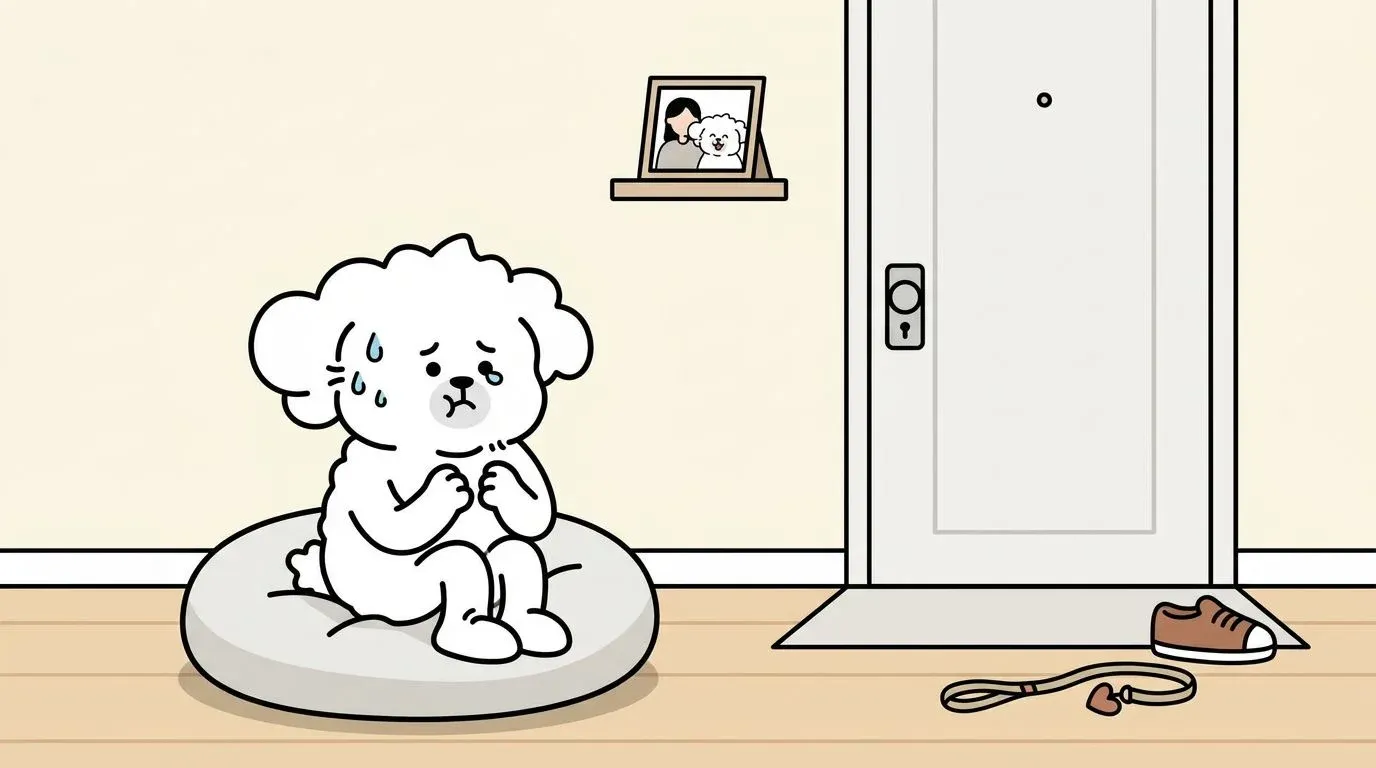
Most dogs don’t love being left alone. But for some, being separated from their owner triggers a genuine panic response — not misbehavior, not boredom, and not stubbornness. Dog separation anxiety is a recognized anxiety disorder, and understanding the difference matters enormously for how you respond to it.
This guide covers the full picture: how to recognize it, what causes it, how to train through it step by step, when to bring in medical support, and why addressing it matters for your dog’s long-term physical health — not just their emotional well-being.
What Is Separation Anxiety in Dogs — And How It Differs From Boredom
Veterinary behavioral definition
The American Veterinary Society of Animal Behavior (AVSAB) defines separation anxiety as a distress response triggered specifically by separation from attachment figures — typically the primary owner or another bonded household member. It belongs to a broader category of anxiety disorders recognized in veterinary behavioral medicine, and it involves a dysregulated stress response rather than a simple behavioral preference.
What distinguishes separation anxiety from other behavior problems is its predictability and specificity: the behavior occurs in relation to departure or absence, not randomly throughout the day. A dog with separation anxiety may be calm and social when people are present, then spiral into distress the moment the door closes.
The ASPCA notes that true separation anxiety involves behaviors that go beyond protest and indicate genuine panic: sustained vocalization, destructive behavior at exit points, house soiling from a housetrained dog, or self-injury. These are not signs of a “bad” dog. They are signs of a dog in distress.
Separation anxiety vs. boredom — a comparison
The distinction matters because the solutions are different. A bored dog responds to more exercise and mental enrichment. An anxious dog will remain distressed regardless of how much activity they had before you left.
| Feature | Separation Anxiety | Boredom / Under-stimulation |
|---|---|---|
| Trigger | Owner departure or absence | Lack of activity, regardless of owner presence |
| Timing | Begins within minutes of departure | Gradual, may occur anytime |
| Behavior type | Targeted (doors, exit points), self-directed | Generalized (chewing furniture, digging) |
| Camera evidence | Persistent vocalization, pacing, panting | Intermittent activity, often resting between bouts |
| Dog’s baseline | Normal or attached behavior when owner present | May show restlessness even with owner present |
| Response to exercise | Little to no improvement | Often improves with adequate exercise |
One useful field test: set up a camera before you leave. A bored dog will typically settle within 20-30 minutes once the initial activity winds down. A dog with separation anxiety rarely settles. The vocalization, pacing, and distress often persist or escalate.
Separation Anxiety Symptoms Checklist
Behavioral signs — barking, howling, destructive behavior
The most visible dog separation anxiety symptoms tend to cluster around vocalization and escape-motivated behavior.
Vocalization:
- Sustained barking, howling, or whining that begins shortly after departure
- Vocalizations that don’t stop or that escalate rather than tapering off
- Neighbors reporting noise they don’t observe when you’re home
Destructive behavior:
- Chewing or scratching at doors, windows, and exit points specifically
- Damage concentrated near where you left, not generalized throughout the house
- Destruction that doesn’t correlate with amount of physical exercise
Escape attempts:
- Scratching through doorframes, breaking through baby gates, bending crate bars
- Behavior that risks self-injury in pursuit of getting out
Physical signs — excessive drooling, house soiling, appetite loss
Physical signs are often underrecognized but are important indicators of genuine physiological stress.
- Excessive salivation or drooling when alone or during pre-departure routines
- House soiling in a dog that is reliably housetrained when people are present
- Refusal to eat or drink while alone (food left in puzzles or Kongs untouched)
- Vomiting or diarrhea in the period before or after owner absence
- Rapid breathing and trembling visible on camera footage
Self-harm — escape attempts, over-grooming, paw chewing
A subset of dogs with severe separation anxiety develop repetitive or self-injurious behaviors.
- Worn or broken nails from scratch attempts
- Raw or irritated paws from licking or chewing
- Hair loss from over-grooming
- Injuries to mouth, paws, or limbs from escape attempts
If you observe any of these, the anxiety has reached a level where professional behavioral support is strongly indicated.
Camera observation tips: Place one camera near the main exit (front door or garage entry) and one with a wide-angle view of the dog’s usual resting area. Review footage at three key time points: within the first 5 minutes of departure, at 20-30 minutes (when bored dogs typically settle), and in the middle of your absence. This footage is also valuable to share with a veterinary behaviorist or trainer.
What Causes Separation Anxiety in Dogs
Genetic and breed predispositions
Research published in applied animal behavior science consistently shows that certain breeds carry higher genetic risk. Dogs bred specifically for close work with humans — hunting partners, herding assistants, companion breeds — tend to show higher rates of separation-related behaviors.
Breeds with elevated prevalence in research and behavioral clinic populations include:
- Labrador and Golden Retrievers — bred for constant handler proximity
- Vizslas — referred to by enthusiasts as “velcro dogs” for their bonding intensity
- German Shepherds and Border Collies — high emotional sensitivity, tight handler orientation
- Cocker Spaniels and Cavalier King Charles Spaniels — strong companionship drive
- Bichon Frises and Maltese — selectively bred purely for human companionship
Rescue dogs show elevated rates across all breeds, though the relationship is complex — it reflects life history and rehoming experience as much as genetics.
Environmental triggers — rehoming, moving, routine changes, post-pandemic adjustment
Separation anxiety commonly emerges or worsens after a disruption to the dog’s established routine or attachment relationships.
Common environmental triggers:
- Rehoming or shelter history — loss of a prior attachment figure
- Moving to a new home — environmental context changes, existing anxiety cues are absent
- Change in household schedule — a family member returning to in-office work after a period of remote work (post-pandemic adjustment is now well-documented in behavioral practice)
- Loss of another household pet or family member — grief and disruption of the social structure
- Traumatic experience during an absence — a storm, fireworks, or distressing event that occurred while alone
How owner behavior patterns can reinforce anxiety
This is the piece that often carries undeserved guilt. Owner behavior doesn’t cause separation anxiety — an underlying predisposition must be present. But certain interaction patterns can make it harder to improve.
Behaviors that can reinforce anxious patterns:
- Long, emotional departures and returns — extensive goodbyes and excited reunions signal to the dog that departure is an event of high significance
- Constant on-demand contact — always responding to soliciting behavior (nudging, pawing) when home can raise the baseline expectation of continuous access
- Punishing anxiety behaviors — punishment increases the dog’s overall anxiety level and makes nothing better
The important distinction: these patterns amplify an existing vulnerability. They are not the original cause. Understanding this keeps the focus where it belongs — on the dog’s internal state and how to change it — rather than on owner blame.
How to Assess Your Dog’s Anxiety Level at Home
Camera monitoring — what to watch for at 3 key time points
Before beginning any training protocol — and certainly before a vet visit — systematic camera observation gives you objective data. Here’s a framework:
Time Point 1: 0-5 minutes post-departure What you want to see: the dog orients to the door briefly, then disengages, sniffs, and settles. Signs of concern: immediate sustained vocalization, scratching at door, pacing without settling, panting.
Time Point 2: 20-30 minutes post-departure What you want to see: dog resting, possibly napping, engaged with any enrichment you left. Signs of concern: continued or resumed distress behaviors, food enrichment left completely untouched, inability to settle.
Time Point 3: Mid-absence (if you’re gone for several hours) What you want to see: periodic movement, resting, normal low-activity behavior. Signs of concern: sustained distress, self-injurious behavior, repeat cycles of panic without resolution.
Camera placement tip: Use two cameras when possible. One facing the main exit point, one covering the primary resting area. Many behaviors — trembling, drooling, repeated repositioning — are only visible in the resting area footage.
Information that helps your vet make a diagnosis
When you bring this to a vet or veterinary behaviorist, the following information significantly accelerates diagnosis:
- Video clips from each of the three time points above (even 2-3 minutes each is helpful)
- A written timeline: when does distress begin? Does it plateau or escalate? Does the dog ever settle?
- Any physical symptoms observed (house soiling, vomiting, self-injury, destruction patterns)
- History of any major life changes in the past 6-12 months
- Current daily schedule (exercise, feeding, social contact)
- Any previous attempts at treatment and what happened
This preparation turns a 15-minute vet conversation into a productive diagnostic session.
Step-by-Step Separation Anxiety Training
Dog separation anxiety training is built on one core principle: never leave the dog at a level of absence that causes distress. Every departure that triggers panic reinforces the anxiety cycle. The goal is to keep every separation below the distress threshold, then systematically extend it.
This approach, known as systematic desensitization with counterconditioning, is the evidence-based standard recommended by AVSAB and the majority of veterinary behaviorists.
Stage 1 — Short absences (5 seconds to 5 minutes)
Goal: Establish that brief departures are routine and non-threatening.
Starting point: Begin shorter than you think necessary. If your dog begins to show distress the moment you pick up your keys, start before you even move toward the door.
Protocol:
- With your dog calm, walk toward the door naturally.
- Touch the door handle. Return to your dog before any distress begins.
- Repeat 5-10 times, gradually increasing to opening the door and immediately stepping back.
- Work up to stepping outside for 3-5 seconds, then 10-15 seconds, then 30 seconds.
- Return before the dog shows distress. If distress begins, you’ve gone too far — reduce the duration.
Success criteria: Dog remains at or below a relaxed baseline (lying down, not vocalizing, not rushing to the door) for the full duration.
Pace: Multiple short practice sessions daily outperform one long session. Aim for 5-10 repetitions per session, 2-3 sessions per day.
Stage 2 — Departure cue desensitization
Many dogs with separation anxiety begin to show distress before you leave — triggered by pre-departure cues like picking up keys, putting on a coat, or moving toward the door. This stage addresses those cues.
Protocol:
- Identify your dog’s earliest distress trigger in your departure routine.
- Perform that trigger repeatedly without departing. Put on your shoes and sit down. Pick up your keys and watch TV. Put on your coat and go to the kitchen.
- Repeat until the cue no longer produces a distress response.
- Work backward through your departure routine: desensitize the last trigger first, then the second-to-last, until the full sequence of cues produces calm.
Why this works: Departure cues become conditioned stimuli that predict absence. Unpaired repetition (cue without consequence) extinguishes the conditioned response.
Stage 3 — Gradual alone-time extension
Once your dog is comfortable with 3-5 minutes of alone time (Stage 1 success) and departure cues are desensitized (Stage 2), begin extending duration.
General progression:
- 5 minutes → 10 minutes → 20 minutes → 30 minutes
- Then: 45 minutes → 1 hour → 90 minutes → 2 hours → 4+ hours
Important rule: Do not jump more than double the previous successful duration until you have multiple successful repetitions at each step. If your dog fails at a new duration (camera shows distress), drop back to the last successful step.
Progress timeline: This is individual and depends on anxiety severity. Some dogs move through this in 4-6 weeks. Others require 4-6 months. Sustainable progress is more valuable than fast progress.
Support tools — crate training, enrichment toys, calming music
These tools support the training process but do not replace it.
Crate training for anxious dogs: A crate, when introduced correctly, gives a dog a predictable, enclosed space that can reduce ambient arousal. For dogs with separation anxiety, the crate should be introduced as a separate positive training project before being used during absences.
Crate introduction protocol:
- Place the crate with the door open in a common area. Feed meals inside.
- Use high-value treats to gradually encourage the dog to rest inside voluntarily.
- Practice closing the door briefly while you remain in the room — only extend to your absence once the dog is relaxed in a closed crate with you present.
- Never use the crate as an emergency confinement tool for an untrained anxious dog — it will intensify distress.
Enrichment toys: Food puzzles, stuffed Kongs (frozen is longer-lasting), lick mats, and snuffle mats can reduce arousal and provide a positive conditioned cue for your departure. Key principle: use these exclusively during absences or departures so their value is preserved. A Kong that appears only when you leave becomes a positive predictor of departure rather than a negative one.
Calming music and ambient sound: Research from the Scottish SPCA and University of Glasgow found that classical music and soft rock produced lower stress-related behaviors in shelter dogs compared to silence or heavy metal. White noise machines can also mask triggering external sounds (mail carrier, door buzzes). These are helpful environmental supports but mild in effect relative to behavioral training.
When to Seek Professional Help and Medication Options
Signs that training alone isn’t enough
Training takes time, but some presentations indicate that behavioral modification alone is unlikely to succeed without additional support.
Consider professional consultation when:
- Your dog’s distress begins within seconds of departure and doesn’t plateau
- Self-injury is occurring (damaged nails, raw paws, dental injuries from crate bars)
- Your dog is not responding to 4+ weeks of consistent desensitization training
- The anxiety is severe enough that you cannot practically avoid triggering it (the dog cannot tolerate even 30-second absences)
- Anxiety in older dogs is appearing alongside other behavioral or cognitive changes (see canine cognitive dysfunction for the overlap between CCD and anxiety)
- You’re unsure whether the behavior is anxiety-driven or pain-driven (a distinction covered in detail in signs your dog is in pain)
Veterinary anxiety medications — how they work and their limitations
For moderate to severe separation anxiety, the combination of behavioral modification and medication produces better outcomes than either alone. This is supported by multiple studies and endorsed by the American College of Veterinary Behaviorists (ACVB).
FDA-approved options:
- Fluoxetine (Reconcile) — an SSRI, the first drug specifically FDA-approved for canine separation anxiety. Reduces the baseline anxiety level that makes behavior modification possible. Takes 4-6 weeks to reach full effect; not a sedative.
- Clomipramine (Clomicalm) — a tricyclic antidepressant with FDA approval for canine separation anxiety. Often prescribed alongside behavior modification; similar timeline to efficacy.
Important limitations:
- Neither medication is a substitute for behavioral training. They lower the anxiety floor so training is more effective.
- Side effects can include appetite changes, gastrointestinal upset, and sedation, particularly in the early weeks.
- Medication decisions require veterinary assessment of the individual dog’s health history.
Situational/short-term options: For predictable high-stress events (moving day, travel), some veterinarians prescribe situational anxiolytics. These are distinct from daily anxiety management and not a substitute for addressing the underlying condition.
Veterinary behaviorist vs. certified dog trainer — who to consult
Not all professional support is equivalent.
| Veterinary Behaviorist (DACVB) | Certified Applied Animal Behaviorist (CAAB) | Certified Dog Trainer (CPDT-KA) | |
|---|---|---|---|
| Credentials | Veterinary degree + residency in behavioral medicine | Graduate degree in animal behavior | Training certification |
| Prescribing authority | Yes — can prescribe medication | No | No |
| Appropriate for | Severe/complex cases, medication management | Moderate-severe, behavioral expertise | Mild-moderate, behavior modification support |
| Typical cost | Higher; referral often needed | Moderate-high | Lower |
For mild to moderate cases, a CPDT-KA trainer experienced in separation anxiety (look for the CSAT — Certified Separation Anxiety Trainer credential) can guide behavioral modification effectively. For severe cases or where medication is likely needed, a DACVB is the appropriate referral.
How Chronic Separation Anxiety Affects Long-Term Health
This is the dimension that most separation anxiety resources don’t cover — and it matters.
Cortisol and the chronic stress response
When a dog experiences separation anxiety, the hypothalamic-pituitary-adrenal (HPA) axis activates, triggering cortisol release — the same stress hormone pathway seen in human anxiety disorders. For a dog experiencing separation distress multiple times per week over months or years, this represents sustained cortisol elevation.
Acute cortisol release is adaptive — it prepares the body for a stressor and resolves when the stressor passes. Chronic cortisol elevation is a different biological state. Research in veterinary stress physiology documents a range of downstream effects when the stress response does not adequately resolve between episodes.
Impact on immune function, digestion, and joint health
Sustained cortisol elevation in dogs has been associated with:
Immune function: Chronic glucocorticoid exposure suppresses immune cell activity, reducing the dog’s ability to mount effective responses to infection or abnormal cell growth. Dogs under chronic stress may show increased susceptibility to respiratory infections and slower wound healing.
Gastrointestinal function: Stress responses alter gut motility and gut microbiome composition. Chronically anxious dogs often show IBS-like symptoms — intermittent soft stools, vomiting, changes in appetite — that owners attribute to dietary factors rather than stress physiology.
Joint and musculoskeletal health: This is the connection most often overlooked. Cortisol is directly catabolic to connective tissue — it slows collagen synthesis and reduces the quality of cartilage repair processes. In a dog already predisposed to joint conditions, chronic anxiety can meaningfully accelerate musculoskeletal deterioration. This is particularly relevant for older dogs managing joint conditions alongside anxiety — the two are not isolated problems. For a deeper look at the joint health dimension, senior dog joint care covers how to support aging dogs managing multiple stressors.
Practical implication: Treating separation anxiety is not only about quality of life and behavior. It is about managing a physiological stressor with documented downstream health effects. For older dogs especially, this framing matters for owners weighing the effort involved in behavioral treatment.
The research base here is growing but not yet as robust as the behavioral literature. The directional evidence, however, is consistent: chronic psychological stress has real somatic consequences in dogs, just as it does in humans.
Separation anxiety is among the most distressing behavior conditions for dogs and owners alike — but it is also one of the most responsive to thoughtful, systematic intervention. The starting point is always observation: understanding what your dog is actually experiencing when you leave, rather than assuming. The camera is your most valuable diagnostic tool, and an objective record of your dog’s alone-time experience is the foundation for everything that follows.
FAQ
Can separation anxiety in dogs be cured permanently?
Will getting a second dog help with separation anxiety?
My dog's separation anxiety appeared suddenly — what caused it?
Are some breeds more prone to separation anxiety?
Is crate training helpful or harmful for dogs with separation anxiety?
Related Articles
Is Your Dog in Pain? 7 Subtle Signs Most Owners Miss
Learn the 7 behavioral signs your dog is in pain that are easy to overlook, how to tell acute from chronic pain, and what to do before your vet visit.
Does Your Senior Dog Have Dementia? A Veterinary Guide to Canine Cognitive Dysfunction
Learn the 7 DISHAAL domains to assess dog dementia symptoms at home, understand evidence-based treatment options, and know when to call your vet.