 Cirius Petpedia
 Dog Bladder Stones: Types, Symptoms, Treatment & Prevention
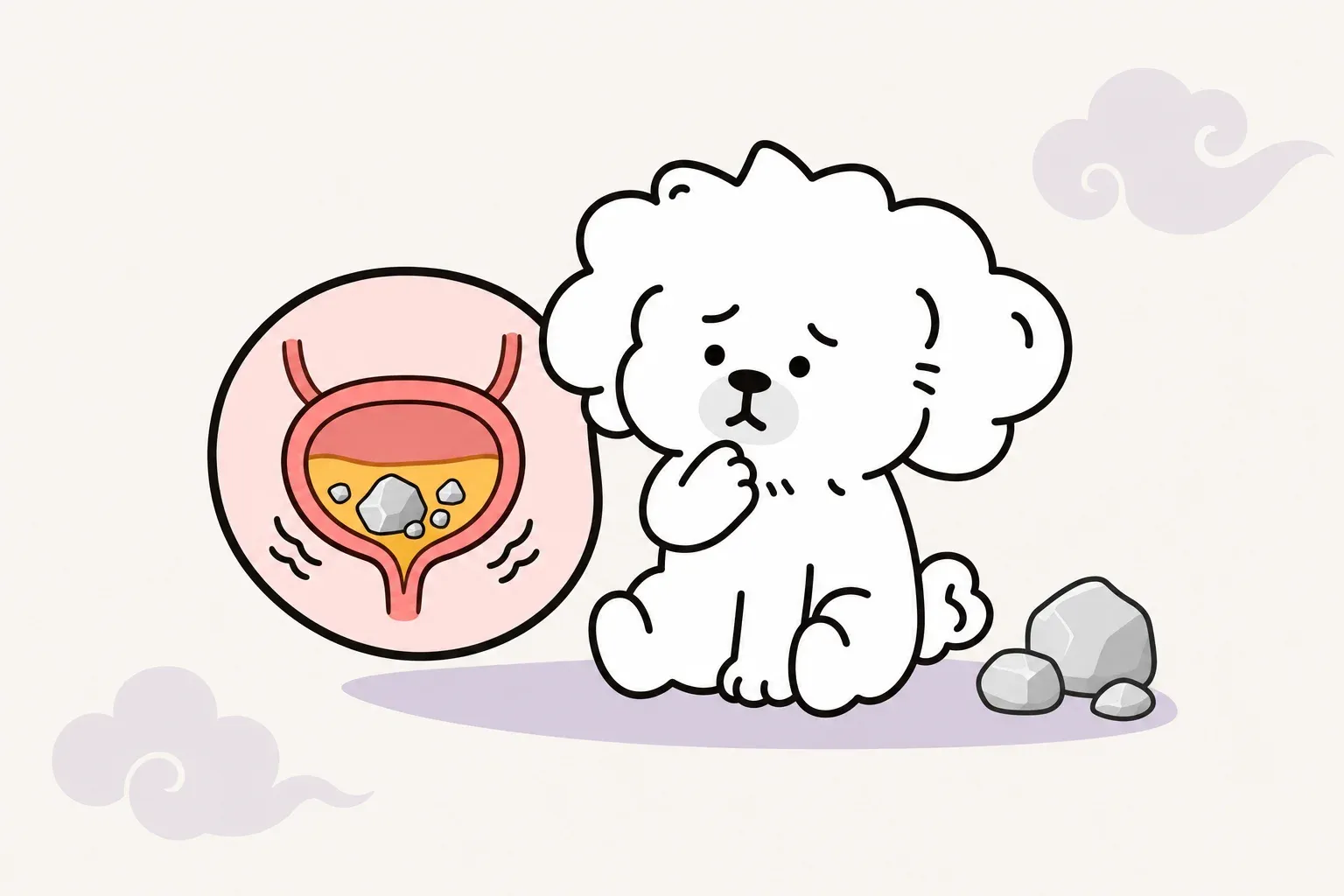
Bladder stones (uroliths) are a common yet often underestimated urinary condition in dogs. If your dog is straining to urinate, producing only small amounts of urine, or showing blood in the urine, bladder stones may be the cause. Early identification and type-specific management are critical — because the wrong treatment for the wrong stone type can make the problem worse, not better.
This guide covers the full picture of dog bladder stones: how they form, how to recognize them, how each type is treated, and what you can do at home to reduce the risk of recurrence.
What Are Bladder Stones in Dogs?
Bladder stones, medically termed uroliths or urinary calculi, are mineral deposits that crystallize and solidify inside the urinary bladder. They range in size from tiny sand-like grains to stones over an inch in diameter. A single large stone can obstruct urine flow; a collection of small stones — called a “stone nidus” — may irritate the bladder lining and cause persistent inflammation.
How Bladder Stones Form
Stone formation begins at the microscopic level. When urine becomes supersaturated with specific minerals — such as magnesium, ammonium, phosphate, calcium, or oxalate — crystals begin to precipitate. If conditions remain favorable (the right pH, concentration, and temperature), these crystals aggregate and harden into macroscopic stones over weeks to months.
Several factors shift the balance toward crystal formation:
- Urine pH: Struvite crystals form in alkaline urine; calcium oxalate forms in acidic to neutral urine
- Urine concentration: Chronically concentrated urine (from insufficient water intake) raises mineral saturation
- Urinary tract infection (UTI): Certain bacteria produce urease, which raises urine pH and directly promotes struvite precipitation
- Genetic metabolism: Some breeds cannot process specific metabolites normally (e.g., uric acid in Dalmatians)
- Diet composition: Excess dietary minerals exceeding renal excretion capacity contribute to crystal load
Bladder Stones vs Kidney Stones vs Urethral Stones
These three conditions share overlapping terminology but differ in location and clinical severity.
| Location | Term | Key Clinical Risk |
|---|---|---|
| Kidney (renal pelvis) | Kidney stones / nephroliths | Usually silent unless obstructing or causing renal damage |
| Urinary bladder | Bladder stones / uroliths | Cause hematuria, dysuria, and cystitis-like signs |
| Urethra | Urethral obstruction | Life-threatening emergency; complete urinary blockage |
Stones that originate in the bladder can migrate down into the urethra, creating an obstruction. This is far more dangerous in male dogs, whose urethra is longer and narrower than in females. A suspected urethral blockage requires emergency veterinary care within hours.
Types of Bladder Stones and Their Causes
The Minnesota Urolith Center at the University of Minnesota, which analyzes the largest database of canine uroliths in North America, reports that struvite and calcium oxalate together account for approximately 80–85% of all submissions in dogs. Understanding the distinction between types is essential because treatment and prevention differ significantly between them.
Struvite Stones: Infection-Driven Formation
Struvite (magnesium ammonium phosphate) stones are the most common type in female dogs, largely because females are far more susceptible to bacterial urinary tract infections than males. The key mechanism: bacteria such as Staphylococcus pseudintermedius and Proteus mirabilis produce the enzyme urease, which hydrolyzes urea into ammonia. Ammonia raises urine pH into the alkaline range (above 7.0), creating the ideal precipitation environment for struvite crystals.
Breeds with higher struvite risk: Miniature Schnauzer, Bichon Frise, Cocker Spaniel, Lhasa Apso, Yorkshire Terrier
Key feature: Infection-induced struvite stones can dissolve with antibiotics plus a prescription dissolution diet — making them the one stone type where non-surgical management is most effective.
For a deeper look at the relationship between bacterial infections and bladder inflammation, see our guide on urinary tract infections and cystitis in dogs.
Calcium Oxalate Stones: Metabolic and Genetic Factors
Calcium oxalate (CaOx) stones are the most common type in male dogs and in older dogs generally. Unlike struvite, they cannot be dissolved with diet and almost always require physical removal. They form when urine contains excessive calcium (hypercalciuria) or excessive oxalate (hyperoxaluria), or when both are present simultaneously.
Contributing factors include:
- Hypercalciuria: Excess calcium excreted into urine, sometimes linked to hyperparathyroidism or idiopathic metabolic defects
- Hyperoxaluria: High dietary oxalate intake (leafy greens, nuts) or impaired intestinal oxalate processing
- Acidic urine pH: CaOx crystallizes preferentially below pH 6.5
- Aging: Risk increases significantly in dogs over 5 years old
Breeds with higher calcium oxalate risk: Miniature Schnauzer, Lhasa Apso, Yorkshire Terrier, Bichon Frise, Shih Tzu, Pomeranian
Less Common Types: Urate and Cystine Stones
Urate stones form when uric acid (a purine metabolite) accumulates in urine. In most mammals, uric acid is converted to the more soluble compound allantoin by the enzyme uricase. Dalmatians carry a genetic mutation that disrupts uric acid transport in both the liver and the kidney, causing uric acid to accumulate in urine. Dogs with portosystemic shunts (liver bypasses) also develop urate stones because the liver cannot adequately process purines. Treatment involves surgical removal combined with a low-purine diet and, in some cases, the medication allopurinol.
Cystine stones arise from a hereditary defect in renal tubular reabsorption of the amino acid cystine. Affected kidneys fail to reabsorb cystine from the urine, leading to high urinary cystine concentrations and eventual stone formation. This condition follows a sex-linked pattern in some breeds, with intact males at highest risk. Breeds disproportionately affected include Newfoundlands, English Bulldogs, Mastiffs, Dachshunds, and French Bulldogs.
Recognizing Bladder Stone Symptoms
The clinical signs of dog bladder stones overlap significantly with those of urinary tract infections — which makes laboratory and imaging workup essential for correct diagnosis rather than relying on symptoms alone.
Early Signs: Frequent Urination, Blood in Urine, Straining
Most dogs with bladder stones exhibit one or more of the following early signs:
| Symptom | Description |
|---|---|
| Hematuria | Blood in urine; may appear pink, red, or brownish |
| Pollakiuria | Increased frequency of urination attempts |
| Dysuria | Straining or apparent discomfort when urinating |
| Small urine volumes | Passing only drops per attempt |
| Licking genitals | Persistent licking suggesting urethral irritation |
| Urine with unusual odor | Particularly strong or ammonia-like smell |
These signs can persist intermittently for weeks before owners seek veterinary attention. Because they mimic simple UTI, many dogs receive antibiotic courses without resolution — a key indicator that stones may be present.
Advanced Symptoms: Inability to Urinate, Vomiting, Lethargy
When a stone migrates into the urethra and causes partial or complete obstruction, symptoms escalate rapidly:
- Complete inability to urinate despite straining
- Crying or vocalizing during urination attempts
- Distended, painful abdomen
- Vomiting
- Progressive lethargy and weakness
- Loss of appetite
Post-renal obstruction (blocked urine outflow) causes uremic toxin accumulation. Without intervention, kidney damage and systemic collapse can occur within 24 to 48 hours.
When It Becomes an Emergency
Seek emergency veterinary care immediately if your dog:
- Has not produced any urine in 8–12 hours
- Is straining repeatedly without passing urine
- Is crying in pain, vomiting, or has a noticeably distended abdomen
- Appears extremely weak or collapses
Urethral obstruction is life-threatening. Time to treatment directly affects survival and outcome.
How Bladder Stones Are Diagnosed
A thorough diagnostic workup serves two purposes: confirming the presence of stones and identifying the stone type so that the appropriate treatment can be selected.
Urinalysis and X-Rays
Urinalysis is the first-line test. It evaluates:
- Urine specific gravity (concentration)
- pH (important for stone type prediction)
- Presence of red blood cells, white blood cells, and bacteria
- Crystal type under microscopy (though crystals do not always correlate with stone composition)
- Protein, glucose, and other chemical markers
Radiography (X-rays) visualizes the majority of bladder stones because most are radiopaque (visible on plain film). Struvite and calcium oxalate stones appear as bright white densities within the bladder shadow. However, urate stones are radiolucent — they do not appear on standard X-rays — making ultrasound essential for dogs suspected of urate stones.
Ultrasound and Stone Composition Analysis
Abdominal ultrasound provides additional information:
- Stone number and size
- Bladder wall thickening (indicating chronic inflammation)
- Detection of radiolucent stones
- Assessment of the kidneys and ureters for concurrent involvement
Quantitative stone composition analysis is the gold standard for identifying stone type. When stones are retrieved (through surgery or voiding), they are submitted to a specialized laboratory (such as the Minnesota Urolith Center or the Canadian Veterinary Urolith Centre) for mineral composition analysis. This analysis directly guides the prevention protocol.
Urine culture and antibiotic sensitivity testing are also performed in all suspected struvite cases to identify the causative organism and guide antimicrobial selection.
Treatment Options by Stone Type
No single treatment applies to all stone types. The selection depends on stone composition (known or predicted), stone size, the dog’s overall health status, and the urgency of the clinical situation.
Dietary Dissolution (Struvite Only)
Prescription dissolution diets work exclusively for infection-induced struvite stones. These diets work by:
- Reducing urine pH to an acidic range (below 6.5), in which struvite is soluble
- Lowering dietary magnesium, phosphorus, and protein to reduce substrate availability
- Promoting higher water intake through increased sodium content, which dilutes mineral concentrations
Concurrent antibiotic therapy eliminates the urease-producing bacteria driving struvite formation. Together, the combination can dissolve stones over 4 to 12 weeks depending on size. Repeat imaging every 4 weeks monitors progress.
Important caveat: Dietary dissolution is not appropriate for dogs that are obstructed, not eating, or have concurrent kidney disease. It should not be attempted for calcium oxalate, urate, or cystine stones.
Surgical Removal: Cystotomy
Cystotomy (surgical opening of the bladder) is the most universally applicable treatment and the only option for calcium oxalate, cystine, and most urate stones. Key aspects:
- Performed under general anesthesia
- Allows complete physical removal with a stone retrieval success rate exceeding 95%
- All retrieved stones are submitted for quantitative analysis
- Recovery typically takes 5–10 days with activity restriction
- Post-surgical urinalysis at 2–4 weeks confirms bladder healing
Non-Surgical Options: Lithotripsy and Urohydropropulsion
Urohydropropulsion (voiding urohydropropulsion) is a non-surgical procedure performed under sedation in which the bladder is flushed and the dog is repositioned while the bladder is compressed, allowing small stones to pass through the urethra. It is effective only for small stones (typically less than 5 mm) and only in female dogs, whose urethra is wide enough to pass stones safely.
Extracorporeal shock wave lithotripsy (ESWL) uses focused high-energy ultrasound waves to fragment stones into small enough pieces to pass spontaneously or be retrieved via urohydropropulsion. ESWL is available at select veterinary referral centers and is best suited for calcium oxalate or urate stones in dogs that are not good surgical candidates. It does not eliminate the need for stone analysis or post-procedural monitoring.
Choosing the Right Treatment
| Stone Type | Dissolution Diet | Cystotomy | Urohydropropulsion | ESWL |
|---|---|---|---|---|
| Struvite (infection) | First-line (if no obstruction) | If obstruction or diet failure | Small stones in females | Possible |
| Calcium oxalate | Not effective | Standard of care | Small stones in females | Available |
| Urate | Low-purine diet alone (limited) | Standard of care | Small stones in females | Available |
| Cystine | Not effective | Standard of care | Small stones in females | Limited data |
Diet and Recurrence Prevention
Treating the current stones is only half of the problem. Without targeted prevention, recurrence rates are significant — and each recurrence means another round of diagnostic workup and treatment. Nutrition and hydration form the core of long-term management.
Dietary Principles by Stone Type
For struvite stone prevention:
- Maintain acidic urine pH (6.0–6.5) through a slightly acidifying maintenance diet
- Restrict dietary magnesium and phosphorus to reduce substrate
- Address any recurrent UTIs promptly — each infection carries struvite recurrence risk
- Avoid high-protein diets that significantly raise urine pH
For calcium oxalate prevention:
- Avoid high-oxalate foods: spinach, beets, sweet potatoes, nuts
- Do not over-supplement with calcium or vitamin D
- Maintain slightly alkaline to neutral urine pH (6.5–7.0) through diet
- Consider moderate protein restriction to reduce renal calcium excretion
- Ask your veterinarian about potassium citrate supplementation, which binds urinary calcium and raises urine pH
For urate prevention:
- Feed a low-purine diet (avoid organ meats, sardines, anchovies, high-meat protein)
- Maintain alkaline urine pH (7.0–7.5)
- Allopurinol (a xanthine oxidase inhibitor) reduces uric acid production in Dalmatians under veterinary supervision
For dogs with concurrent kidney concerns, dietary overlap between kidney-supportive and stone-preventive diets can be complex. Our article on kidney health and diet in dogs addresses this intersection in more detail.
Increasing Water Intake: Practical Tips
Higher urine volume dilutes mineral concentrations and reduces the risk of crystal supersaturation. This is arguably the single most important prevention strategy across all stone types.
Practical approaches to increase your dog’s daily water consumption:
- Switch to wet food or add water to kibble: Canned and fresh foods contain 70–80% moisture vs. 10% in dry kibble
- Use a pet water fountain: Running water attracts many dogs to drink more frequently
- Place multiple water bowls in different rooms to lower the effort barrier
- Add low-sodium broth (no garlic or onion) to water to make it more appealing
- Monitor urine color: Pale yellow urine indicates good hydration; dark yellow or orange suggests concentration
For a full breakdown of daily water requirements and hydration strategies, see our dedicated guide on dog hydration and water intake.
Monitoring Schedule and Follow-Up Care
Bladder stones have a documented tendency to recur, making follow-up imaging and urinalysis non-negotiable for affected dogs.
Recommended monitoring schedule post-treatment:
| Time Point | Tests Recommended |
|---|---|
| 2–4 weeks post-treatment | Urinalysis, urine culture (if struvite) |
| 3 months post-treatment | Urinalysis + abdominal radiograph or ultrasound |
| 6 months post-treatment | Full urinalysis + imaging |
| Every 6–12 months (ongoing) | Urinalysis + imaging (frequency adjusted to risk level) |
Dogs with a first stone episode and full resolution can transition to annual monitoring after two consecutive clear imaging studies. Dogs with recurrent stones, breed predisposition, or metabolic factors may warrant every 6-month monitoring indefinitely.
Annual wellness examinations — including urinalysis — are the most reliable way to detect stone recurrence before symptoms emerge. Our guide on annual health checkups for dogs explains what to expect from these visits and when to schedule them.
References
FAQ
How much does bladder stone surgery cost for dogs?
How likely are bladder stones to come back in dogs?
How long does dietary dissolution take for struvite stones?
Can dogs eat a normal diet after bladder stone treatment?
Are certain dog breeds more prone to bladder stones?
Related Articles
Will a Dog UTI Go Away on Its Own? Myths vs Facts
Dog UTI symptoms, causes, diagnosis, treatment costs, and home care — the complete guide to canine urinary tract infections and cystitis.
How Much Water Should a Dog Drink? By Weight, Age & Season
Daily water targets by weight, dehydration self-tests, and tips for dogs that won't drink. Covers all ages, diets, and seasons.

Dog Kidney Disease Diet: Stage-by-Stage Feeding Guide and Best Foods
Complete IRIS stage-specific feeding guide for dogs with kidney disease — best foods, foods to avoid, prescription diet selection, homemade recipes, and supplements.