 Cirius Petpedia
 Is Your Dog's Howling Just a Bad Habit? Understanding the Real Causes
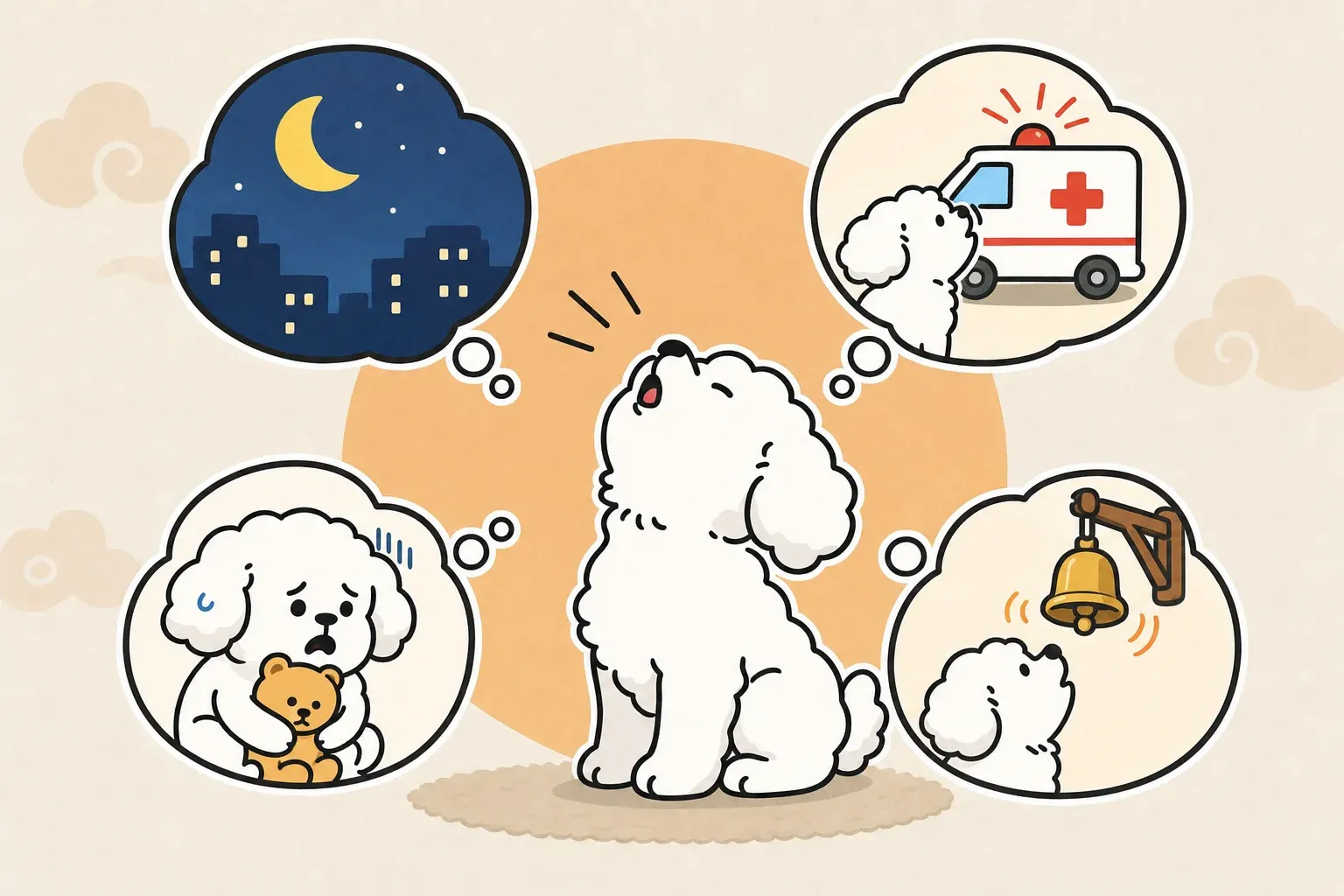
When a dog lifts its nose and releases a long, wavering howl, most owners have one immediate question: what does that mean, and should I be worried?
The honest answer is that it depends entirely on context. Howling is one of the oldest and most layered forms of canine communication. It can signal distress, pain, or cognitive decline—or it can mean your dog heard a fire truck two blocks away and felt compelled to reply. Understanding why your dog howls is the first step toward knowing whether to act and how.
This guide covers 8 evidence-based causes of dog howling, breed tendencies, age-specific patterns, and structured solutions for unwanted howling—including the severity triage framework and desensitization protocols that most resources skip entirely.
What Is Howling? Understanding the Difference Between Howling, Barking, and Whining
The Wolf Ancestry Behind Your Dog’s Howl
Domestic dogs share approximately 99.9% of their DNA with gray wolves, and howling is one of the most direct behavioral links to that ancestry. In wolf packs, howling serves three primary functions: coordinating group movements across large territories, reinforcing social bonds, and signaling location to separated members.
Your dog has not forgotten any of this. When a dog howls, it is drawing on a communication system that predates domestication by tens of thousands of years. That context matters when you try to interpret—or redirect—the behavior.
Howling vs Barking vs Whining: A Quick Comparison
The three core vocalizations differ in structure, purpose, and typical triggers:
| Vocalization | Sound Profile | Primary Function | Typical Triggers |
|---|---|---|---|
| Howling | Sustained, melodic, long-range | Location signaling, social bonding, response to distant sounds | Sirens, other dogs howling, loneliness, pain |
| Barking | Short, sharp, repetitive | Alerting, territorial warning, frustration | Strangers, territorial intrusion, excitement |
| Whining | High-pitched, brief | Immediate emotional expression | Discomfort, anticipation, attention-seeking, fear |
Understanding which vocalization your dog is using—and when—is essential context before attempting any behavior modification. If you want a deeper look at the nuances of canine whining, dog whining causes and what they mean provides a parallel breakdown.
8 Reasons Dogs Howl
Separation Anxiety: A Distress Call When Left Alone
Separation anxiety is the most clinically significant cause of howling in dogs, and it is frequently misdiagnosed as simple bad manners. Dogs with separation anxiety are not choosing to be difficult—they are experiencing genuine distress that triggers an instinctive distress call.
Characteristic pattern: howling begins within 20–30 minutes of the owner’s departure, often within the first few minutes, and may continue for hours. It is typically accompanied by other anxiety indicators—destructive behavior focused on exit points, house-soiling despite being house-trained, pacing, excessive salivation, and self-directed behaviors like excessive grooming.
A useful diagnostic tool is a recording device or home camera. Dogs with true separation anxiety usually show distress signals (panting, pacing, vocalizing) beginning at the moment departure cues appear—you putting on shoes, picking up keys—not only after you leave.
For a full clinical breakdown of the condition and its treatment spectrum, separation anxiety in dogs covers the evidence base in detail.
Response to Sounds: Sirens, Music, and Other Dogs
Sound-triggered howling is one of the most frequently misunderstood types. Many owners assume their dog is distressed when howling at an ambulance siren. In most cases, the opposite is true: the dog is simply responding in kind to what it perceives as another animal’s long-distance call.
Emergency sirens occupy a frequency range—typically 700–1800 Hz—that overlaps with canine howling. Dogs perceive the sound as a vocalization from another animal and reply instinctively. The same response can be triggered by other dogs howling in the neighborhood, certain musical instruments (particularly wind instruments and harmonicas), and sometimes specific musical passages.
Key distinction: if your dog howls at a siren and then immediately returns to relaxed behavior when the sound fades, this is neutral communication, not distress. No intervention is needed beyond managing noise if neighbors are affected.
Communication and Territorial Marking
Dogs howl to announce their presence and mark territorial boundaries. This is particularly common in multi-dog households or neighborhoods with high canine density. A dog that hears a neighboring dog bark or howl may respond with its own howl as a counter-announcement.
This type of howling tends to be episodic, brief, and matched to external triggers. It does not typically escalate or continue in the absence of stimulus.
Pain or Medical Issues: Joint Pain, Abdominal Discomfort, Dental Problems
Pain-related howling is one of the most critical causes to rule out, yet it is frequently missed because dogs are stoic and their pain signals can be subtle. A dog vocalizing due to pain is essentially telling you it cannot cope with its discomfort through other means.
Common medical causes include:
- Arthritis and joint pain: Howling may occur when moving from rest, during position changes, or when touched in a painful area
- Abdominal pain: Associated with gastrointestinal distress, bloat, urinary obstruction, or internal conditions
- Dental pain: Dental disease is extremely common in dogs and frequently underrecognized as a pain source
- Post-surgical or injury pain: Acute-onset howling following any physical event
Behavioral clues that suggest pain: howling associated with specific movements, reduced activity, changes in posture, reluctance to be touched, changes in eating or drinking, or sudden onset howling in a dog with no prior history of the behavior.
For a thorough guide to identifying pain signals across all behavioral channels, signs your dog is in pain provides a comprehensive reference.
Canine Cognitive Dysfunction (Senior Dog Dementia)
Canine Cognitive Dysfunction Syndrome (CDS) is an age-related neurological condition comparable in mechanism to Alzheimer’s disease in humans. Prevalence increases sharply with age: research published in veterinary behavioral literature estimates that CDS affects approximately 14–35% of dogs over age 8, with rates rising in dogs over 12.
Nighttime howling is one of the hallmark symptoms of CDS. The underlying mechanism involves disrupted circadian rhythms, spatial disorientation, and anxiety arising from confusion about the dog’s environment. A dog with CDS may howl in the middle of the night in a room it has occupied for years because it genuinely does not recognize where it is.
CDS-associated howling characteristics:
- Occurs predominantly or exclusively at night
- New onset in a senior dog with no prior howling history
- Accompanied by other cognitive signs: staring at walls, getting stuck in corners, altered sleep-wake cycles, reduced recognition of family members, house-soiling
Full management strategies for this condition, including environmental modifications and veterinary options, are covered in the canine cognitive dysfunction guide.
Attention-Seeking: Learned Howling Patterns
Dogs are exceptionally good at learning which behaviors produce desired outcomes. If a dog discovers that howling reliably produces attention—even negative attention like scolding—it will repeat the behavior. This is operant conditioning in the most literal sense.
Attention-seeking howling tends to be situationally specific: it occurs when the owner is present but not engaged with the dog, typically stops when attention is given, and is not accompanied by other distress signals. The dog is calm before and after, and makes eye contact while howling.
The reinforcement history matters enormously here. A dog that has been howling for attention for months has a deeply established association that takes consistent extinction work to modify.
Environmental Stress: Moving, New Family Members, Schedule Changes
Major environmental disruptions—a house move, a new baby, a new pet, significant changes to daily schedule, loss of a companion animal—can trigger howling as an expression of generalized anxiety and adjustment stress.
This type is typically temporary if the dog receives appropriate support during the transition. It tends to decrease as the dog habituates to the new environment or routine over days to weeks. Persistent howling beyond 3–4 weeks following an environmental change warrants more structured intervention.
Excitement and Joy: Positive Howling
Not all howling is distress. Some dogs howl during play, when greeting beloved family members returning home, or in response to stimuli they find exciting. Hound breeds in particular may howl with apparent enthusiasm during activities they enjoy.
Positive howling tends to be brief, occurs in a context of overall relaxed or excited (not tense) body posture, and resolves quickly. It is worth recognizing because behavioral attempts to suppress it can inadvertently cause anxiety or confusion in dogs that are simply expressing enjoyment.
Understanding the broader picture of what your dog’s body is communicating alongside vocalization helps distinguish positive from distress-based howling. Dog body language: a complete guide is a useful companion resource.
Dog Breeds That Howl the Most
High-Howling Breeds: Huskies, Beagles, Basset Hounds, and More
Howling tendency is significantly breed-mediated. Breeds developed for hunting, tracking, sledding, or guarding relied on long-distance vocal communication as a functional tool, and that genetic predisposition persists regardless of whether the dog currently performs those tasks.
| Breed | Howling Tendency | Primary Howling Trigger | Notes |
|---|---|---|---|
| Siberian Husky | Very High | Communication, boredom, other dogs | Rarely barks; howling is primary vocalization |
| Alaskan Malamute | Very High | Communication, excitement | Pack-oriented; amplified in multi-dog homes |
| Beagle | Very High | Scent tracking, other dogs | ”Baying” is breed-specific hunting howl |
| Basset Hound | High | Scent tracking, boredom | Deep, resonant bay; carries long distances |
| Bloodhound | High | Tracking | Purpose-bred for scent work with loud bay |
| Dachshund | High | Alerting, boredom | Disproportionate vocal volume for body size |
| American Eskimo Dog | High | Communication, excitement | Spitz-type vocalization patterns |
| Redbone Coonhound | Very High | Tracking, communication | Coonhound bay is one of the loudest dog vocalizations |
| Bluetick Coonhound | Very High | Tracking | Classic cold-nose hound with deep bay |
| Wolf Hybrids | Very High | All triggers | Strongest retained wolf vocal behavior |
Lower-howling breeds include Bulldogs, Basenjis (who yodel rather than howl), most toy breeds, and many Retrievers—though individual variation exists within any breed.
Why Breed Matters for Howling Management
Breed context changes the appropriate management approach. A Husky howling because it has been alone in an apartment for 9 hours is not the same problem as a Beagle howling in response to neighborhood sounds. The former requires addressing enrichment needs fundamentally mismatched to the living situation; the latter may require targeted desensitization and management of noise exposure.
Attempting to simply suppress vocalization in a breed with high genetic predisposition through punishment-based methods typically fails and can produce secondary anxiety. The more effective approach acknowledges the breed’s communication needs and redirects them.
Howling by Age: Puppies, Adults, and Senior Dogs
Puppy Howling: Separation Stress and Adjustment
Puppies separated from their littermates and mother typically go through an adjustment period of 1–3 weeks during which nighttime howling is common. This is a normal response to the loss of constant social contact, not a behavioral disorder.
The distinction to monitor: howling that decreases progressively over the first 2–3 weeks as the puppy adjusts is normal. Howling that remains intense beyond 4 weeks, or that is accompanied by extreme physical signs of distress (inability to eat, self-injury), may indicate a more significant anxiety profile that warrants early behavioral support.
Priority actions for puppy howling:
- Establish a consistent sleeping area with familiar scents (a piece of clothing with owner’s scent)
- Avoid rewarding nighttime howling with immediate attention; wait for a brief quiet before responding
- Provide adequate daytime enrichment and exercise
- Maintain a consistent schedule to build predictability
Adult Dogs: Habitual vs Sudden Onset Howling
The critical distinction in adult dogs is between habitual howling (a long-established pattern) and sudden-onset howling (new behavior in a dog that did not previously howl).
Habitual howling in adult dogs often reflects reinforcement history or unmet behavioral needs. Sudden-onset howling—particularly if the dog is otherwise healthy and the trigger is not environmental—should prompt a veterinary evaluation to rule out pain or an emerging health condition before behavioral intervention begins.
Senior Dogs: Cognitive Decline and Pain Differentiation
Senior dogs (generally 7+ for large breeds, 10+ for small breeds) who develop new howling patterns present a diagnostic challenge because two serious conditions—pain and cognitive dysfunction—can produce superficially similar symptoms.
| Feature | Pain-Related Howling | CDS-Related Howling |
|---|---|---|
| Timing | Associated with movement, touch, position changes | Predominantly nocturnal, unrelated to activity |
| Physical signs | Posture changes, guarding, reluctance to move | Disorientation, staring, getting stuck |
| Responsiveness | Responds to environment | May not respond normally to familiar people/commands |
| Other cognitive signs | Absent | Present (altered sleep, confusion) |
| Onset pattern | Can be acute or gradual | Gradual, progressive |
Both warrant veterinary evaluation. A dog showing signs of either condition should not have behavioral modification attempted without first addressing the underlying medical cause.
How to Stop Unwanted Howling: Solutions by Cause
Separation Anxiety Howling: Gradual Desensitization Training
Separation anxiety requires a structured, graduated desensitization program—not crating, scolding, or simply ignoring the behavior. The goal is to systematically rebuild the dog’s tolerance for alone time from a sub-threshold starting point.
Desensitization protocol (12–16 week framework):
Phase 1 (Weeks 1–2): Departure cue neutralization
- Practice picking up keys, putting on shoes, and reaching for the door handle without leaving
- Pair these cues with positive experiences (treat delivery, calm praise)
- Goal: dog remains below anxiety threshold when departure cues appear
Phase 2 (Weeks 3–6): Threshold separation
- Begin with departures measured in seconds (step outside, return before distress begins)
- Increase duration only when the dog remains relaxed at the current duration on 3 consecutive sessions
- Never progress to a new duration if the previous session ended in distress
- Typical progression: 10 sec → 30 sec → 1 min → 3 min → 5 min → 10 min → 20 min → 45 min → 90 min
Phase 3 (Weeks 7–12+): Duration building
- Increase departure durations toward target goal
- Introduce variability (different times of day, departure from different doors)
- Maintain a pre-departure routine that signals calm rather than escalating arousal
A certified applied animal behaviorist (CAAB) or veterinary behaviorist should be consulted for moderate-to-severe cases. Anti-anxiety medication prescribed by a veterinarian can support the behavioral process when anxiety is severe enough to prevent learning.
Noise Sensitivity: Step-by-Step Desensitization Protocol
For dogs that howl excessively at sirens, other dogs, or specific sounds beyond a brief response:
Step 1: Identify the threshold Record or note how loud/close a trigger sound must be before the dog begins to howl. This is the threshold you will work below.
Step 2: Create controlled exposure Use recorded versions of the trigger sound (YouTube siren sounds, dog howling tracks) played at very low volume—well below the dog’s threshold. Pair the barely audible sound with high-value food rewards during the entire exposure.
Step 3: Systematic volume increase Over multiple sessions (typically 2–3 per week for 6–10 weeks), gradually increase volume only when the dog is eating calmly and showing no stress at the current level.
Step 4: Generalization Introduce real-world exposure (playing near an area where sirens are occasionally heard) once the recorded version no longer triggers a prolonged howling response.
For the complete clinical protocol with safety guidelines, noise phobia and sound desensitization in dogs provides a detailed framework.
Attention-Seeking Howling: Extinction and Alternative Behavior Reinforcement
Extinguishing attention-seeking howling requires complete and consistent removal of all reinforcement—including negative attention. Scolding counts as reinforcement if the dog’s goal was contact.
Extinction protocol:
- When howling begins, withdraw all attention: turn away, leave the room if possible, avoid eye contact and speech
- Wait for a pause in howling—even 2 seconds of quiet
- Immediately return attention and reinforce the quiet with calm praise or a treat
- Gradually extend the required quiet period before reinforcement
Important: extinction can produce an initial “extinction burst”—a temporary increase in the behavior before it decreases. If you reinforce during an extinction burst, you have taught the dog to howl harder and longer. Consistency is essential.
Simultaneously, teach and reinforce an alternative behavior (sit, go to place) as the designated attention-seeking behavior.
Pain-Related Howling: When to Visit the Vet
Pain-related howling requires veterinary assessment, not behavioral modification. No training protocol should be attempted when pain is the underlying cause, as this would require the dog to suppress a legitimate pain signal.
Indicators that pain is likely:
- Sudden onset howling with no behavioral history
- Howling associated with specific movements or touch
- Physical signs accompanying vocalization (limping, posture changes, changes in activity level)
- Howling that does not match any clear behavioral trigger
For a systematic approach to identifying pain across all behavioral channels, the signs your dog is in pain guide outlines the full assessment framework.
Howling Self-Assessment Checklist
Use this checklist to categorize your dog’s howling before deciding on a course of action. The results will help you determine whether this is normal behavior, a behavioral issue requiring training, or a medical situation requiring veterinary evaluation.
Timing and Pattern
- Howling occurs only when I am absent or about to leave
- Howling occurs at specific times (nighttime, early morning)
- Howling occurs in response to specific sounds (sirens, music, other dogs)
- Howling has no clear trigger pattern—it seems random
- Howling is new behavior; my dog did not do this before
Frequency and Duration
- Howling lasts less than 60 seconds and resolves on its own
- Howling continues for more than 5 minutes
- Howling occurs multiple times per day
- Howling has increased in frequency or intensity over the past month
Co-occurring Behaviors
- Destructive behavior (chewing, scratching exit points) accompanies howling
- House-soiling occurs alongside howling episodes
- Dog appears disoriented or confused during or after howling
- Dog is reluctant to move, guards certain body areas, or shows postural changes
- Dog does not respond normally to its name during howling episodes
- Body posture during howling is relaxed (positive trigger)
Physical Observations
- Changes in appetite or water intake
- Changes in activity level or willingness to exercise
- Visible signs of discomfort (squinting, lip licking, reluctance to be touched)
- Age over 7 years (large breed) or 10 years (small breed)
Interpreting Your Results:
Mostly temporal/sound triggers, brief duration, relaxed body posture → Normal or low-concern howling. Monitor for changes.
Absence-triggered, long duration, accompanied by destructive behavior or soiling → Separation anxiety protocol recommended. Consider veterinary consultation for adjunct support.
Nighttime onset in a senior dog, disorientation, no clear trigger → Veterinary evaluation for CDS and pain urgently recommended.
Sudden onset, associated with movement or touch, physical signs present → Veterinary evaluation before any behavioral intervention.
When to See a Veterinarian
The following situations warrant prompt veterinary attention. Delaying evaluation in these cases risks allowing a treatable condition to progress:
Seek veterinary evaluation if:
- Howling began suddenly with no change in environment or routine
- Howling is associated with specific movements, positions, or being touched
- The dog is a senior (7+ years for large breeds, 10+ for small breeds) and howling is a new pattern
- Howling is accompanied by disorientation, house-soiling, or altered recognition of family members
- Howling is accompanied by reduced appetite, water intake changes, or activity decline
- Any other physical symptoms accompany the vocalization
- Howling significantly worsens over a period of 2–3 weeks despite no changes in the environment
Do not attempt behavioral modification for howling until medical causes have been excluded by a veterinarian. Behavioral protocols applied to a dog in pain are not only ineffective—they can cause harm by suppressing an important communication signal.
Building a Response Plan: Putting It All Together
The most common mistake owners make when addressing howling is treating it as a single, uniform behavior that requires a single solution. The 8 causes covered in this guide each have distinct mechanisms, and the appropriate response differs substantially between them.
A practical decision sequence:
-
Rule out medical causes first. If howling is new, sudden, or accompanied by physical signs—see a vet before anything else.
-
Identify the trigger. Use observation, home camera footage, and the self-assessment checklist above to pinpoint what precedes and accompanies the howling.
-
Match the intervention to the cause. Separation anxiety requires desensitization. Noise response requires counter-conditioning. Attention-seeking requires extinction. Cognitive decline and pain require veterinary management.
-
Account for breed and age. A 10-year-old Beagle with new nighttime howling needs a different evaluation pathway than a 2-year-old Husky that howls when bored.
-
Measure progress. Track frequency, duration, and intensity of howling over time. If a behavioral protocol is not producing measurable improvement within 4–6 weeks, reassess the diagnosis or seek professional guidance.
For managing vocalization more broadly—including barking—barking control training for dogs covers the complementary behavioral framework.
Understanding howling begins with taking it seriously as communication. Whether your dog is calling for you across an empty house, responding to the neighborhood sirens, or signaling something more urgent—the behavior always has a reason. Your job is to find the right one.
References
FAQ
Why does my dog howl when I leave?
Is dog howling at sirens harmful or normal?
Why is my old dog suddenly howling at night?
What is the difference between howling and whining?
Which dog breeds howl the most?
Related Articles

Dog Separation Anxiety Guide: Symptoms, Training, and Help
Learn how to identify dog separation anxiety symptoms, follow a vet-backed step-by-step training plan, and know when medication or a specialist is needed.

Is Your Dog in Pain? 7 Subtle Signs Most Owners Miss
Learn the 7 behavioral signs your dog is in pain that are easy to overlook, how to tell acute from chronic pain, and what to do before your vet visit.
Does Your Senior Dog Have Dementia? A Veterinary Guide to Canine Cognitive Dysfunction
Learn the 7 DISHAAL domains to assess dog dementia symptoms at home, understand evidence-based treatment options, and know when to call your vet.