 Cirius Petpedia
 8 Indoor Games for Dogs That Actually Tire Them Out
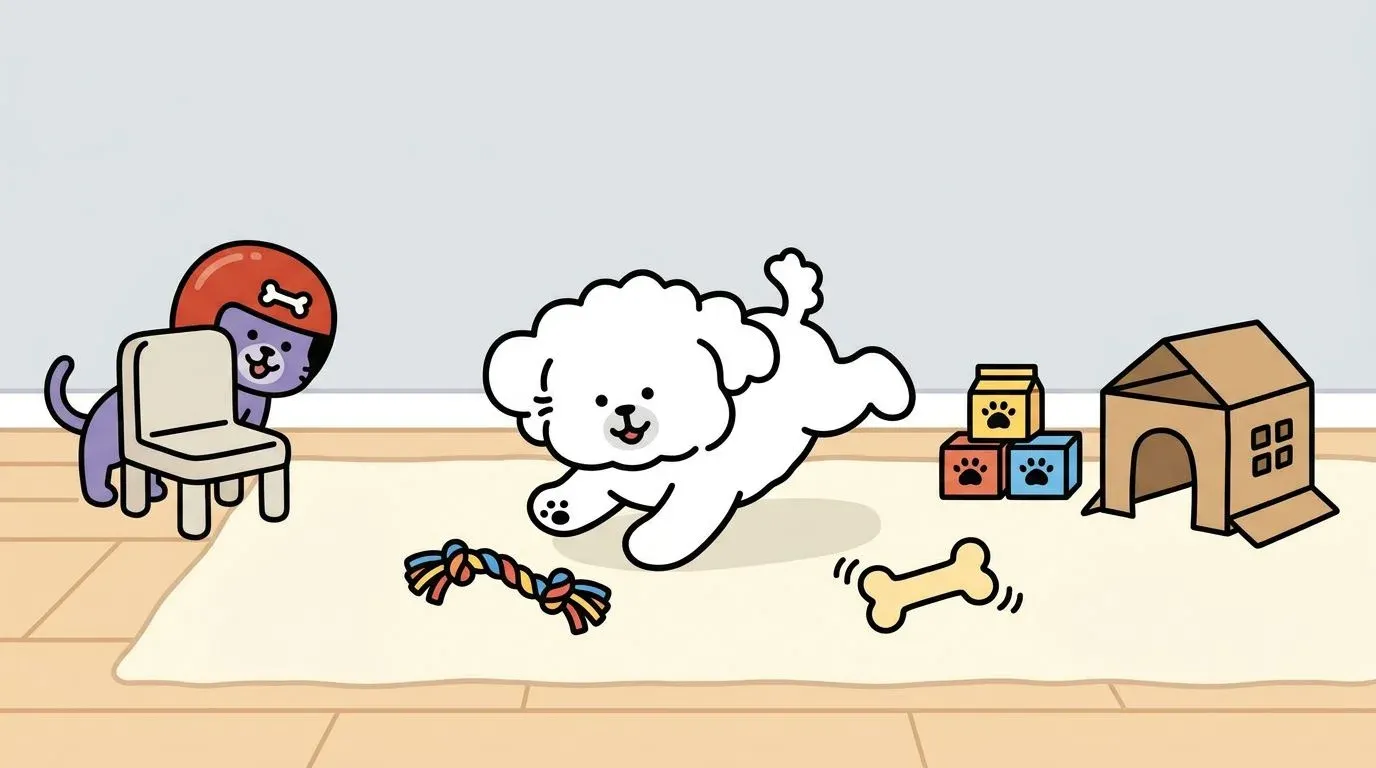
Your dog has been staring at you for the past hour. The leash is by the door. It is raining sideways outside, or the thermometer reads triple digits, or you are nursing a sore knee. Whatever the reason, the walk is not happening today — and the pacing and nudging are getting louder.
The good news: a well-chosen indoor activity can deliver genuine exhaustion, not just distraction. The key word is “genuine.” Not every toy tossed across the living room actually tires a dog out. The games on this list are structured to target the brain, the body, or the handler-dog bond in ways that translate into a settled, satisfied dog by the end of the session.
Can Indoor Play Really Replace a Walk?
The short answer is no — not entirely. Outdoor walks deliver things a living room cannot: fresh air, changing scent landscapes, social exposure, and low-level cardiovascular work sustained over time. Dogs that go weeks without outdoor access show behavioral changes even when they receive robust indoor enrichment.
But the longer answer is more useful. On any given day when a walk is genuinely not possible, indoor play can meet most of a dog’s needs and prevent the behavioral fallout — destructive chewing, barking, restlessness — that comes from accumulated under-stimulation.
Here is the piece of data most dog owners find surprising: a 15-minute active nose work session produces cognitive fatigue comparable to a 30-minute physical walk, according to research reviewed in Applied Animal Behaviour Science. The reason is that parsing complex odor information is one of the most demanding cognitive tasks a dog’s brain performs. Mental fatigue is real fatigue — it just looks different. Instead of a dog flopping down from muscle tiredness, you get a dog that settles, sighs, and sleeps.
The implication is practical: a rainy day is not automatically a bad day for your dog. A structured indoor session covering brain work, some physical play, and a bonding activity can check most of the boxes a walk would have covered.
Brain Games
Nose Work: From Beginner Scent Trails to Advanced Hunts
Nose work is the most cognitively demanding indoor activity available to dogs, which makes it the most effective at producing genuine tiredness. The underlying mechanic is straightforward: you hide a treat, the dog uses its nose to find it. The difficulty scales from a treat hidden in a closed fist all the way to multi-room hunts with dozens of hiding spots.
Why it works. Dogs have roughly 300 million olfactory receptors compared to about 6 million in humans. Tracking a scent trail requires the dog to build and update a three-dimensional odor map in real time — a task that demands sustained prefrontal engagement. Cortisol measurements in dogs post-nose work sessions are consistently lower than pre-session baselines, indicating genuine stress relief alongside cognitive fatigue.
How to run a beginner session:
- Place a high-value treat (cooked chicken, small cheese cube) in one closed fist. Hold both fists at nose height.
- The instant the dog presses its nose to the correct fist, open it and let the dog take the treat.
- After five or six successful finds, move to hiding the treat under one of three upturned cups.
- Once that becomes easy, stuff treats into the folds of a rolled bath towel and let the dog unwrap it.
Difficulty levels and time estimates:
| Level | Setup | Typical Session Length |
|---|---|---|
| Beginner | Treat in fist, then under cups | 5–8 minutes |
| Intermediate | Snuffle mat or towel roll | 10–12 minutes |
| Advanced | Multi-room hide, treat behind furniture | 15–20 minutes |
For a structured 5-stage protocol that scales from palm finds to outdoor scent detection, the dog nose work training guide covers the full progression with technique details.
Puzzle Toys and DIY Brain Challenges
Commercial puzzle feeders range from simple sliding boards to complex multi-step mechanisms. The goal is the same: the dog must perform a sequence of physical and cognitive actions to access the food. Dogs that receive meals from puzzle feeders rather than a bowl consume food at a slower pace, which reduces bloat risk in large breeds, and show lower arousal levels during the remainder of the day.
If you do not own a puzzle feeder, effective DIY alternatives exist:
- Muffin tin game: Place a treat in several cups of a muffin tin, cover every cup with a tennis ball. The dog must remove each ball to check the cup.
- Egg carton search: Tuck treats into the egg cups and fold the lid closed.
- Cardboard box shuffle: Drop treats into a shallow cardboard box filled with crumpled paper. The dog paws and noses through the paper to find them.
Rotate setups regularly. A dog that has memorized a puzzle’s solution is pattern-following, not problem-solving. Switching formats — or presenting the same muffin tin with a different number of balls covering treats — resets the cognitive challenge.
The Cup Game for Focus and Patience
The cup game is a dog-directed version of a shell game. Three identical opaque cups sit upside down on the floor. You load one cup in view of the dog, then rearrange all three slowly. The dog must track the cup and indicate the correct one.
This specific activity targets impulse control alongside scent discrimination. The dog that lunges immediately at the first cup it sees and gets it wrong has to learn to pause, assess, and commit — a skill that transfers to real-world patience in high-distraction situations.
Running the cup game:
- Use three identical paper or plastic cups.
- Let the dog watch you place a treat under one cup.
- Slide the cups slowly to new positions, keeping them within reach of the dog.
- Give a cue word (“find it” or “which one?”) and wait.
- If the dog nudges the correct cup, lift it immediately and let the dog take the treat. If wrong, calmly reset and reload.
Start with no movement — just show the dog which cup has the treat, then ask them to find it. Once the dog is orienting to the loaded cup reliably, introduce the slow shuffle. Add more cups as the dog succeeds.
Body Games
Tug-of-War: Energy Burn With Built-In Rules
Tug-of-war has a long history of being unfairly maligned. The concern that it “teaches dominance” has no support in modern behavioral research. What the research does show is that tug-of-war is a high-intensity cardiovascular activity with built-in handler interaction — it burns more energy per minute than most indoor alternatives and strengthens the dog-handler bond when played with clear rules.
The rules matter. An unstructured tug session where the dog grabs the toy whenever it wants and growls without consequence does create arousal problems. A structured session with clear on/off cues produces the opposite: a dog that practices impulse control within high-excitement states.
Rules for structured tug:
- Designate a specific tug toy. That toy means tug; other toys do not.
- Start each session with a cue (“tug” or “take it”) rather than waving the toy at the dog until it grabs on.
- Every 30 seconds or so, cue “drop it” or “out.” When the dog releases, reward with praise or a treat, then restart the game. The game is the reward for dropping on cue.
- End on a “drop it” success. Put the toy away after the session to maintain its value.
Sessions of 5 to 10 minutes are typically enough to produce genuine physical fatigue. Larger breeds may need slightly longer sessions; smaller breeds tire more quickly from the sustained resistance.
Joint note: Avoid extreme pulling angles or sessions where a smaller dog is lifted off the floor. Keep tug at ground level or low angle.
Indoor Fetch: Setting Up a Safe Play Zone
Indoor fetch requires more setup than tug but delivers a greater cardiovascular output for medium and large dogs. The challenge is creating a safe play corridor on a surface that does not risk injury.
Slippery floors — hardwood, tile, laminate — are the primary concern. A dog that runs and skids on hard floors with each change of direction is absorbing abnormal impact forces through its joints with every stop. For more on why this matters, particularly in dogs predisposed to joint issues, the article on protecting dog joints on slippery indoor surfaces covers the mechanics in detail.
Setup for safe indoor fetch:
- Lay a runner rug or yoga mat along the play corridor. Secure the edges with furniture to prevent curling.
- Use a soft toy or foam ball rather than a hard rubber ball — softer materials reduce the chance of impact injury if the dog collides with furniture.
- Keep throwing distance moderate. The goal is several shorter retrieves rather than one long sprint that requires a hard stop at the wall.
- If your dog does not have a reliable “drop it,” indoor fetch degrades into chase within a few throws. Tug-of-war is a better choice until the retrieve is solid.
Large breeds benefit most from indoor fetch as a physical outlet. Smaller dogs often get comparable exercise from a shorter tug session without the space requirements.
DIY Obstacle Course: Household Agility
An indoor agility course turns your living room into a working environment. The dog navigates a sequence of obstacles — weave around a chair, go under a table, jump over a broomstick balanced on two stacks of books, pause on a balance cushion.
The physical benefit is obvious. The less obvious benefit is that completing a sequence requires the dog to hold multiple steps in working memory and respond to handler direction at each one — a combined cognitive and physical workout that mirrors what formal agility training delivers.
Simple household obstacles:
| Obstacle | Materials | What It Trains |
|---|---|---|
| Weave poles | Upright water bottles, 18 inches apart | Lateral movement, body awareness |
| Low jump | Broomstick across two stacks of books (max 4–6 inches) | Sequencing, confidence |
| Tunnel | Two chairs with a blanket draped over | Novelty tolerance |
| Balance station | Couch cushion on the floor | Proprioception, joint stability |
| Pause box | Tape square on floor | Self-control, spatial awareness |
Start with two or three elements and add a cue for each one (“through,” “over,” “wait”). Once each element is solid individually, chain them into a three-step sequence. Increase length gradually.
Joint safety callout: Limit jump height to no more than 4 to 6 inches for any dog — and to flat mat-only stations for senior dogs, dogs with patellar luxation, or dogs recovering from joint surgery. The neurological benefit of navigating a sequence does not require any jumping at all. Why furniture jumping is risky for joint health explains the biomechanics that apply to indoor obstacles as well.
Bonding Games
Hide and Seek: Recall Training Disguised as Fun
Hide and seek is the simplest game on this list to set up, and for many dogs, the one that produces the most visible excitement. You hide somewhere in the house; the dog finds you. That is the entire game.
What makes it valuable is what is happening underneath: every successful find reinforces the recall behavior and the idea that seeking out the owner is rewarding. Dogs with emerging separation anxiety are often dogs for whom the owner’s presence has become the primary source of all good things. Hide and seek flips that slightly — the dog has to work to find you, which gives the interaction a self-directed quality that passive proximity does not.
How to run it:
- Ask the dog to sit-stay, or have a second person hold the dog.
- Move to another room and hide — behind a door, in a closet, around a corner. In the beginning, make it easy. A partial hide in the hallway is fine.
- Call the dog once, clearly, with whatever recall word you use. Then wait quietly.
- When the dog finds you, celebrate genuinely — an enthusiastic verbal reward and some physical contact.
- As the dog gets better at the game, use harder hides. Get behind furniture. Go upstairs. Stay completely silent after calling.
The bonding component comes from the reunion. Each find is a practiced version of “coming to the owner is the best thing that happened today” — which is exactly what you want your dog to believe.
Trick Training: New Skills in Short Sessions
Trick training in short bursts — five minutes, twice a day — is one of the highest-return activities for the handler-dog relationship. The learning process itself, not just the finished trick, is what produces the behavioral benefit. Dogs that regularly engage in goal-directed problem-solving with their owners show lower baseline anxiety and higher frustration tolerance than dogs whose daily interaction consists mainly of passive time together.
The selection of tricks matters less than the structure. A few principles:
- Use a clicker or a consistent marker word (“yes” in a bright voice) to mark the exact moment the dog does the right thing. Treats delivered a second later than the behavior teach the wrong thing.
- End on a success. If the dog is struggling with a new behavior, drop back to a known behavior, mark and reward that, and end the session. Ending frustrated teaches frustration.
- Aim for 80% success rate. If the dog is failing more than two times out of ten, the task is too hard. Break it into a smaller step.
Good beginner tricks that build on each other: sit, down, stay, paw, spin, “look at me” (eye contact on cue). Once those are solid, more complex behaviors — weaving between your legs, backing up, standing on a box — build on the same reinforcement history.
For dogs showing early signs of age-related behavioral changes, structured trick sessions are a form of cognitive maintenance. The research on preventing cognitive decline in senior dogs consistently lists novel learning tasks alongside physical exercise as the most evidence-supported interventions.
Picking the Right Games for Your Dog
Small Breeds vs. Large Breeds
Physical and spatial differences between breed sizes change which games are practical and safe.
Small breeds (under 20 lbs): The living room is proportionally larger for a Chihuahua or a Miniature Dachshund than it is for a Labrador. Cup games, puzzle feeders, and nose work all work extremely well regardless of living space. Tug-of-war is effective but keep sessions shorter — 3 to 5 minutes — and avoid lifting the dog off the floor. Indoor fetch requires less distance to produce genuine exercise; a 10-foot corridor is often sufficient.
Large and giant breeds (over 60 lbs): Larger dogs often need a combination of physical play and mental work to reach satisfaction. Tug-of-war for 8 to 10 minutes, followed by a 10-minute nose work session, typically produces a settled dog. Indoor fetch requires a clear corridor of at least 15 feet and secure, non-slip flooring. Puzzle feeders may be worth purchasing in a more durable, large-format version since small ones tend to get scooped across the floor rather than engaged with.
Medium breeds (20–60 lbs): The full list of games applies. Session length scales with breed energy profile rather than weight — a Border Collie and a Basset Hound at the same weight have completely different enrichment needs.
Puppies, Adults, and Seniors
Puppies (under 6 months): Keep all sessions very short — 5 minutes maximum per session — and choose low-impact games. Nose work at the basic fist-and-cup level is excellent. Avoid any jumping, extended tug, or surface changes that challenge developing proprioception. Multiple micro-sessions throughout the day outperform one long session.
Adults (1–7 years): The full range of activities applies. Healthy adults can handle 15 to 25-minute structured sessions and benefit from variety. Combining one brain game and one physical game in a single session produces the most thorough fatigue. Rotating game types across days prevents habituation and keeps motivation high.
Seniors (8+ years): Brain games remain valuable — and arguably more important — as physical capacity declines. Nose work, puzzle feeders, the cup game, and short trick training sessions are ideal. Reduce intensity and duration of physical games. Be attentive to signs of soreness after sessions: reluctance to lie down, stiffness when rising, or reduced interest in next-day play. Weight management in senior dogs matters acutely; the link between inactivity and weight-related joint stress is well-established, and indoor play is a meaningful tool for maintaining a healthy weight when outdoor exercise is reduced.
Joint-Safe Choices for Dogs With Mobility Issues
Dogs managing arthritis, patellar luxation, hip dysplasia, or post-surgical recovery can still participate in meaningful indoor enrichment — the activity selection just needs to remove impact.
High-value, low-impact options:
- Nose work (all levels): zero physical impact, full cognitive engagement
- Puzzle feeders: stationary activity, excellent for pain management days
- The cup game: minimal movement required
- Short trick training sessions focused on stationary behaviors (sit, down, eye contact, paw)
- Slow mat-walking: moving across a textured surface for proprioceptive feedback
Avoid or modify:
- Tug-of-war with pulling force on unstable joints — can be allowed as very gentle mouthing without resistance
- Any jumping in obstacle courses
- Indoor fetch on hard floors without full non-slip coverage
The principle is consistent: mental enrichment does not require physical exertion. A dog that cannot safely run or jump can still have a fully stimulating indoor day through nose work, problem-solving, and interaction with its owner.
Indoor Play Safety Checklist
Before starting any indoor play session, a quick check prevents the most common preventable injuries and problems.
Flooring:
- Non-slip rugs or mats cover the active play area
- Rug edges are secured or weighted to prevent curling
- No loose objects on the floor that could be stepped on or swallowed
Space:
- Clear at least 10 feet of unobstructed space for any physical game
- Fragile items removed from lower shelves and surfaces
- Children and other pets separated or supervised during active sessions
Equipment:
- Toys are sized appropriately — no pieces small enough to be swallowed
- Tug toy is in good condition without fraying that could break off
- Puzzle toys are cleaned between sessions (food residue spoils)
Session management:
- Sessions are 10 to 20 minutes with clear start and end cues
- Water is available but not immediately before intense physical play
- Stop if the dog shows panting beyond normal exercise level, reluctance to continue, or any lameness
When to skip the physical games:
If a dog has been less active than usual, is recovering from illness, or is showing stiffness after rest, stick to nose work and puzzle feeders for the session. A dog coming off a sedentary period needs a gradual re-introduction to physical play just as a human returning from bed rest would.
None of these games require specialized equipment, dedicated space, or a naturally talented dog. The cup game needs three paper cups. Nose work starts with a treat in your fist. Trick training requires ten minutes and something the dog will work for. The dog pacing next to the door right now does not need a field — it needs a focused activity and someone willing to run it.
Pick one game from each category. Run them in sequence over the next hour. The dog that was bouncing off the walls will be asleep before you finish the last trick session.
FAQ
How many indoor play sessions should a dog have per day?
Can indoor play really replace a daily walk?
What indoor games work best for dogs that are destructive when bored?
Are indoor games safe for dogs with joint problems or arthritis?
What age can dogs start indoor brain games?
Related Articles
7 Proven Ways to Relieve Your Cat's Stress at Home
Learn the signs of stress in cats, what triggers it, and 7 science-backed methods for cat stress relief you can start at home today.
Dog Jumping Off Furniture: Why Their Joints Are Paying the Price
Every couch jump sends 2–5x body weight through your dog's joints. Learn how repeated landings cause joint damage and what to do about it.
What Your Dog's Sleeping Position Reveals About Their Joint Health
Dog sleeping position joint pain connection explained — learn which postures signal discomfort, how to observe changes, and how to build a joint-friendly sleep setup.
If Your Dog Lives on Hardwood Floors, Here's How to Protect Their Joints
Slippery hardwood, laminate, and tile floors quietly damage your dog's joints over time. Learn the biomechanics, floor risk comparison, and proven solutions.
Dog Tick Prevention on Walks: How to Check, Remove, and Protect Against Tick-Borne Disease
A complete guide to dog tick prevention during walks. Learn how to check for ticks, safely remove them, and protect your dog from dangerous tick-borne diseases like Lyme, Ehrlichiosis, and Babesiosis.
Dog Heat Stroke Prevention: Critical Temperature Thresholds and Warning Signs Every Owner Must Know
Learn the 4-tier temperature risk system, breed-specific vulnerabilities, pavement heat dangers, and step-by-step emergency protocol to prevent and treat dog heat stroke this summer.
If Your Dog Is Prone to Skin Issues in Wet Weather: A Seasonal Care Guide
Learn how humid and wet weather triggers yeast infections, bacterial pyoderma, and hot spots in dogs — plus a complete post-walk routine, indoor humidity management, and nutrition tips.
Planning a Car Trip With Your Dog? Essential Safety Rules You Need to Know
Complete guide to dog car travel safety: crash-tested restraint options, desensitization training, motion sickness solutions, hot car laws, and emergency protocols.
Dog Spring Outing Checklist: Safety, Hazards, and Gear
Complete dog spring outing checklist: health checks, tick and Lyme prevention, toxic plants, lawn chemicals, gear by activity, and post-outing care.
Dog Spring Shedding Care: Brushing, Skin, and Joint Health
Science-backed dog spring shedding care: brushing routines, breed guides, skin nutrition, and the skin-to-joint inflammation link grooming guides miss.
Dog Hiking Safety Tips: Joint Care and Post-Hike Recovery
Dog hiking safety tips for joint protection, trail pacing, and post-hike recovery — backed by veterinary rehab principles.
Dog-Friendly Cabin Trip: 10-Point Checklist
Dog-friendly cabin trip checklist: booking, packing, road trip, arrival, checkout, and post-trip health. Vet-informed 6-stage guide for vacation rentals.
Dog Stroller Guide: Choose the Right One for Joint Health
Dog stroller guide: who benefits medically, how to choose by joint condition and size, stroller types compared, and how to train your dog.
7 Essential Things to Check Before Choosing a Dog Daycare
Learn how to choose dog daycare confidently with this 7-point checklist covering staff ratios, safety protocols, costs, red flags, and when daycare isn't the right fit.
Moving With a Cat? 5 Common Mistakes That Make Stress Worse
Cat moving stress can trigger serious illness — from feline cystitis to hepatic lipidosis. Avoid the 5 key mistakes with our D-21 to D+30 timeline guide.
Dog-Friendly Restaurant Etiquette: Complete Owner's Guide
Dog friendly restaurant etiquette from prep to table. Training plan, packing checklist, on-site rules, and troubleshooting for owners.