 Cirius Petpedia
 Wet vs Dry Dog Food: Which Is the Right Choice for Your Dog?

The dog food aisle offers two fundamentally different products, and the choice between them shapes your dog’s hydration, weight, dental health, and daily calorie intake in ways that aren’t obvious from the packaging. Most owners default to dry food for convenience, or switch to wet food when a dog refuses kibble — without a clear framework for when each format genuinely serves their dog better.
This guide cuts through the generic pros-and-cons lists that dominate search results. You’ll find actual calorie density numbers, a life-stage and health-condition decision matrix, and a practical mixed feeding guide with ratio examples and calorie math you can apply today.
What Makes Wet and Dry Dog Food Different
The gap between wet and dry dog food goes deeper than texture. It begins with how they’re manufactured and ends with meaningfully different nutritional profiles that affect everything from portion sizes to how you store leftovers.
How They’re Made: Processing and Moisture Content
Dry kibble is produced through extrusion — raw ingredients (meat meals, grains, fats, vitamins) are combined into a dough, cooked under high heat and pressure, then pushed through a die to form pellets. The pellets are dried to reduce moisture to roughly 10–12% and sprayed with palatability enhancers. The extrusion process allows long shelf lives (12–18 months unopened) but generates temperatures high enough to degrade some heat-sensitive vitamins, which manufacturers compensate for by adding supplemental forms.
Wet food is made differently. Whole or fresh meat ingredients are combined with broths, gravies, or gels, sealed in cans or pouches, and then heat-sterilized at temperatures sufficient to kill pathogens and create a shelf-stable product. Because the food is cooked inside the sealed container, there’s less nutrient oxidation compared to kibble that’s sprayed and bagged post-extrusion. The result is a moisture content of 70–80% — and that difference in water content is the single most important factor driving every other distinction between the two formats.
Nutritional Density and Calorie Comparison
Because wet food is largely water, its calorie density is dramatically lower on an as-fed (as-served) basis than dry food. This has practical consequences for portion sizes.
| Format | Moisture Content | Typical Calorie Density | Approximate Protein (Dry Matter Basis) |
|---|---|---|---|
| Dry kibble | 10–12% | 300–400 kcal/100g | 25–35% |
| Wet/canned | 70–80% | 80–120 kcal/100g | 40–55% |
| Semi-moist | 25–35% | 200–280 kcal/100g | 25–40% |
A key detail that confuses many owners: when you compare protein percentages on a wet food label versus a dry food label, the wet food always appears lower — because you’re comparing nutrient fractions diluted by very different amounts of water. Converting to dry matter basis (removing the water’s contribution) is the only fair way to compare. Most quality wet foods actually deliver comparable or higher protein density than dry food on a dry matter basis.
For a detailed explanation of how to read and interpret these percentages on product labels, see our guide to reading dog food labels.
The Case for Dry Food
Dry food’s dominance of the US market — roughly 70–75% of dog food sales by volume — is built on real practical advantages, though a few commonly cited benefits deserve qualification.
Convenience and Cost-Effectiveness
Kibble wins on logistics without much contest. A 30-lb bag stores at room temperature for months, requires no refrigeration after opening (within reason), and can be measured into a bowl in seconds. For multi-dog households or owners with irregular schedules, this matters.
The cost gap is substantial. On a cost-per-calorie basis, quality dry kibble typically runs $0.50–$1.50 per 100 kcal, while comparable-quality wet food runs $1.50–$4.00 per 100 kcal. For a 50-lb dog eating approximately 1,100 kcal/day, that difference compounds quickly over months.
The economic comparison does become more nuanced at the premium tier — some high-quality wet foods (single-protein, limited-ingredient, grain-free formulas) are priced comparably to ultra-premium kibble. But across mid-market products, dry food is meaningfully cheaper to feed as a sole diet.
Dental Health Benefits
The claim that dry food cleans dogs’ teeth is one of the most persistent in pet nutrition, and it warrants a careful look. Standard kibble does provide some mechanical surface abrasion as dogs chew, but most dogs shear through soft kibble before the friction reaches the gumline where calculus accumulates. Studies examining plaque and tartar scores in dry-fed versus wet-fed dogs have found modest, inconsistent benefits from regular kibble.
What does make a measurable difference is food specifically designed for dental hygiene — larger kibble sizes that require more chewing, formulations with texture additives that physically scrub tooth surfaces, or products carrying the Veterinary Oral Health Council (VOHC) Seal of Acceptance. The VOHC independently tests dental products against defined plaque and tartar reduction criteria; their seal is a more reliable indicator of dental benefit than format alone. For a full breakdown of diet, treats, and home care routines that meaningfully reduce dental disease in dogs, the guide to dog dental health and food choices covers the clinical evidence in detail.
The Hydration Trade-Off
The most significant downside of dry food is its moisture deficit. Dogs fed exclusively on kibble must compensate through water bowl intake. Many don’t drink enough — particularly cats, but also dogs — and chronic mild dehydration can stress the kidneys and urinary tract over years. For dogs with urinary health concerns or a history of stones, this trade-off deserves explicit attention rather than assumption that water bowl access is sufficient.
The Case for Wet Food
Wet food’s share of the US pet food market has grown steadily, driven partly by premiumization trends and partly by veterinary recommendations for specific health conditions. Its advantages are real, though it carries practical limitations that dry food doesn’t.
Palatability and Hydration Boost
The most consistent advantage of wet food is palatability. The higher fat content, stronger aroma, and softer texture make it broadly appealing, including to dogs that resist dry food. For dogs recovering from illness, with reduced appetite due to pain or medication, or transitioning off a restricted diet, wet food’s palatability is a clinical tool, not just a preference.
The hydration advantage is equally concrete. An 8-oz serving of wet food delivers roughly 5–6 oz of water directly with the meal. For a medium-sized dog eating two meals daily, this meaningfully supplements total daily water intake in a way that drinking from a bowl alone may not reliably provide. Dogs with urinary tract issues, kidney disease, or chronic dehydration risk stand to benefit measurably.
If your dog refuses even palatable wet food, the issue may not be texture preference but an underlying eating behavior — our guide on managing picky eating in dogs covers how to distinguish true food aversion from learned pickiness.
Weight Management Advantages
Wet food’s lower calorie density makes it a useful tool for weight management. Because it delivers more volume per calorie, dogs on wet food tend to feel more satiated with fewer calories consumed. A bowl that looks full to a dog may contain 40–50% fewer calories than an equivalent-looking bowl of dry food.
The Association for Pet Obesity Prevention’s 2023 clinical survey estimated that approximately 59% of US dogs are classified as overweight or obese by their veterinarians — a figure that has been rising steadily. For owners trying to reduce a dog’s calorie intake without dramatically shrinking portion sizes (which causes visible food-seeking behavior and stress), substituting some kibble with wet food, or switching to wet food entirely, is a practical caloric dilution strategy.
Storage, Cost, and Dental Concerns
The disadvantages of wet food are the inverse of dry food’s strengths. Opened cans must be sealed and refrigerated within 2 hours; they’re safe for 3–5 days at or below 40°F (4°C). This limits the convenience of using wet food with automatic feeders or when owners travel. Per-calorie cost is substantially higher, as noted above.
The dental concern is legitimate. Wet food’s soft texture provides no mechanical scraping on tooth surfaces, and its higher carbohydrate content (in some formulations) can contribute to plaque accumulation. Dogs fed exclusively wet food generally require more proactive dental hygiene — regular brushing becomes more important, not optional.
Side-by-Side Comparison at a Glance
| Category | Dry Food (Kibble) | Wet Food (Canned/Pouched) |
|---|---|---|
| Moisture content | 10–12% | 70–80% |
| Calorie density | 300–400 kcal/100g | 80–120 kcal/100g |
| Shelf life (unopened) | 12–18 months | 2–5 years |
| Shelf life (opened) | Weeks (airtight container) | 3–5 days refrigerated |
| Cost per 100 kcal | $0.50–$1.50 | $1.50–$4.00 |
| Palatability | Moderate | High |
| Dental impact | Minimal abrasion | No abrasion; proactive hygiene required |
| Hydration contribution | Low | High |
| Weight management | Requires strict portioning | Built-in volume satiety |
| Convenience | High (no refrigeration) | Lower (must refrigerate, shorter window) |
| AAFCO compliance | Available across all price points | Available across all price points |
Choosing the Right Food Type for Your Dog
The most useful framing isn’t “which format is better” — it’s “which format fits this dog’s specific life stage, health situation, and household logistics.” The matrix below distills the most common scenarios into actionable recommendations.
By Life Stage: Puppy, Adult, Senior
Puppies (under 12 months for small/medium breeds; under 18–24 months for large/giant breeds) have high caloric needs relative to body size and benefit from soft food texture during the teething phase. Many owners successfully start with wet or mixed feeding, transitioning toward more dry food as adult teeth come in. The critical requirement at any life stage is AAFCO compliance for the appropriate life stage — look for labeling that reads “complete and balanced nutrition for growth” or “all life stages.” An “adult maintenance” formula does not meet puppy nutritional requirements.
Adult dogs (12 months to ~7 years, breed-dependent) are generally the least constrained by life stage. Health status, weight, activity level, and household logistics drive the format choice more than age. Dry food as a caloric foundation with occasional wet food as a palatability or hydration supplement is the most common and practical approach for healthy adult dogs.
Senior dogs (7+ years for most medium to large breeds; 10+ for small breeds) face several overlapping changes: declining kidney function that benefits from higher dietary moisture, reduced activity and metabolism requiring careful calorie management, dental disease risk, and often reduced appetite or olfactory sensitivity. Wet food’s palatability and hydration advantages directly address several of these. For a thorough look at the nutritional adjustments that matter most as dogs age, our guide to senior dog diet and nutrition covers protein requirements, phosphorus restriction for kidney health, and joint-supportive nutrients in detail.
By Health Condition: Urinary, Joint, Dental, Obesity
| Health Condition | Recommended Approach | Reasoning |
|---|---|---|
| Urinary tract issues / kidney disease | Wet food or mixed (wet-dominant) | High dietary moisture reduces urinary concentration and crystal formation risk |
| Obesity / weight management | Wet food or mixed (wet-dominant) | Lower calorie density enables satiety at lower caloric intake |
| Dental disease / periodontal risk | Dry food (VOHC-certified dental formula) + brushing | Mechanical texture benefit; wet food alone increases plaque accumulation risk |
| Joint disease / arthritis | Mixed feeding; wet food if palatability declines | Wet food maintains intake during pain-related appetite suppression; weight management is critical for joint load |
| Digestive sensitivity | Gradual transition of either type; limited-ingredient wet food often better tolerated | Fewer ingredients reduces allergen and irritant exposure |
| Picky eating / appetite loss | Wet food (palatability advantage) | Temperature, aroma, and texture of wet food stimulate appetite more reliably |
Small Breeds vs Large Breeds
Breed size introduces two specific considerations that affect format choice.
Small breeds (under 20 lbs) have proportionally faster metabolisms and are at higher risk of hypoglycemia if they miss meals. They also have smaller mouths — standard large kibble sizes can be physically difficult to chew, making wet food or small-breed kibble more appropriate. The calorie density of dry food, while generally beneficial, requires especially careful portioning in small dogs because margin for error in overfeeding is small.
Large breeds (over 50 lbs) are prone to obesity, joint disease, and in some breeds, bloat (gastric dilatation-volvulus, or GDV). For GDV-prone breeds (Great Danes, Standard Poodles, Weimaraners), feeding multiple smaller meals rather than one large meal per day is generally recommended — format matters less than portion timing and avoiding exercise immediately after meals. Large breeds also have higher absolute water requirements, so the hydration contribution of wet food is proportionally meaningful. Portion calculation becomes more important at large body weights; our guide to calculating feeding amounts by dog size and activity level provides a structured approach.
A Practical Guide to Mixed Feeding
Mixed feeding — combining dry and wet food — is increasingly common and, when done with accurate calorie tracking, is nutritionally sound for most healthy adult dogs. The approach can deliver the palatability and hydration advantages of wet food while keeping cost manageable.
Benefits of Combining Both
The primary appeal of mixed feeding is flexibility. The dry food component provides structural calories, convenience, and mild dental texture. Adding wet food improves palatability (useful for picky eaters or recovering dogs), increases dietary moisture, and adds meal variety. For dogs on long-term calorie restriction, replacing a portion of kibble with wet food allows the total meal volume to remain satisfying while reducing calorie intake.
Mixed feeding also serves as a useful entry point for owners considering adding fresh food elements, such as whole-food meal toppers or partial home-cooked components alongside commercial diets.
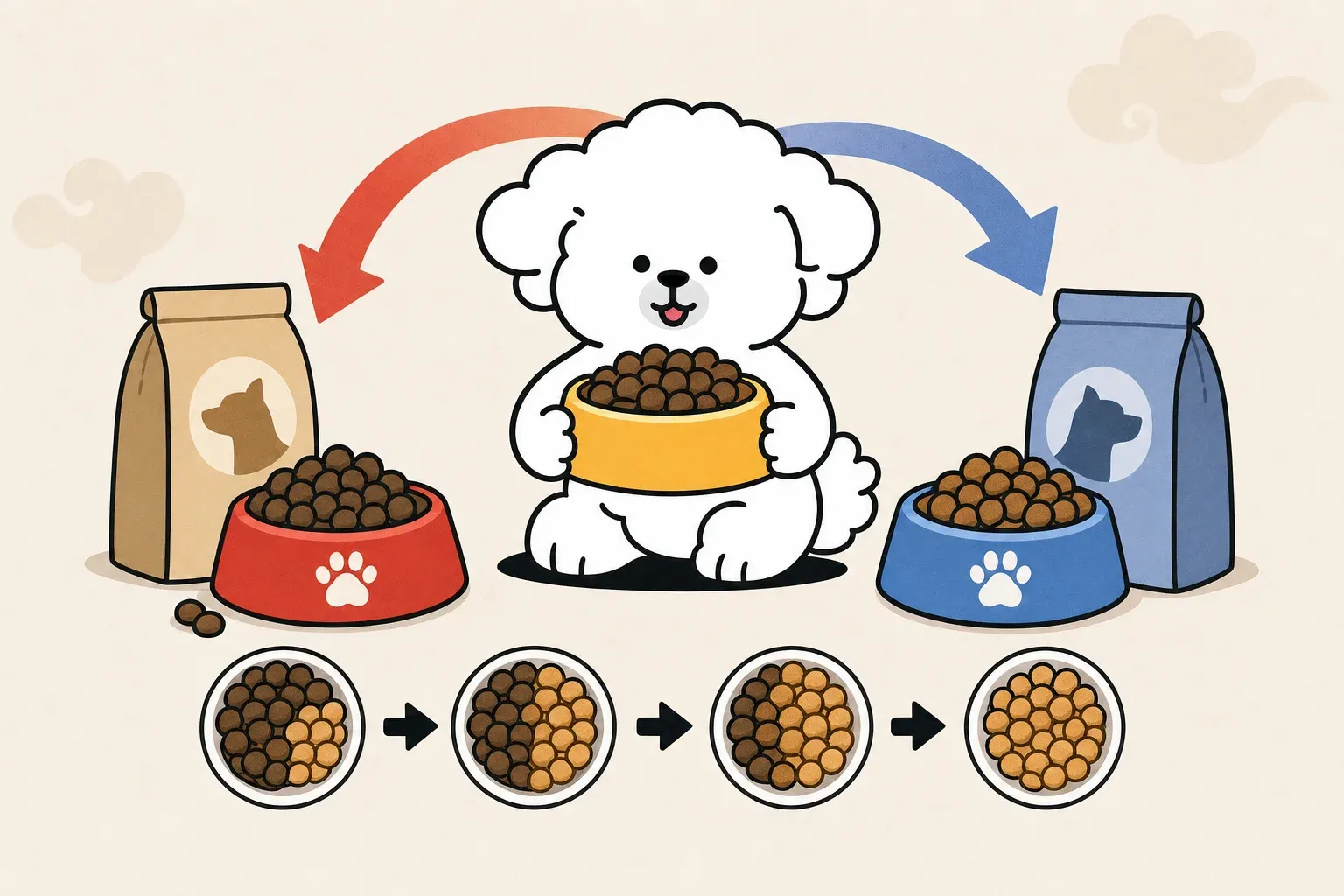
When starting mixed feeding from a single-format diet, transition gradually over 7–10 days to avoid digestive upset. See the complete food transition guide for the day-by-day protocol.
How to Calculate Ratios and Calories
The critical rule of mixed feeding: total daily calories from both foods combined must equal the dog’s daily caloric requirement — not the kibble-only amount plus a standard wet food serving on top. The most common mistake is adding wet food as a supplement without reducing kibble, resulting in consistent overfeeding.
Example calculation for a 30-lb adult dog (daily caloric need: ~750 kcal):
Using a 70:30 dry-to-wet ratio:
- Dry food target: 750 × 0.70 = 525 kcal
- Wet food target: 750 × 0.30 = 225 kcal
If the dry food has 360 kcal/cup and the wet food has 95 kcal/100g:
- Dry food portion: 525 ÷ 360 = ~1.46 cups per day
- Wet food portion: 225 ÷ 0.95 = ~237g per day (~1 standard 8 oz can)
Using a 50:50 ratio:
- Dry food target: 375 kcal → ~1.04 cups per day
- Wet food target: 375 kcal → ~395g per day (~1.5–2 standard cans)
| Dog Weight | Daily kcal Need (typical adult) | 70:30 Dry | 70:30 Wet | 50:50 Dry | 50:50 Wet |
|---|---|---|---|---|---|
| 10 lbs | ~350 kcal | 245 kcal | 105 kcal | 175 kcal | 175 kcal |
| 20 lbs | ~550 kcal | 385 kcal | 165 kcal | 275 kcal | 275 kcal |
| 30 lbs | ~750 kcal | 525 kcal | 225 kcal | 375 kcal | 375 kcal |
| 50 lbs | ~1,100 kcal | 770 kcal | 330 kcal | 550 kcal | 550 kcal |
| 70 lbs | ~1,450 kcal | 1,015 kcal | 435 kcal | 725 kcal | 725 kcal |
Note: Caloric needs vary by activity level, neutered status, and individual metabolism. These figures represent moderate-activity adult dogs. Consult your veterinarian if your dog has a medical condition affecting caloric requirements.
Checklist Before You Choose
Use these criteria when evaluating any new wet or dry food, regardless of which format you select.
AAFCO Compliance
- Look for the AAFCO nutritional adequacy statement on the label — it should specify life stage: “growth” (puppy), “adult maintenance,” “senior,” or “all life stages”
- “All life stages” meets the highest nutritional standard and is appropriate for any dog
- “Complementary” or “intermittent feeding only” means the food is not nutritionally complete on its own
Ingredient Label Priorities
- The first ingredient should be a named animal protein (e.g., “chicken,” “salmon,” “beef”) — not a protein by-product as the sole protein source, and not corn or soy as the first ingredient
- For wet food: check that the ingredient list includes a whole protein source, not just broth — broth-based foods with protein listed fourth or fifth may have lower actual protein content than the label’s percentage suggests
- For detailed label reading guidance, see the dog food label reading guide linked above
Calorie Density on the Label
- AAFCO requires manufacturers to provide calorie information; many include it on the label (often listed as “Calorie Content” in kcal/kg and kcal per can or cup)
- If not on the label, you can request it from the manufacturer — use this number, not the feeding guidelines alone, when calculating portions
Transition Protocol
- Whether switching between formats or within formats (old kibble to new kibble), abrupt changes cause GI upset in most dogs
- Standard protocol: 25% new food for 3 days → 50% for 3 days → 75% for 3 days → 100% new food
- Senior dogs and dogs with sensitive GI tracts benefit from a 14-day transition at the same incremental pace
Storage Reminders
- Dry food: store in an airtight container away from heat and direct light; use within 6 weeks of opening a bag
- Wet food: refrigerate opened portions within 2 hours; use within 3–5 days; keep unopened cans in a cool, dry location
The information in this article is provided for educational purposes and does not constitute veterinary or nutritional advice. Every dog’s caloric and nutritional needs differ based on breed, age, health status, and activity level. Consult a licensed veterinarian or board-certified veterinary nutritionist before making significant changes to your dog’s diet, particularly if your dog has an existing health condition.
References
- 1. AAFCO Dog Food Nutrient Profiles — Association of American Feed Control Officials
- 2. Wet vs. Dry Dog Food — VCA Animal Hospitals
- 3. Dry vs. Wet Dog Food, or Both? — PetMD, reviewed by veterinarians
- 4. Nutritional Assessment Guidelines for Dogs and Cats — WSAVA Global Nutrition Committee, 2011
- 5. Obesity in Dogs — Association for Pet Obesity Prevention, 2023 Clinical Survey
- 6. Dental Disease in Dogs — American Veterinary Dental College
FAQ
Can I feed my dog only wet food?
Does mixing wet and dry dog food cause digestive problems?
How long does opened wet food last in the refrigerator?
Is dry food better for dogs' teeth?
How do I calculate calories when mixing wet and dry food?
Related Articles
How to Switch Dog Food Safely: A 7-Day Transition Schedule
Learn how to switch dog food safely. Includes a 7-day transition schedule, stool quality chart, breed-size tips, and troubleshooting for digestive upset.
How Much Water Should a Dog Drink? By Weight, Age & Season
Daily water targets by weight, dehydration self-tests, and tips for dogs that won't drink. Covers all ages, diets, and seasons.

Senior Dog Nutrition: An Age-Appropriate Feeding Guide
Senior dog nutrition guide: age-stage feeding changes, food transition protocols, condition-specific diet adjustments, and supplement criteria.