 Cirius Petpedia
 If Your Cat Keeps Biting: Types of Aggression and How to Respond
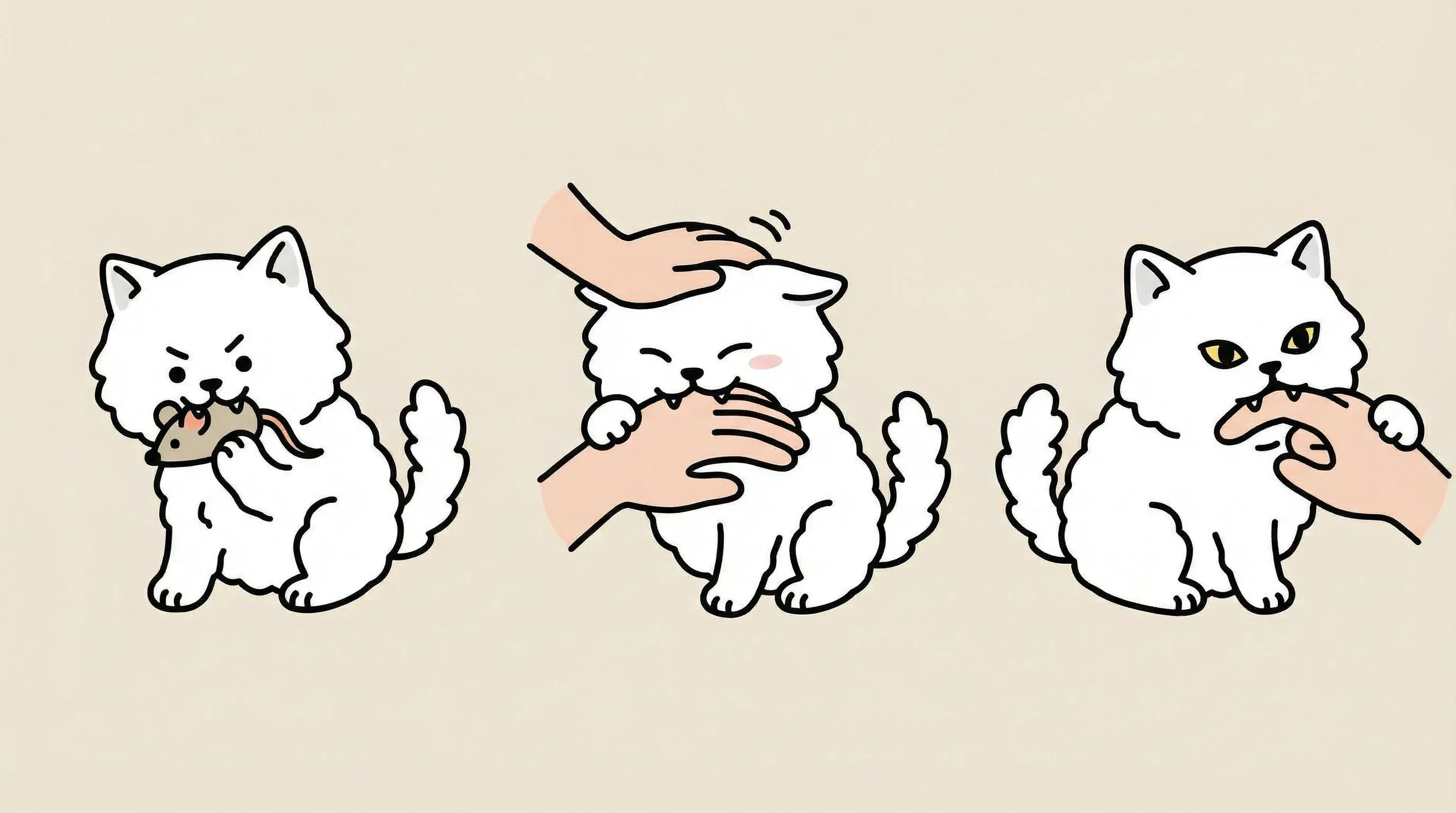
Your cat was sitting in your lap, purring. You were petting them. Everything seemed fine — and then they bit you. Hard.
If this sounds familiar, you are not alone. Biting is one of the most common behavioral concerns that cat owners bring to veterinarians and behaviorists. It is also one of the most frequently misunderstood, because cat biting behavior does not come from a single cause. It reflects several biologically distinct types of aggression, each with different triggers, different warning signals, and different solutions.
Getting the type right matters. Responding to play aggression with the same strategy you would use for pain-related aggression will make things worse, not better. This guide walks through all six major types of cat biting behavior, explains why your cat bites, and gives you targeted strategies for each — based on feline behavioral science and AAFP (American Association of Feline Practitioners) guidelines.
Why Do Cats Bite?
Biting as Communication and Instinct
Cats are not aggressive by default. In the wild, aggression carries real physical costs — injuries that compromise hunting ability can be life-threatening — so cats evolved to communicate discomfort, threat, and intent through subtle postural and vocal signals before escalating to contact. When a domestic cat bites, it is usually because those earlier signals were missed, ignored, or misread.
Understanding why your cat bites starts with recognizing two things: biting is a natural part of feline communication, and it is also an expression of biological drives that have not changed significantly from their wild ancestors. The hunting sequence — orient, stalk, chase, pounce, bite, kill — is hard-wired. Indoor cats have the same instincts; they just lack appropriate outlets.
Biting can communicate:
- Overstimulation: “I have had enough physical contact.”
- Fear: “I cannot escape this situation.”
- Frustration: “I am aroused by something I cannot reach, and you are in the way.”
- Pain: “Touching that area hurts.”
- Play: “You are the most available prey object.”
- Territory: “This space, person, or resource is mine.”
When Biting Becomes a Behavioral Concern
Occasional gentle mouthing in play is normal, especially in kittens. Biting becomes a concern when it is hard enough to break skin, happens unpredictably, is escalating in frequency or intensity, or is causing fear in household members.
A sudden change in biting behavior in a previously calm adult cat should always prompt a veterinary evaluation before behavioral intervention. Pain, hyperthyroidism, hypertension, neurological changes, and cognitive dysfunction can all manifest as new or worsened aggression. Behavioral causes and medical causes are not mutually exclusive — an anxious cat with an underlying painful condition may require both medical and behavioral treatment simultaneously.
6 Types of Cat Biting Behavior
Understanding which type you are dealing with is the essential first step. The table below summarizes the key distinguishing features; the sections that follow go into depth on each.
| Type | Primary Trigger | Key Body Language Before Bite | Typical Target |
|---|---|---|---|
| Play aggression | Movement, play deprivation | Dilated pupils, crouched stalk, tail flick | Hands, feet, ankles |
| Petting-induced | Accumulated petting stimulus | Tail lash, skin ripple, ear rotation | Petting hand |
| Fear aggression | Perceived threat, inability to escape | Flattened ears, arched back, hissing | Whoever is closest |
| Redirected | Sight/sound of inaccessible stimulus | Intense fixed gaze toward window or door | Bystander (person or animal) |
| Territorial | Intrusion into claimed space or resource | Blocking posture, stiff tail, growling | Intruder (person or animal) |
| Pain-related | Touch to painful area or anticipatory pain | Sudden flinch, guarding posture, vocalizes | Person touching the cat |
Play Aggression: The Hunting Instinct at Work
Play aggression is the most common type in young cats and is rooted in the predatory motor sequence. When a cat stalks, ambushes, and bites your ankles or hands, it is not being mean — it is hunting. The problem is that hands and feet make highly responsive “prey,” and cats that learn to hunt people become progressively bolder as their skills improve.
Typical profile: Under two years old, most active at dawn and dusk, often escalates without warning once the “prey” moves.
Body language before the bite: Dilated pupils, crouched low with weight on hindquarters, tail twitching or lashing, wiggling hindquarters before the pounce.
What makes it worse: Rough play with hands during kittenhood, inconsistent responses (sometimes play-wrestling is allowed, sometimes it is not), long stretches with no interactive play.
Petting-Induced Aggression: Why Cats Bite During Cuddles
Petting-induced aggression — also called overstimulation aggression — is particularly confusing for owners because it looks like the cat was perfectly content right up until the bite. In reality, the cat was communicating discomfort for minutes before biting; the signals are simply easy to miss.
This type is thought to arise from the dual nature of the cat’s social grooming repertoire. Cats enjoy social contact up to a point. But sustained repetitive tactile stimulation (like continuous stroking) eventually activates an arousal-or-irritation response, especially along the back, base of tail, and belly.
Typical profile: Common in cats that were not extensively socialized as kittens, males more often than females in some studies, often occurs during quiet, settled contact.
Body language before the bite: Skin rippling or twitching along the back, tail beginning to lash or thump, ears slowly rotating backward, head turning toward your hand, cessation of purring. These signals appear in sequence — the bite comes only after they have been ignored.
What makes it worse: Petting without watching the cat, continuing to pet through early signals, punishing after the bite (which increases anxiety and shortens the tolerance window next time).
Fear Aggression: Defensive Biting
Fear aggression occurs when a cat perceives a threat and cannot escape it. It is purely defensive — the goal is to create enough of an aversive event that the threat withdraws. Cats showing fear aggression are not dominant or predatory; they are scared.
Typical profile: Cats with limited early socialization, cats that have experienced negative handling, cats in unfamiliar environments (vet clinic, new home), or any cat that feels cornered.
Body language before the bite: Ears flat against the head, body crouched low or pressed against a wall, tail tucked under the body or around the feet, piloerection (puffed fur), hissing, spitting, or growling. This cat is giving every possible signal that it is terrified.
What makes it worse: Approaching or looming over a fearful cat, direct eye contact (perceived as a threat), restraining the cat, punishment.
Redirected Aggression: Misplaced Frustration
Redirected aggression is one of the most dangerous forms because the target has absolutely nothing to do with the cause. The cat becomes highly aroused by something it cannot access — typically another cat outside the window, the sound of a cat fight, or a bird — and then redirects that arousal toward whoever or whatever is nearby.
A 2020 survey-based study found that redirected aggression accounts for a significant proportion of severe cat bites reported by owners, precisely because it appears to come out of nowhere to the person who is bitten.
Typical profile: Any age, any sex. Often occurs in indoor-only cats that can see but not reach outdoor cats. The attack can happen minutes to hours after the triggering stimulus.
Body language before the bite: Intense focused stare toward a window, door, or wall; highly elevated arousal (twitching tail, dilated pupils); failure to respond normally to owner — the cat may seem “not there.” Do not approach or touch a cat in this state.
What makes it worse: Approaching the cat while it is still aroused, attempting to soothe or physically redirect the cat, not identifying and managing the triggering stimulus.
Territorial Aggression: Guarding Space and Resources
Territorial aggression is directed at perceived intruders — another cat, a new person in the household, or a visitor. It can also be directed toward familiar people or animals after one returns from a veterinary visit carrying unfamiliar scents (a phenomenon sometimes called non-recognition aggression).
Typical profile: More common in intact males, but occurs in spayed and neutered cats and females. Often seen when a new cat is introduced too quickly, or after household disruption.
Body language before the bite: Stiff-legged posture, tail held stiffly upright or lashing, piloerection along the spine, direct staring, growling or yowling. The cat may block access to resources (food bowl, litter box, favorite resting spot).
What makes it worse: Forcing face-to-face introductions between cats, not providing enough vertical and horizontal space in multi-cat homes, inconsistent access to separate resources.
Pain-Related Aggression: When Biting Signals Discomfort
A cat in pain will bite when touched in a sensitive area — and may also bite in anticipation of pain, before you have even made contact. This type is often misidentified as “suddenly unpredictable” or “out of character” aggression.
Common underlying causes include dental disease, arthritis (particularly in older cats), ear infections, skin conditions, abdominal pain, and trauma. Cat arthritis is significantly underdiagnosed — studies suggest up to 90% of cats over 12 years show radiographic evidence of osteoarthritis, yet most owners are unaware.
Typical profile: Middle-aged to senior cats, any cat that has had a recent injury or illness, cats that have become reluctant to be handled in areas they previously tolerated.
Body language before the bite: Flinching or pulling away when a specific area is touched, vocalizing (hissing, growling, or yowling) upon contact, guarding posture (hunched back, reluctance to be touched), change in grooming behavior around a painful area.
Rule out this type first if aggression onset was sudden or the cat is over 7 years old.
How to Respond to Each Type
Redirecting Play Aggression with Appropriate Toys
The solution to play aggression is not restraint or punishment — it is appropriate discharge of predatory energy. Cats need to complete the hunting sequence. Interactive wand toys (feather wands, fishing-rod style toys) allow the full stalk-chase-pounce-bite-kill sequence to occur with an appropriate target.
Practical protocol:
- Schedule two 10–15 minute interactive play sessions daily, ideally at dawn and dusk when predatory drive is highest.
- End each session with a small meal or treat — this completes the “post-hunt feeding” sequence and prevents post-play frustration.
- Never use hands or feet as play objects, even for “gentle” play — the cat cannot reliably distinguish between play-wrestling and real handling.
- If the cat ambushes you, freeze (movement triggers the chase). Calmly redirect to a nearby toy, then resume walking only once the cat is engaged.
For indoor-only cats with high prey drive, environmental enrichment through play — puzzle feeders, rotating toy selection, window perches with bird feeders — substantially reduces play aggression frequency by addressing the underlying motivational deficit.
Reading Petting Threshold Signals
Managing petting-induced aggression requires learning your individual cat’s tolerance signals and stopping before you reach them — not after.
The threshold model: Every cat has a petting tolerance window. Within that window, petting is pleasant. As stimulation accumulates, arousal rises. The bite occurs when arousal exceeds the threshold. Your goal is to stop while arousal is still below threshold, then let it reset.
Active monitoring protocol:
- Start with short petting sessions (10–20 seconds), then pause and observe.
- Watch specifically for: tail movement (any lashing is a warning), skin twitching on the back, ear rotation toward back, head turning toward your hand.
- At the first signal, stop petting, let your hand rest still, and allow the cat to relax or move away.
- Over time, you can learn your cat’s specific sequence and extend sessions gradually.
Some cats simply do not enjoy prolonged petting — that is a normal variant of feline temperament, not a behavioral problem. Respecting that preference is more effective than trying to change it.
High stress levels reduce petting tolerance. If your cat’s threshold suddenly drops, stress management — including identifying and reducing stressors at home — can help restore a more comfortable baseline.
Creating Safe Spaces for Fear and Redirected Aggression
Fear aggression and redirected aggression both respond to the same core principle: reduce triggering stimuli, provide reliable escape routes, and never approach a cat that is in an activated state.
For fear aggression:
- Identify what triggers the fear (specific people, handling types, sounds, locations) and minimize forced exposure.
- Create high, enclosed safe spaces (covered cat beds on shelves, cat trees with enclosed platforms) where the cat can retreat and feel genuinely secure.
- Use positive association: ask new visitors to ignore the cat entirely and toss treats in the cat’s direction without looking at it. Let the cat dictate the pace of social interactions.
- For cats with generalized fear, a consultation with a veterinary behaviorist may include consideration of anti-anxiety medications alongside behavioral modification.
For redirected aggression:
- Identify the external stimulus (most commonly an outdoor cat visible through a window). Block visual access through window film, strategic furniture placement, or cardboard.
- If you encounter your cat in a highly aroused state — staring intently, not responding to your voice — do not approach. Leave the room, close the door, and wait 30–60 minutes for arousal to fully dissipate before re-entering.
- After a redirected aggression incident involving another household cat, separate the cats as if it were a first introduction. Reintroduce using the same gradual protocol as for introducing a new cat.
Managing Territorial Issues in Multi-Cat Homes
Territorial aggression in multi-cat households is largely a resource management problem. Cats are not inherently territorial — they are territorial under conditions of perceived resource scarcity or forced proximity.
Resource provisioning:
- The standard formula is N+1: one resource (litter box, food bowl, water bowl, resting spot) per cat plus one extra, distributed across different locations.
- Vertical space is a resource. Cat trees, shelves, and elevated perches increase the total usable space in a home and allow cats to establish distance without direct confrontation.
- Feeding in separate locations eliminates the most common flashpoint for resource guarding.
Scent management:
- Rub a clean cloth on one cat’s cheeks, then leave the cloth near the other cat’s resting area. Repeat in reverse. Gradual scent familiarity reduces the “stranger threat” signal without forcing physical contact.
- After vet visits, the returning cat may carry clinic scents that trigger non-recognition aggression. Rub both cats with the same cloth before reintroduction, or allow the returning cat to rest in a separate room for a few hours until the scent normalizes.
If separation anxiety is a factor in one cat’s behavior — particularly if aggression is directed primarily at the cat with whom they are most bonded — behavioral evaluation can clarify whether the aggression is territorial or anxiety-driven.
Common Mistakes That Make Biting Worse
Why Physical Punishment Backfires
Scruffing, spraying with water, swatting, or yelling after a bite does not teach the cat that biting is wrong. It teaches the cat that you are a source of unpredictable aversive events — which increases anxiety, erodes the human-cat bond, and in fear-aggressive or redirected-aggressive cats, dramatically escalates the aggression.
The AVSAB (American Veterinary Society of Animal Behavior) position statement on punishment explicitly states that punishment-based techniques are contraindicated in the treatment of aggression because they suppress warning signals without addressing underlying motivation. A cat that stops hissing or swatting after punishment has not become less aggressive — it has been taught to skip the warning phase and go directly to biting.
The Problem with Yanking Your Hand Away
The instinctive response to a bite is to pull your hand back sharply. In most aggression types, this is the worst possible move. Fast movement triggers the predatory chase reflex in play aggression — the bite was a mistake, but the rapid withdrawal of your hand signals “prey fleeing,” prompting a follow-up attack.
Instead: when bitten, go still and quiet. Let your hand go slightly toward the cat rather than away (this counterintuitively reduces the prey-chase stimulus), then slowly withdraw once the cat releases. Turn away, break eye contact, and end the interaction entirely.
When Ignoring Doesn’t Work
“Just ignore it” is incomplete advice. Withdrawing attention after a bite is correct — attention is a reinforcer, and giving attention in response to biting teaches cats that biting produces attention. However, ignoring biting without identifying and addressing the underlying cause simply means your cat will keep biting.
The correct sequence is: (1) safely disengage and ignore the immediate incident; (2) analyze the context to identify the aggression type; (3) implement the type-specific strategy consistently over days and weeks. Passive ignoring without active behavior management rarely produces lasting change.
When to See a Veterinarian
Sudden Aggression Changes as Medical Red Flags
Any cat that becomes aggressive without a clear behavioral cause should be examined by a veterinarian before behavioral intervention begins. This is especially true for:
- Cats over 7 years old with new or worsened aggression
- Aggression that appears suddenly in a previously calm cat
- Aggression paired with other behavioral changes (increased vocalization, changes in appetite, altered sleep, unusual elimination)
- Aggression specifically associated with being touched in one location
Medical conditions that can directly cause or worsen aggression include: hyperthyroidism, hypertension, chronic pain (dental disease, arthritis, internal pain), cognitive dysfunction syndrome, neurological conditions, and certain metabolic disorders. Treating the underlying condition often resolves or dramatically reduces the aggression without behavioral intervention.
Cat Bite Infection Risk and First Aid
Cat bites carry a significantly higher infection risk than dog bites. Cat teeth are narrow and pointed, creating deep puncture wounds that seal over quickly and trap bacteria — particularly Pasteurella multocida, which is present in the oral flora of approximately 70–90% of cats.
Immediate first aid:
- Wash the wound thoroughly with soap and water for at least five minutes.
- Apply an antiseptic such as povidone-iodine or chlorhexidine.
- Cover with a clean bandage.
- Monitor for signs of infection: increasing redness, swelling, warmth, pus, or red streaking (which may indicate spreading infection).
Seek medical care promptly if:
- The bite is deep, on the hand or face, or near a joint
- Signs of infection develop within 24–48 hours
- You are immunocompromised, diabetic, or taking medications that suppress immune function
- You develop fever, swollen lymph nodes, or flu-like symptoms
Cat bite infections can progress to cellulitis, septic arthritis, or systemic infection within 24–48 hours. When in doubt, see a physician.
FAQ
Why does my cat bite me out of nowhere?
Are love bites different from aggressive bites?
Why does my cat bite my ankles when I walk by?
Is kitten biting normal, and will cats grow out of it?
When should I see a vet or veterinary behaviorist for cat biting?
Related Articles
Dog Lethargy Causes: When Slowing Down Signals More Than Just Aging
Learn how to distinguish normal dog tiredness from true lethargy, identify dog lethargy causes by age, and know which signs need emergency vet care.
Veterinary Guide to Cat Overgrooming: Causes, Treatment, and When to Worry
Cat overgrooming causes range from allergies to anxiety. This vet-backed guide covers diagnosis, body-area mapping, treatment options, and when to see a doctor.
Does Your Senior Dog Have Dementia? A Veterinary Guide to Canine Cognitive Dysfunction
Learn the 7 DISHAAL domains to assess dog dementia symptoms at home, understand evidence-based treatment options, and know when to call your vet.
Dog Noise Phobia Treatment: Thunder and Fireworks Guide
Step-by-step guide to treating dog noise phobia from thunder and fireworks. Desensitization protocol, tool comparisons, and when to see a vet.
Is Your Dog in Pain? 7 Subtle Signs Most Owners Miss
Learn the 7 behavioral signs your dog is in pain that are easy to overlook, how to tell acute from chronic pain, and what to do before your vet visit.
Dog Separation Anxiety Guide: Symptoms, Training, and Help
Learn how to identify dog separation anxiety symptoms, follow a vet-backed step-by-step training plan, and know when medication or a specialist is needed.
Dog Walk Refusal: Is It Behavior or Hidden Joint Pain?
Dog walk refusal may signal arthritis, hip dysplasia, or IVDD. Use our 10-point checklist to tell behavioral causes from joint pain—and what to do next.
If Your Dog Won't Stop Barking: Type-by-Type Training Guide
Stop dog barking by identifying the type. 5 types, targeted training protocols, and realistic timelines — evidence-based guide for dog owners.
Transform Your Indoor Cat's Behavior and Health by Redesigning Their Play Environment
Use the AAFP/ISFM Five Pillars framework to build a science-backed indoor cat enrichment plan—from hunting sequence play design to sensory stimulation and behavior monitoring.
How to Start Nose Work with Your Dog: A Step-by-Step Beginner's Guide
Learn how to start nose work with your dog using a 5-stage progressive protocol. From palm treat finds to outdoor scent detection — start today with no special equipment.
How to Introduce Cats: A Step-by-Step Guide From Isolation to Harmony
Learn how to introduce cats using a proven 5-step protocol with clear timeline ranges, age and sex strategies, and a failed-introduction recovery plan.
Dog Coprophagia: Why Dogs Eat Poop and How to Stop It
Dog coprophagia affects 1 in 6 dogs. Learn the three types, their distinct causes, evidence-based correction protocols, and why most deterrents don't work.
How to Crate Train Your Dog: A Step-by-Step Guide from First Introduction to Calm Alone Time
Learn how to crate train a dog with a 5-step protocol, age-based time limits, and troubleshooting for crying, crate aversion, and accidents.
Loose Leash Walking Training: 5 Steps to Stop Dog Pulling
Stop your dog pulling on walks with this 5-stage loose leash walking training guide — from indoor introduction to real-world heel, with troubleshooting.
Is Your Dog Guarding More Than Just the Food Bowl? Types of Resource Guarding and How to Fix Them
Dog resource guarding goes beyond food bowls. Learn the 4 types, a severity assessment framework, and type-specific training protocols to stop guarding safely.
Bringing Home a New Puppy? The Complete Socialization Training Guide You Need
Learn the science behind puppy socialization windows, get a week-by-week timeline, and discover safe pre-vaccination methods with a practical category-based checklist.
Cat Meowing at Night: 3 Common Responses That Make It Worse
Cat meowing at night is disrupting your sleep—and your usual fixes may be making it worse. Learn the behavioral science behind night crying and a 4-step evening routine that actually works.
How to Potty Train a Puppy: The Complete Guide for First-Time Dog Owners
Learn how to potty train a puppy with crate training, bell training, nighttime protocols, regression fixes, and tips for apartment living and rescue dogs.
How to Stop Puppy Biting: Age-by-Age Training Guide
Learn how to stop puppy biting with science-backed methods, age-specific protocols from 8 weeks to adulthood, and a step-by-step training system.
Does Your Cat Have Separation Anxiety? Signs to Watch and How to Help
Learn the real signs of cat separation anxiety symptoms, how to tell anxiety apart from boredom, and a week-by-week desensitization protocol you can start today.
Dog Excessive Licking Causes: Normal vs. Concerning Signs
Dog excessive licking causes include skin allergies, joint pain, anxiety, and GI distress. Learn the body-region diagnostic map and when to call a vet.