 Cirius Petpedia
 Moving With a Cat? 5 Common Mistakes That Make Stress Worse
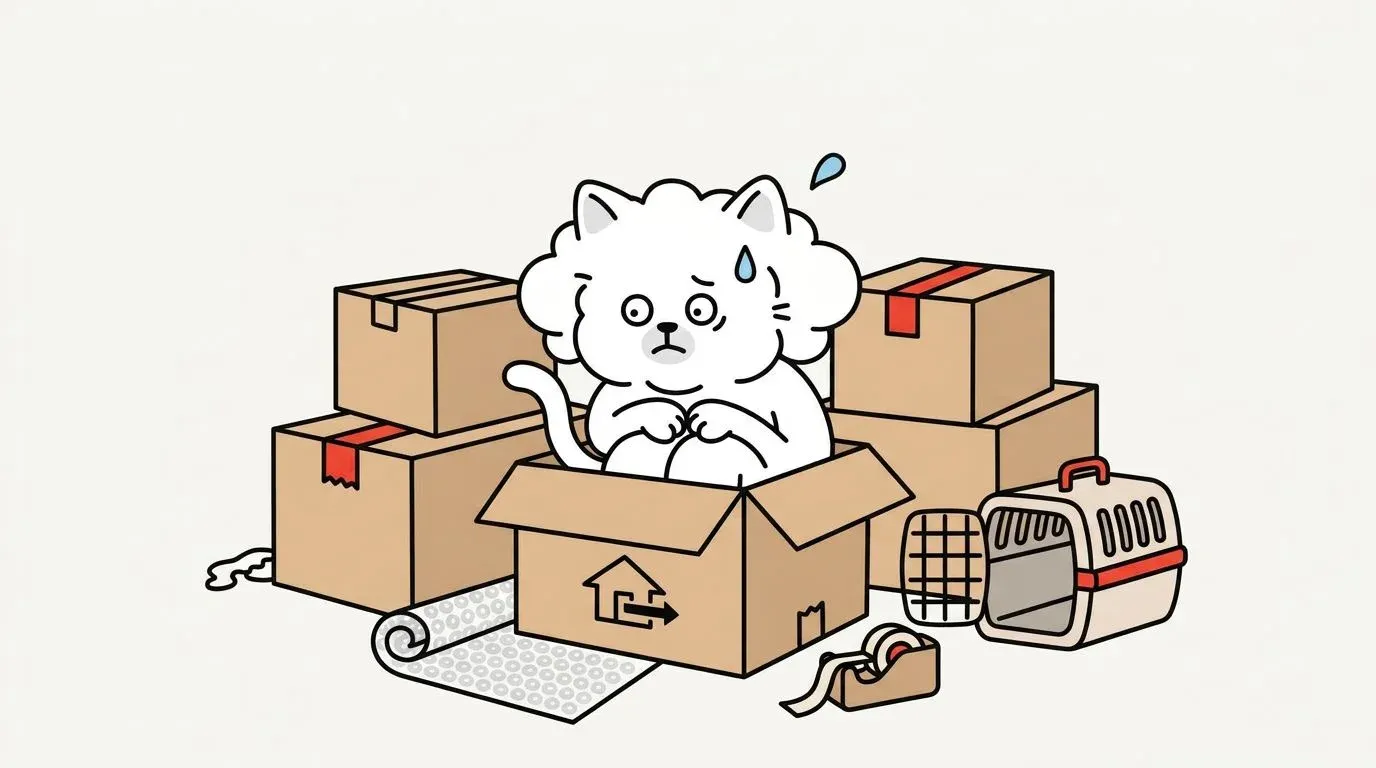
Moving is ranked among the most stressful life events for humans. For cats, the experience lands on a different order of magnitude — because where a person understands what is happening and why, a cat simply loses the only thing that defines safety: a known territory.
Cat moving stress is not a behavioral quirk or temporary moodiness. It is a measurable physiological event involving cortisol release, autonomic nervous system activation, and immune suppression that, if poorly managed, can progress from behavioral disruption to serious physical illness within days. Understanding what actually happens to a cat during a move — and which common owner responses make it worse — is the difference between a smooth two-week transition and a months-long struggle that ends in a vet visit.
This guide covers the physiology, the common owner mistakes, and a concrete D-21 to D+30 timeline framework that addresses what competing resources consistently omit: how to adapt your approach to your individual cat’s personality type, and how to recognize when professional intervention is needed.
Why Moving Is Uniquely Stressful for Cats
Territorial Instinct: Why Space Changes Hit Cats Hardest
Cats are obligate territorial animals. Unlike dogs, whose social bond to their owner provides a portable sense of security, cats derive safety primarily from a known, mapped physical space. Every corner, scent mark, elevated surface, and hiding spot in your current home represents months or years of accumulated environmental intelligence.
When that environment disappears, your cat does not simply feel confused. From a neurological standpoint, the entire safety architecture — built through repetitive experience and reinforced through scent marking — is erased simultaneously. The new home contains zero familiar reference points, which the feline nervous system registers as a sustained threat state.
This is why dogs typically re-orient within a day or two of a move while cats may remain in a hypervigilant, stress-activated state for weeks. The difference is not temperament in the colloquial sense — it is a fundamental difference in what constitutes security for each species.
The Physiology of Feline Stress Response
When a cat perceives sustained threat — as in a full environmental displacement — the hypothalamic-pituitary-adrenal (HPA) axis activates chronically, not just acutely. Cortisol and adrenaline remain elevated beyond the initial transition. The measurable consequences include:
- Immune suppression: T-lymphocyte and natural killer cell activity decrease, leaving cats vulnerable to opportunistic infections, including upper respiratory viruses that may have been dormant
- Bladder wall sensitization: Corticotropin-releasing factor (CRF) — a stress hormone — directly irritates the glycosaminoglycan (GAG) layer of the bladder wall, triggering Feline Idiopathic Cystitis (FIC) even in cats with no prior urinary history
- Gastrointestinal disruption: Stress-induced motility changes produce vomiting and diarrhea, separate from any dietary changes
- Hypothalamic appetite suppression: Sustained cortisol elevation reduces the drive to eat, and in cats with body condition reserves, this can escalate to hepatic lipidosis (fatty liver disease) faster than owners expect
The critical point is that these are not behavioral responses. They are physiological cascades that begin within hours of a stressful relocation and compound if the environmental situation does not resolve. Management is not optional — it is medical prevention.
Recognizing Moving Stress Symptoms
Catching stress early allows intervention before physiological cascades begin. Symptoms fall into three categories with different urgency levels.
Behavioral Signs: Hiding, Vocalization, Aggression
Expected and manageable (Days 1–7):
- Hiding under beds, in closets, or behind furniture for most of the day
- Reduced social interaction, including avoiding owners who were previously sought out
- Vigilant, wide-eyed posture without direct engagement
Worth monitoring closely (Days 1–14):
- Persistent loud vocalization, especially at night
- Redirected aggression toward owners or housemates
- Increased facial rubbing and scent marking (a coping behavior, but indicates high stress load)
Contact your vet if:
- Aggression escalates or becomes unpredictable beyond 2 weeks
- Vocalization is accompanied by straining, restlessness, or appearing to be in pain
Appetite Changes: Refusal to Eat, Reduced Water Intake
A cat missing one meal is normal. Missing two consecutive meals warrants attention. Missing meals for 48+ hours in a cat with any body fat reserves requires veterinary contact, as hepatic lipidosis can begin within 2–3 days of caloric deprivation in susceptible cats.
Reduced water intake is harder to detect but equally important, especially in cats already predisposed to urinary issues. If your cat’s litter box shows significantly reduced urine output in the first week, increase water availability through a water fountain or wet food.
| Eating behavior | Action |
|---|---|
| Skips 1 meal | Monitor, offer food in a quiet location |
| Skips 2 consecutive meals | Offer highly palatable food; reduce environmental stimulation |
| No food for 48+ hours | Veterinary contact — hepatic lipidosis risk |
| No urine in litter box for 24h | Urgent veterinary contact — possible obstruction |
Physical Symptoms: Vomiting, Diarrhea, Over-Grooming
Isolated vomiting once or twice in the first 48 hours is often stress-induced gastric motility disruption and may not require treatment. However, stress-related cat vomiting that continues beyond 48 hours, or that accompanies lethargy and appetite loss, needs veterinary assessment.
Diarrhea in the first week is common with both stress and any diet change. Ensure your cat’s food brand stays consistent during the move.
Over-grooming or excessive licking — particularly new focal patches — is a stress displacement behavior that can escalate to self-inflicted hair loss if the underlying stress is not addressed.
5 Common Mistakes That Make Moving Stress Worse
These are the errors that consistently appear across cat owner reports and veterinary case histories. Each one is well-intentioned, and each one makes the neurological situation meaningfully worse.
Mistake 1: Letting Your Cat Roam Free Immediately
Opening doors and allowing full-home exploration on moving day feels like freedom. For a cat, it is sensory overload. The olfactory mapping required to establish territorial security — a process that takes time and repeated exploration — cannot happen simultaneously across an entire new home.
Full immediate access does not speed up adaptation. Research in feline environmental psychology consistently shows that graduated spatial introduction produces faster behavioral normalization. Start with one room. Let your cat map, scent-mark, and settle that space before expanding.
Mistake 2: Replacing Familiar Items With New Ones
Moving is an opportunity to replace that worn cat bed or scratched blanket. Resist it entirely. Your cat’s existing bedding, toys, and scratching surfaces carry scent profiles that represent continuity in an otherwise completely foreign environment. These items function as olfactory anchors.
Introduce any new items only after your cat has re-established stable behavior patterns — typically 3–4 weeks post-move for confident cats, longer for anxious ones.
Mistake 3: Hovering and Over-Comforting
Owners who are worried about their cat naturally want to check on them frequently, sit near them, offer food by hand, and provide constant reassurance. This approach, while emotionally understandable, signals to the cat that the environment warrants sustained vigilance.
Calm, predictable behavior from you is more reassuring than active comforting. Establish consistent routines (feeding times, play sessions), be present without being intrusive, and allow your cat to initiate contact rather than pursuing them.
Mistake 4: Skipping Carrier Training Before Moving Day
Carrier avoidance is extremely common in cats, which means moving day often involves a prolonged, physically stressful capture-and-confinement sequence that floods the cat with cortisol before the move even begins.
If you begin carrier familiarization at least 3 weeks before moving day — leaving the carrier accessible with familiar bedding inside, feeding meals near it, then inside it — cats can learn to enter voluntarily. This single step reduces the physiological stress load of transport significantly.
Mistake 5: Rushing Multi-Cat Reintroduction
When multiple cats move together, owners often assume they will simply re-establish their previous relationship in the new space. This is frequently incorrect. New territory eliminates established hierarchy signals, and cats that lived harmoniously before a move can become hostile competitors in the new home.
The safest protocol is to confine cats together in the starting room, monitor body language carefully, and treat any escalating tension as a multi-cat reintroduction situation requiring the same methodical scent-swap approach used for introducing cats for the first time.
The Moving Timeline: D-21 to D+30
This structured timeline addresses what most moving guides omit: specific actions, sequenced by phase, that address the predictable stress curve of feline relocation.
D-21 to D-7: Carrier Training and Vet Visit
Carrier training (start immediately):
- Leave carrier open in a high-traffic area with familiar bedding inside
- Feed meals near the carrier, progressing to inside it over 2–3 weeks
- Once your cat enters voluntarily, begin short positive-association closures (1–2 minutes, no transport)
Veterinary visit:
- Discuss the move with your vet, particularly if your cat has any history of urinary issues, anxiety, or chronic illness
- Ask about short-term anxiolytic options if your cat has severe stress history
- Update vaccinations if due — immune suppression during the move increases infection risk
- Get health certificates if the move involves interstate or international travel
Environmental preparation:
- Purchase a pheromone diffuser (synthetic F3 feline facial pheromone analog) to set up in the new home’s starting room before arrival
- Source the same litter brand and food — do not change either during the transition period
D-7 to D-1: Packing Phase Environment Management
Packing disrupts the existing environment and can begin elevating stress before moving day. Boxes, missing furniture, and altered scent landscapes signal environmental instability to the territorial brain.
- Maintain a designated packing-free zone where your cat’s core resources (bed, food, litter) remain unchanged until the last possible moment
- Keep feeding times and play sessions consistent despite the household disruption
- Set up the pheromone diffuser in the new home’s starting room at least 24 hours before your cat arrives, if access is possible
D-Day: Moving Day Safety Protocol
Moving day itself carries the highest risk of escape, injury, and acute stress flooding.
- Confine your cat to a single room (bathroom or bedroom) during the entire packing and loading process
- Post a sign on the door: “Cat inside — do not open”
- Leave the carrier in the room as a retreat option
- Transport in the carrier with a familiar-smelling item (worn clothing, existing bedding) — do not cover completely; some cats prefer visual access
- In the vehicle, minimize noise; do not play loud music
- At the new home, take your cat directly to the pre-prepared starting room before any unpacking begins
D+1 to D+7: First Week Confinement and Gradual Exploration
The starting room is the most critical investment in your cat’s adaptation timeline. It should contain:
| Resource | Notes |
|---|---|
| Food and water | Away from litter box — opposite end of room |
| Litter box | Same brand/type as previous |
| Hiding spots | Cardboard boxes work; covered cat beds preferred |
| Elevated surfaces | Even a chair next to a shelf provides choice |
| Scratching post | Familiar, not new |
| Pheromone diffuser | Running continuously |
Do not force interaction. Visit regularly and calmly. Begin interactive play sessions in the room once your cat shows interest in the environment (Day 3–5 for most cats).
Signs your cat is ready to expand: Approaching the door with interest, vocalizing toward you rather than away, grooming in your presence, eating consistently.
D+7 to D+30: Territory Expansion and Routine Building
Introduce new rooms one at a time. Allow your cat to investigate each new space thoroughly — typically 1–3 days per room — before opening another.
Continue pheromone support through the full 30-day window. Maintain consistent feeding times, litter cleaning frequency, and play session schedules.
If separation anxiety symptoms appear during this phase — excessive vocalization when you leave, destructive behavior, hyper-attachment — address them proactively rather than waiting for resolution.
Build enrichment into the new territory: window perches, vertical climbing options, foraging feeders, and interactive play are essential tools for indoor cat environmental enrichment during adaptation.
Adapting Strategies to Your Cat’s Personality
The timeline above provides a framework. How you execute it depends substantially on your individual cat’s temperament. Applying a social cat’s protocol to a fearful cat produces worse outcomes, not better.
Shy and Anxious Cats: Minimal Stimulation, Maximum Hiding Spots
Fearful cats need more hiding options, longer confinement periods, and owners who are present without being intrusive. Resist the urge to retrieve them from hiding spots to “show them it’s safe.” A cat in a hiding spot is managing its own stress load — interrupting that increases the burden.
Extend the confinement period to 7–14 days minimum. Expand territory in smaller increments (one doorway at a time, then one room). Use pheromone products at higher density (two diffusers in the starting room for large spaces).
Interactive play is particularly valuable for anxious cats — the prey drive activation interrupts the threat-monitoring loop and provides a positive association with the new space. Short sessions (5–10 minutes) multiple times per day outperform long single sessions.
Social Cats: Owner-Accompanied Exploration
Social cats that derive significant comfort from human presence adapt best when territory expansion happens with the owner present. Rather than opening a door and observing from a distance, enter the new room with your cat, remain calm and seated, and allow exploration to radiate outward from you as a safe anchor.
These cats may move through the adaptation timeline faster — some social cats are exploring freely within 3–5 days — but benefit from owner supervision during the expansion phase to prevent resource-guarding if other pets are present.
Independent Cats: Self-Paced Discovery With Active Monitoring
Independent cats often appear to adapt quickly and may resist confinement more than anxious cats. This can be misleading — behavioral normalization on the surface can mask low-grade chronic stress.
Allow slightly earlier territory expansion based on behavioral cues, but increase monitoring rigor: watch for subtle stress signals (reduced grooming, slight appetite changes, increased resting) that indicate cumulative stress loading even without overt distress.
General stress management strategies apply across all temperament types; the primary variable is how proactively you intervene versus how long you wait for self-resolution.
When Moving Stress Becomes a Medical Emergency
Feline Idiopathic Cystitis (FIC) and Relocation Stress
FIC — inflammation of the bladder with no identifiable infectious cause — has a well-documented stress trigger mechanism. Corticotropin-releasing factor released during chronic stress sensitizes the bladder wall, producing symptoms indistinguishable from a urinary tract infection: straining to urinate, frequent attempts with small or no output, blood in urine, and crying in the litter box.
In male cats, FIC carries a risk of complete urethral obstruction, which is a life-threatening emergency. If you observe a male cat making repeated trips to the litter box producing little or no urine, do not wait — this is a same-day veterinary emergency.
For all cats, any signs of urinary distress in the first 4 weeks after a move should be evaluated promptly. FIC that is caught early responds well to treatment; obstruction that is delayed does not.
Hepatic Lipidosis Risk From Stress-Induced Appetite Loss
Hepatic lipidosis (fatty liver disease) is the most common severe liver disease in cats and is uniquely prone to stress-related triggering. When a cat stops eating, the body mobilizes fat stores to the liver faster than the liver can process them, leading to fat accumulation and progressive liver failure.
The dangerous threshold is 48–72 hours without caloric intake in a cat with normal body condition reserves. Overweight cats are at higher risk because fat mobilization happens more rapidly.
If your cat has not eaten meaningfully for 48 hours after the move, contact your veterinarian rather than waiting another day to see if appetite returns. Early intervention — sometimes as simple as appetite stimulants or syringe feeding guidance — prevents a manageable situation from becoming critical.
Immune Suppression and Upper Respiratory Infections
The sustained cortisol elevation of relocation stress suppresses T-lymphocyte activity for days to weeks. Cats that carry latent herpesvirus (Feline Herpesvirus-1, extremely common in the general cat population) are particularly vulnerable to viral reactivation during this window, producing symptoms of upper respiratory infection: sneezing, eye discharge, and nasal congestion.
Minor URI symptoms that resolve within a few days are typically self-limiting. However, secondary bacterial infection can develop, particularly in cats whose immune systems are compromised by concurrent appetite loss. Any URI symptoms persisting beyond 5–7 days or accompanied by eye ulceration, breathing difficulty, or severe lethargy warrant veterinary assessment.
Signs Your Cat Has Successfully Adapted
Knowing when adaptation is complete matters as much as knowing how to manage the process. Many owners continue intensive management protocols longer than necessary, which can inadvertently maintain a state of heightened awareness rather than allowing full relaxation.
Behavioral Indicators: Grooming, Play, and Marking
| Behavior | What it signals |
|---|---|
| Self-grooming in open spaces | Comfort — cats do not groom when stressed |
| Stretching and relaxed sleep postures | Absence of vigilance |
| Initiating play | Environmental security re-established |
| Facial rubbing on furniture and walls | Positive territorial claiming, not anxiety |
| Voluntary exploration to room boundaries | Active mapping, not flight |
| Returning to previous social habits with owner | Trust re-established |
Grooming is the most reliable single indicator. A cat that is grooming thoroughly and regularly in exposed areas of the home has made the transition.
Eating Indicators: Normal Appetite and Regular Litter Box Use
Return to baseline food consumption (the same quantity and enthusiasm as before the move) signals resolution of the cortisol-driven appetite suppression. This typically precedes full behavioral normalization by a few days.
Consistent, predictable litter box use — including urination frequency and volume matching pre-move patterns — is the critical health indicator. Any ongoing changes in litter box habits beyond week four should be discussed with a veterinarian.
When all indicators align — grooming, play, eating, and normal litter box use — your cat has adapted. You can scale back pheromone support, reintroduce new furniture or environmental changes you deferred, and resume whatever pre-move enrichment routine your cat enjoyed.
Moving stress in cats is manageable with preparation and patience. The five mistakes outlined here, the D-21 to D+30 timeline, and the temperament-specific adaptations represent the current best practice synthesis from veterinary behavioral science. If your cat’s stress symptoms escalate rather than improve over the first two weeks, or if any physical symptoms appear, early veterinary contact is always the right decision — there is no threshold too low for asking a professional.
FAQ
How long does it take a cat to adjust to a new home?
My cat cries constantly after moving. What should I do?
Can I let my cat use the whole house from day one?
Do pheromone diffusers actually work for moving stress?
We have two cats. Who should we move first?
Related Articles
7 Proven Ways to Relieve Your Cat's Stress at Home
Learn the signs of stress in cats, what triggers it, and 7 science-backed methods for cat stress relief you can start at home today.
Dog Jumping Off Furniture: Why Their Joints Are Paying the Price
Every couch jump sends 2–5x body weight through your dog's joints. Learn how repeated landings cause joint damage and what to do about it.
What Your Dog's Sleeping Position Reveals About Their Joint Health
Dog sleeping position joint pain connection explained — learn which postures signal discomfort, how to observe changes, and how to build a joint-friendly sleep setup.
If Your Dog Lives on Hardwood Floors, Here's How to Protect Their Joints
Slippery hardwood, laminate, and tile floors quietly damage your dog's joints over time. Learn the biomechanics, floor risk comparison, and proven solutions.
Dog Tick Prevention on Walks: How to Check, Remove, and Protect Against Tick-Borne Disease
A complete guide to dog tick prevention during walks. Learn how to check for ticks, safely remove them, and protect your dog from dangerous tick-borne diseases like Lyme, Ehrlichiosis, and Babesiosis.
Dog Heat Stroke Prevention: Critical Temperature Thresholds and Warning Signs Every Owner Must Know
Learn the 4-tier temperature risk system, breed-specific vulnerabilities, pavement heat dangers, and step-by-step emergency protocol to prevent and treat dog heat stroke this summer.
If Your Dog Is Prone to Skin Issues in Wet Weather: A Seasonal Care Guide
Learn how humid and wet weather triggers yeast infections, bacterial pyoderma, and hot spots in dogs — plus a complete post-walk routine, indoor humidity management, and nutrition tips.
Planning a Car Trip With Your Dog? Essential Safety Rules You Need to Know
Complete guide to dog car travel safety: crash-tested restraint options, desensitization training, motion sickness solutions, hot car laws, and emergency protocols.
Dog Spring Outing Checklist: Safety, Hazards, and Gear
Complete dog spring outing checklist: health checks, tick and Lyme prevention, toxic plants, lawn chemicals, gear by activity, and post-outing care.
Dog Spring Shedding Care: Brushing, Skin, and Joint Health
Science-backed dog spring shedding care: brushing routines, breed guides, skin nutrition, and the skin-to-joint inflammation link grooming guides miss.
Dog Hiking Safety Tips: Joint Care and Post-Hike Recovery
Dog hiking safety tips for joint protection, trail pacing, and post-hike recovery — backed by veterinary rehab principles.
Dog-Friendly Cabin Trip: 10-Point Checklist
Dog-friendly cabin trip checklist: booking, packing, road trip, arrival, checkout, and post-trip health. Vet-informed 6-stage guide for vacation rentals.
Dog Stroller Guide: Choose the Right One for Joint Health
Dog stroller guide: who benefits medically, how to choose by joint condition and size, stroller types compared, and how to train your dog.
7 Essential Things to Check Before Choosing a Dog Daycare
Learn how to choose dog daycare confidently with this 7-point checklist covering staff ratios, safety protocols, costs, red flags, and when daycare isn't the right fit.