 Cirius Petpedia
 Can't Stop Your Cat From Scratching Furniture? Behavioral Science Says Otherwise
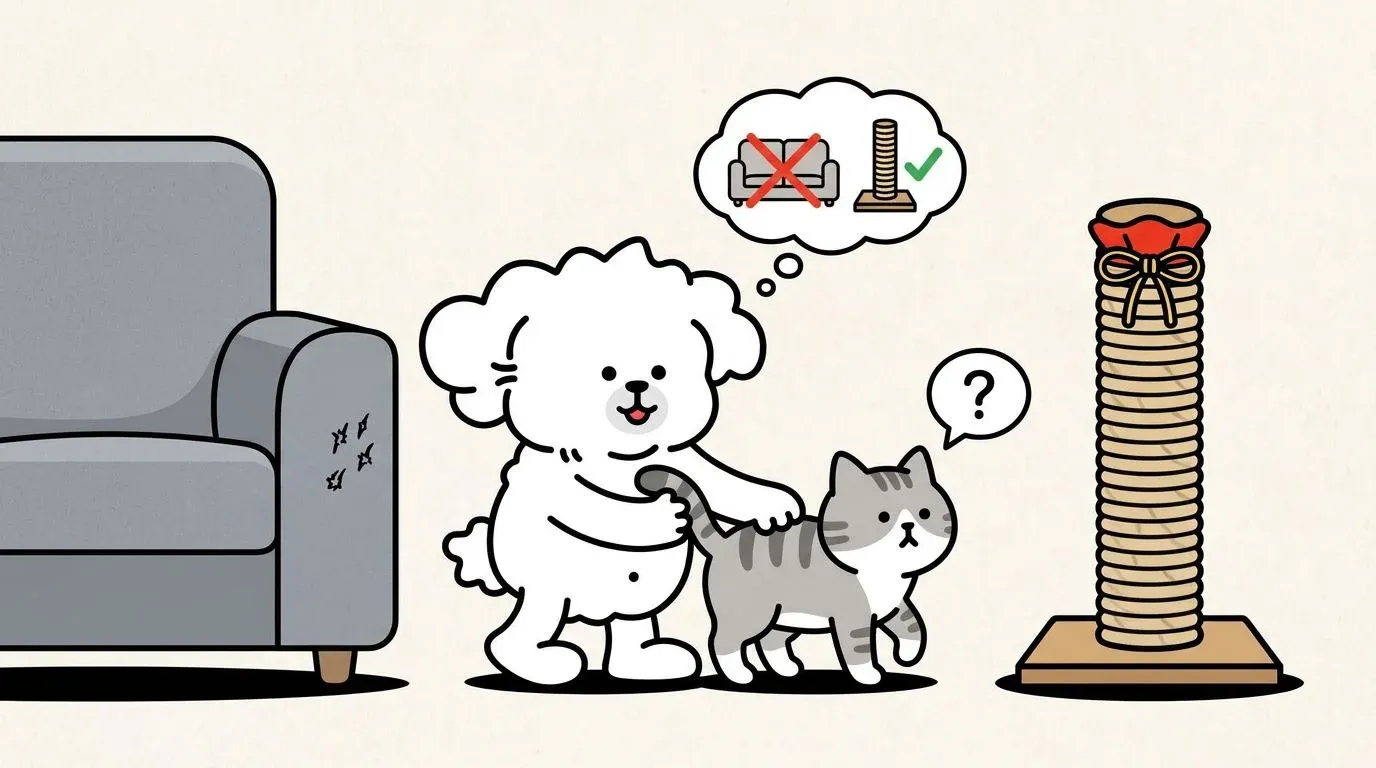
You’ve tried everything. You’ve yelled, you’ve clapped your hands, you’ve sprayed water — and your couch still looks like it went through a shredder. Sound familiar?
Here is the frustrating truth: the standard advice fails because it treats cat scratching as a discipline problem. It isn’t. Scratching is a biological drive, as fundamental to a cat as purring or grooming. You cannot eliminate it through punishment. But you can reliably redirect it — once you understand what’s actually driving it.
This guide explains the behavioral science behind cat scratching, why common responses make things worse, and a concrete five-step protocol backed by AAFP and ASPCA guidance that actually works.
The Shredded Sofa Problem — Why Cats Keep Scratching Your Furniture
Your cat is not scratching your furniture to spite you. That framing is understandable — especially when you watch them make eye contact and then drag their claws down the couch — but it leads directly to ineffective responses.
Furniture scratching is most common at specific moments: right after waking up, near entry points, and in areas where people spend the most time. These patterns are clues. They point to the biological functions scratching actually serves, which we will get to shortly. The key point right now is that your cat experiences a genuine physical need that has to go somewhere. Without appropriate outlets, it goes to your furniture.
Punishment Doesn’t Work — Here’s Why
Spraying a cat with water, making a loud noise, or pushing them off the furniture teaches the cat one thing: that you are present when a negative event occurs. It does not associate the punishment with the act of scratching. When you are not in the room, the scratching continues — often on the same surface.
There is a more damaging outcome. According to the American Association of Feline Practitioners (AAFP) behavioral health guidelines, aversive-based training in cats elevates cortisol levels and increases anxiety. Anxiety, as we will see, is one of the primary drivers of excessive scratching. Punishment for scratching can actually cause more scratching.
The Real Cost of Ignoring the Behavior
The other failure mode is waiting for the cat to “grow out of it.” Scratching behavior does not diminish with age — it becomes more entrenched. Each scratch deposits pheromones from interdigital glands on the paws. These chemical markers signal to the cat: this is a safe, established territory. The scent fades before humans can detect it but remains detectable to the cat for days. Every scratch on your sofa reinforces that the sofa is a preferred scratching location. The longer it continues, the stronger that association becomes.
The Wrong Response Makes It Worse — Breaking the Punishment Cycle
Understanding why punishment fails at a mechanistic level is worth the detour. It changes how you approach the problem.
How Punishment Increases Stress-Driven Scratching
Cats are not capable of connecting a punishment administered five seconds after a behavior with that behavior — particularly when the behavior (scratching) provided a satisfying physical and chemical reward. What they do register is that their environment has become unpredictable and threatening.
The American Veterinary Society of Animal Behavior (AVSAB) position statement on punishment explicitly states that aversive techniques used on cats are contraindicated when the underlying cause of a behavior is anxiety or stress-driven, because punishment increases the arousal state that caused the behavior in the first place. Stress scratching punished by a startling noise may briefly stop — and then resume at higher frequency as the cat’s stress level remains elevated.
The Stress-Scratch-Punish Loop
This dynamic creates a self-reinforcing cycle. Stress drives scratching. Punishment adds more stress. Increased stress drives more scratching. Owners escalate punishment, which escalates stress. The furniture continues to be destroyed, and the cat becomes increasingly anxious and reactive.
Breaking this loop requires addressing both sides simultaneously: reducing the stressor where possible, and redirecting the scratching to appropriate surfaces. Neither alone is as effective as both together.
For cats whose scratching is clearly anxiety-driven — triggered by changes in the household, new pets, or the owner’s absence — cat stress relief strategies can significantly reduce the overall behavioral load and make redirection training faster.
Why Cats Scratch — The Behavioral Science
Scratching serves four distinct biological functions. Understanding all four explains why a single scratching post in a corner is rarely enough, and why certain surfaces attract cats more than others.
Claw Sheath Maintenance and Nail Health
Cats’ claws grow in layers. The outer sheath — the dead, dull layer — must be regularly removed to expose the sharp new claw beneath. Scratching on a textured surface catches and pulls off the outer sheath efficiently. This is entirely non-optional from the cat’s perspective. A cat that cannot scratch to maintain its claws will scratch something. The question is what.
This also explains texture preferences. A surface with enough resistance to grip and strip the sheath is what the cat is looking for — which is why rough-textured materials like sisal rope, cardboard, and natural wood attract scratching more than smooth surfaces.
Scent Marking Through Interdigital Pheromones
The spaces between a cat’s toes contain scent glands that deposit species-specific chemical signals during scratching. These interdigital pheromones are invisible to humans but function as territorial communication: to your cat, a scratched surface says I was here, this is safe, this is mine.
Research by Ellis and Wells (2010) in Applied Animal Behaviour Science demonstrated that cats preferentially scratch areas already marked with their own scent, and show heightened scratching in response to stress that disrupts established territorial security. This is why cats scratch near doorways, windows, and the most-trafficked areas of the home — locations that require the strongest territorial signaling.
It also explains why commercial deterrent sprays containing synthetic territorial pheromones can reduce scratching on treated surfaces.
Full-Body Stretching and Musculoskeletal Health
A cat fully extended against a tall scratching surface is not just scratching — it is performing a full spinal and shoulder stretch that maintains musculoskeletal flexibility. Cats do this most predictably immediately upon waking, which is why you often see your cat go straight from a nap to the sofa arm.
This stretching function has a practical implication for scratching post selection: the post must be tall enough for your cat to fully extend at maximum height. Most commercially available posts are too short. The ASPCA recommends a minimum height of three feet for an adult cat.
Stress Relief and Emotional Expression
Scratching also functions as a displacement behavior — a way of managing emotional arousal. A cat that has just seen an outdoor cat through the window, heard an unfamiliar noise, or experienced a household conflict may scratch intensely as a way of processing and discharging that arousal.
Cats showing elevated stress will scratch more, scratch harder, and are less deterrable from inappropriate surfaces. This is the mechanism behind the stress-scratch link. Addressing underlying anxiety — whether from territorial conflict with other cats, separation-related distress, or environmental changes — is a necessary component of any lasting scratching solution.
The 5-Step Environmental Fix Backed by Behavioral Science
This protocol is aligned with AAFP behavioral health guidelines and ASPCA destructive scratching recommendations. It works by making appropriate scratching surfaces more attractive than the furniture, rather than trying to eliminate the behavior.
Step 1: Choose the Right Scratching Post (Material, Angle, Height)
Most post failures come down to three variables: material, orientation, and height.
Material: The majority of cats prefer sisal rope over carpet. Sisal provides enough texture to grip and strip the claw sheath effectively. Corrugated cardboard scratchers are effective for cats that prefer a horizontal scratching surface. Natural wood posts (with bark intact) work well for cats that scratch door frames. Avoid carpet-covered posts — carpet does not provide adequate texture for claw maintenance, and it teaches the cat that carpet-textured surfaces are acceptable scratching targets.
Orientation: Observe whether your cat scratches predominantly on vertical surfaces (sofa arms, door frames, carpeted stairs) or horizontal surfaces (rugs, mats). Vertical scratchers need tall, stable posts. Horizontal scratchers need flat pads or angled boards. Many cats use both.
Height: The post must allow full-body extension. For most domestic cats, this means a minimum of 28–36 inches. Critically, the post must be stable. If it wobbles when a cat leans on it, the cat will abandon it immediately and return to the furniture, which doesn’t move.
| Feature | Correct Choice | Common Mistake |
|---|---|---|
| Material | Sisal rope, corrugated cardboard, natural wood | Carpet, soft fabric |
| Height | 28–36 inches minimum | Short posts (under 18 inches) |
| Stability | Heavy base, no wobble under full weight | Lightweight, tips easily |
| Orientation | Match your cat’s current scratching angle | One type only for a multi-angle scratcher |
Step 2: Strategic Placement — Target Where Your Cat Wants to Scratch
The most effective placement for a new scratching post is directly adjacent to the furniture your cat currently scratches. Not across the room, not tucked in a corner — right next to the couch arm or chair leg.
Cats scratch where they spend time and where their scent already exists. Placing a post at the preferred scratching site means the cat encounters it naturally and during the moments when the scratching drive is highest. Once your cat is using the post consistently — typically within two to four weeks — you can begin shifting it a few inches per day toward a more convenient location.
Place additional posts near sleeping areas (cats scratch immediately upon waking), near food stations, and near entry points where territorial signaling is highest. The AAFP recommends one scratching surface per cat in a multi-cat household, plus one additional.
For cats with limited indoor environmental variety, enrichment activities that increase vertical space can reduce the territorial pressure that drives excessive scratching.
Step 3: Positive Reinforcement — Using Catnip and Treats Effectively
Catnip contains nepetalactone, which binds to feline olfactory receptors and triggers a mild euphoric response. Rubbing dried catnip or applying catnip spray to a new scratching post creates a strong initial attractant. Approximately 50–70% of adult cats respond to catnip (the trait is genetic); for non-responders, silver vine or valerian root serve a similar function.
Pair the catnip with food-based reinforcement. Each time your cat scratches the post instead of the furniture, immediately offer a high-value treat. This positive association accelerates learning and is far more effective than punishment-based deterrence alone. Clicker training — marking the scratching behavior with a click the moment the cat makes contact with the post, then treating — can speed the association in cats that respond well to marker training.
Do not punish scratching on the furniture during this transition period. Focus only on reinforcing the post. Redirecting attention to the correct surface is more efficient than creating aversion to the wrong one.
Step 4: Protect Existing Furniture — Temporary Deterrent Barriers
While the positive reinforcement protocol develops, physical deterrents on the targeted furniture protect surfaces and reduce your cat’s ability to strengthen the existing scent-marked preference.
Effective deterrents:
- Double-sided sticky tape applied to the scratched surface. Most cats find the tacky texture aversive. Commercial products like Sticky Paws are designed for this purpose and leave no residue on fabric.
- Transparent plastic furniture guards that cover the scratch zone. These eliminate the tactile feedback the cat seeks.
- Aluminum foil is a lower-cost option but visually disruptive to the room and less durable.
These work as temporary bridges, not permanent solutions. Once your cat is reliably using the designated post, the deterrents can be removed gradually. Remove them too early, and the established scent marks on the furniture will pull your cat back.
Step 5: Pheromone Management — Clean Existing Scratch Marks
The scent marks deposited during previous scratching episodes are a powerful ongoing attractant. Simply covering a surface is not enough if the underlying pheromones remain.
Clean previously scratched areas with an enzymatic cleaner designed to break down organic compounds. Standard household cleaners do not neutralize pheromones effectively. Apply the cleaner to both the scratched surface and the surrounding area — the scent field extends beyond the visible damage zone.
After cleaning, applying a synthetic calming pheromone spray (Feliway Classic or equivalent) to the furniture can replace the territorial stress pheromones with the facial-pheromone analog that signals security and familiarity. This reduces the anxiety-driven component of the scratching. Multiple studies have documented statistically significant reductions in stress-related scratching following pheromone diffuser use in the primary territory.
Pair this with regular nail trimming to reduce the physical effectiveness of scratching on your furniture. Blunt nails cause less damage and may reduce the satisfaction of scratching inappropriate surfaces, nudging your cat toward the textured post.
Why Declawing Is Not the Answer
In English-speaking countries, declawing remains a topic of active debate — though the professional consensus has shifted decisively. Understanding what declawing involves and its documented consequences is essential before considering it as an option.
What Declawing Actually Involves
Declawing (onychectomy) is not a nail removal procedure. It is the surgical amputation of the third phalanx — the last bone segment — of each toe. A meaningful analogy: it is equivalent to amputating every human finger at the first knuckle.
The surgery is performed under general anesthesia and carries the standard risks of any surgical procedure in a small animal. Post-operative pain management requires several days of analgesics. Recovery time is typically two to six weeks, during which the cat walks on healing surgical wounds with every step.
The AVMA’s 2016 literature review identified several categories of documented post-surgical complications: paw pain, lameness, and abnormal weight-bearing gait; wound dehiscence; nerve damage; and regrowth complications when the entire phalanx is not cleanly removed.
Behavioral Consequences of Declawing
The behavioral consequences documented in veterinary literature are significant. Patronek (2001) reported that relinquishment to shelters was significantly more common in declawed cats, with owners citing increased aggression and litter box avoidance as reasons.
The mechanism is not difficult to understand. Cats use claws for balance, grip, and — critically — defense. A cat that has lost its primary defensive tool and still experiences pain when walking may respond by increasing bite-based aggression. Litter box avoidance is common because the granular texture of litter against healing or sensitive paws is aversive.
The ASPCA, AVMA, and AAFP all oppose routine elective declawing. The AAFP’s 2017 position statement formally designates it as a procedure that “is not considered an appropriate solution for normal scratching behavior.” Several US cities and the entire state of New York have passed legislation restricting or banning the procedure. Fourteen countries have banned it outright.
Behavioral modification — using the protocol described above — is effective, non-invasive, and produces lasting results without surgical risk or behavioral side effects.
When to See a Veterinarian About Excessive Scratching
Most scratching problems are behavioral and respond to the protocol above. But certain patterns warrant veterinary evaluation.
Sudden onset of new or dramatically increased scratching in an adult cat with no obvious environmental trigger can indicate a medical issue. Skin conditions, allergic reactions, fungal infections (ringworm), and ectoparasite infestations (mites) all cause dermal irritation that increases scratching and grooming. Pain in the extremities — paw injuries, arthritis in the carpals — can cause cats to scratch differently or at unusual sites.
Scratching behavior paired with limping, excessive licking of the paws, visible skin changes, or hair loss near the legs and paws should always prompt a vet visit.
Behavioral scratching that does not respond to eight to twelve weeks of consistent redirection training is worth discussing with a veterinary behaviorist. Some cats have underlying anxiety disorders — particularly those linked to separation-related distress — where pharmaceutical support alongside behavioral modification produces significantly better outcomes than either approach alone.
In multi-cat households where one cat is scratching dramatically more than others, consider whether that cat is experiencing chronic low-level stress from resource competition or territorial conflict. Social dynamics are a frequently missed driver of excessive scratching in households with more than two cats.
The goal is to work with your cat’s biology rather than against it. Scratching is not going away — but with the right surfaces in the right places, it will go exactly where you want it.
FAQ
Why does my cat scratch furniture instead of the scratching post?
Does double-sided tape actually stop cats from scratching furniture?
How long does it take to redirect a cat's scratching to a post?
Is declawing a safe or humane solution for cat scratching?
Can cats scratch furniture because of stress or anxiety?
Related Articles
Dog Lethargy Causes: When Slowing Down Signals More Than Just Aging
Learn how to distinguish normal dog tiredness from true lethargy, identify dog lethargy causes by age, and know which signs need emergency vet care.
Veterinary Guide to Cat Overgrooming: Causes, Treatment, and When to Worry
Cat overgrooming causes range from allergies to anxiety. This vet-backed guide covers diagnosis, body-area mapping, treatment options, and when to see a doctor.
Does Your Senior Dog Have Dementia? A Veterinary Guide to Canine Cognitive Dysfunction
Learn the 7 DISHAAL domains to assess dog dementia symptoms at home, understand evidence-based treatment options, and know when to call your vet.
Dog Noise Phobia Treatment: Thunder and Fireworks Guide
Step-by-step guide to treating dog noise phobia from thunder and fireworks. Desensitization protocol, tool comparisons, and when to see a vet.
Is Your Dog in Pain? 7 Subtle Signs Most Owners Miss
Learn the 7 behavioral signs your dog is in pain that are easy to overlook, how to tell acute from chronic pain, and what to do before your vet visit.
Dog Separation Anxiety Guide: Symptoms, Training, and Help
Learn how to identify dog separation anxiety symptoms, follow a vet-backed step-by-step training plan, and know when medication or a specialist is needed.
Dog Walk Refusal: Is It Behavior or Hidden Joint Pain?
Dog walk refusal may signal arthritis, hip dysplasia, or IVDD. Use our 10-point checklist to tell behavioral causes from joint pain—and what to do next.
If Your Dog Won't Stop Barking: Type-by-Type Training Guide
Stop dog barking by identifying the type. 5 types, targeted training protocols, and realistic timelines — evidence-based guide for dog owners.
Transform Your Indoor Cat's Behavior and Health by Redesigning Their Play Environment
Use the AAFP/ISFM Five Pillars framework to build a science-backed indoor cat enrichment plan—from hunting sequence play design to sensory stimulation and behavior monitoring.
How to Start Nose Work with Your Dog: A Step-by-Step Beginner's Guide
Learn how to start nose work with your dog using a 5-stage progressive protocol. From palm treat finds to outdoor scent detection — start today with no special equipment.
How to Introduce Cats: A Step-by-Step Guide From Isolation to Harmony
Learn how to introduce cats using a proven 5-step protocol with clear timeline ranges, age and sex strategies, and a failed-introduction recovery plan.
Dog Coprophagia: Why Dogs Eat Poop and How to Stop It
Dog coprophagia affects 1 in 6 dogs. Learn the three types, their distinct causes, evidence-based correction protocols, and why most deterrents don't work.
How to Crate Train Your Dog: A Step-by-Step Guide from First Introduction to Calm Alone Time
Learn how to crate train a dog with a 5-step protocol, age-based time limits, and troubleshooting for crying, crate aversion, and accidents.
Loose Leash Walking Training: 5 Steps to Stop Dog Pulling
Stop your dog pulling on walks with this 5-stage loose leash walking training guide — from indoor introduction to real-world heel, with troubleshooting.
Is Your Dog Guarding More Than Just the Food Bowl? Types of Resource Guarding and How to Fix Them
Dog resource guarding goes beyond food bowls. Learn the 4 types, a severity assessment framework, and type-specific training protocols to stop guarding safely.
Bringing Home a New Puppy? The Complete Socialization Training Guide You Need
Learn the science behind puppy socialization windows, get a week-by-week timeline, and discover safe pre-vaccination methods with a practical category-based checklist.
Cat Meowing at Night: 3 Common Responses That Make It Worse
Cat meowing at night is disrupting your sleep—and your usual fixes may be making it worse. Learn the behavioral science behind night crying and a 4-step evening routine that actually works.
How to Potty Train a Puppy: The Complete Guide for First-Time Dog Owners
Learn how to potty train a puppy with crate training, bell training, nighttime protocols, regression fixes, and tips for apartment living and rescue dogs.
How to Stop Puppy Biting: Age-by-Age Training Guide
Learn how to stop puppy biting with science-backed methods, age-specific protocols from 8 weeks to adulthood, and a step-by-step training system.
Does Your Cat Have Separation Anxiety? Signs to Watch and How to Help
Learn the real signs of cat separation anxiety symptoms, how to tell anxiety apart from boredom, and a week-by-week desensitization protocol you can start today.
Dog Excessive Licking Causes: Normal vs. Concerning Signs
Dog excessive licking causes include skin allergies, joint pain, anxiety, and GI distress. Learn the body-region diagnostic map and when to call a vet.
If Your Cat Keeps Biting: Types of Aggression and How to Respond
Discover why your cat bites, how to identify all 6 types of cat aggression, and evidence-based strategies to stop cat biting — including petting threshold signals.