 Cirius Petpedia
 5 Reasons Your Dog Marks Inside and Proven Ways to Stop It
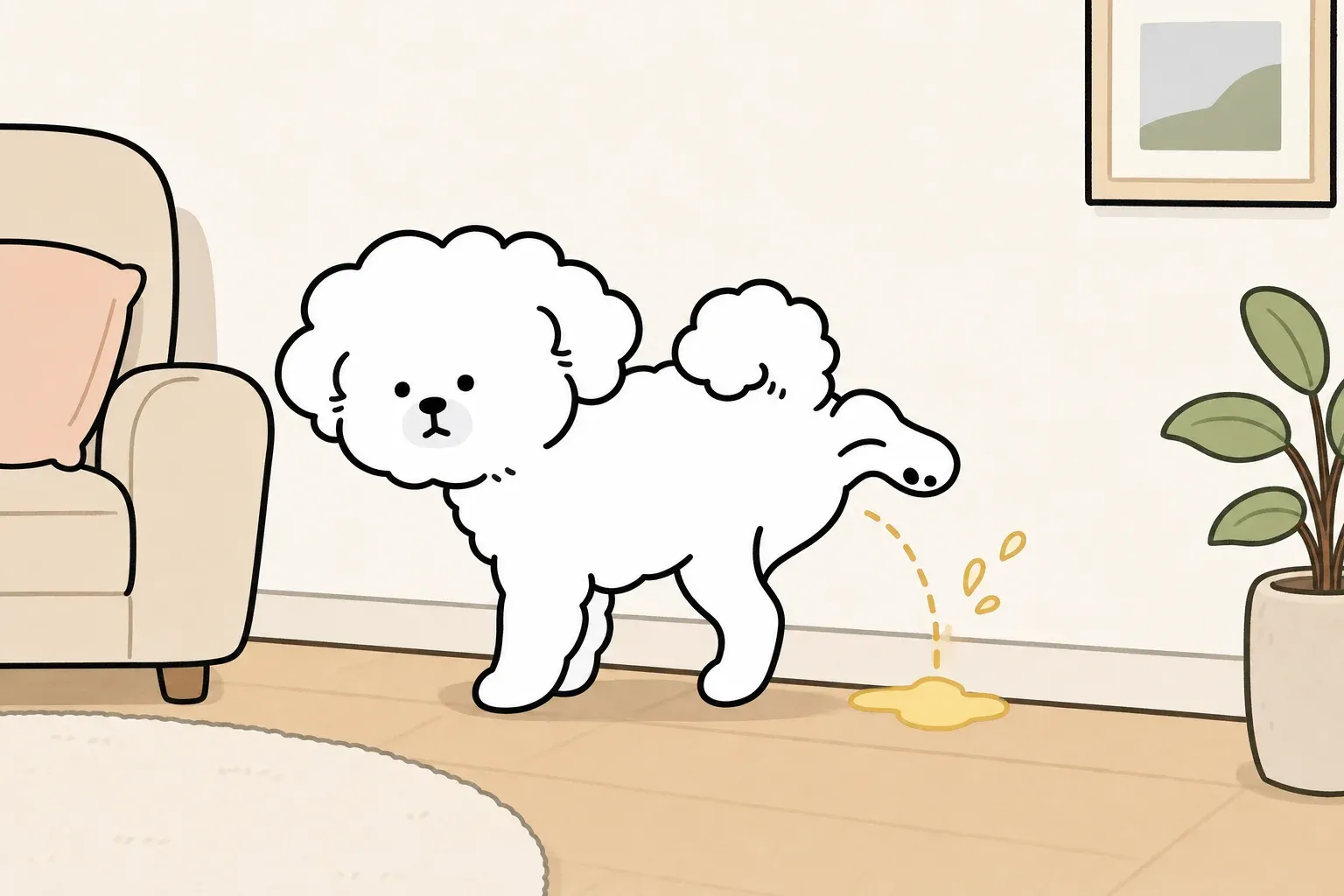
You’ve cleaned the same spot on the baseboard three times this week. You’ve moved the furniture. You’ve scolded, redirected, and tried every tip you’ve read online. And your dog is still marking indoors.
This is one of the most frustrating situations in dog ownership — not because it’s rare, but because most available advice treats it as a single, uniform problem with a single fix. It isn’t. Indoor marking has at least five distinct causes, and the strategy that works for one cause can be completely ineffective for another.
This guide gives you a structured way to identify what’s actually driving the behavior in your dog, then apply the right correction approach from the start — including a 4-week plan and the research on neutering you need to know before making that decision.
What Is Marking and How Is It Different from Accidents
Before you can fix the problem, you need to confirm you’re actually dealing with marking. Many owners assume any indoor urination is a housetraining failure, when the mechanism and the solution are fundamentally different.
Characteristics of Marking Behavior
Urine marking is a communication behavior. Dogs use urine to deposit chemical signals — pheromones — that carry information about identity, reproductive status, and territorial presence. When a dog marks indoors, they are responding to a social or environmental trigger, not a need to relieve a full bladder.
The physical signs distinguish marking from accidents quite clearly:
- Small urine volume. Marking deposits are typically a few drops to a small splash, not the full emptying of a bladder.
- Vertical surface preference. Chair legs, table bases, wall corners, door frames, and the sides of furniture are common targets.
- Target specificity. Marking tends to concentrate on objects with social significance: new items brought into the home, spots where guests have stood, areas another pet has been.
- Posture. Males typically leg-lift; females may squat with a slightly raised posture or mark while squatting normally.
Marking vs. Housetraining Accidents: A Quick Diagnostic Checklist
Use this checklist to identify which issue you’re dealing with:
| Factor | Marking | Housetraining Accident |
|---|---|---|
| Volume of urine | Small (drops to splash) | Large (full bladder) |
| Surfaces targeted | Vertical (walls, legs) | Horizontal (floor, carpet) |
| Location pattern | Specific spots/objects | Random or near exits |
| Triggers | Social events, new items | Delay in outdoor access |
| Dog’s age | Often adolescent–adult | Any age |
| Bladder control otherwise | Normal | May be incomplete |
If your dog hits vertical surfaces in small amounts near socially significant objects, you’re dealing with marking. If the issue is larger volumes in open floor areas, revisit foundational housetraining practices first, as the correction paths differ.
5 Common Causes of Indoor Marking
Identifying the cause is the most important step in this process. Each cause has a different behavioral driver, and a strategy that targets the wrong driver will produce minimal results.
Hormonal Triggers: Sexual Maturity and Reproductive Instincts
This is the most common cause in intact male dogs and intact females during or near their heat cycle. As dogs reach sexual maturity — typically between 6 and 12 months in smaller breeds, up to 18 months in larger ones — sex hormones drive a surge in territorial signaling behaviors. Urine marking is a primary outlet.
In intact males, testosterone increases the motivation to deposit scent signals, particularly in response to detecting the pheromones of female dogs in heat. An intact male who smells a female in heat through an open window or from a neighbor’s yard may begin marking intensively inside the home.
Intact females mark most frequently during proestrus and estrus, using urine to signal reproductive availability. The behavior typically subsides after the cycle ends.
Distinguishing signs: Sudden onset at sexual maturity, often accompanied by other hormonal behaviors such as mounting or humping, leg-lifting in males, restlessness, or attempts to escape the yard.
Territorial Response: New Objects, Visitors, Environmental Changes
Dogs treat their home as a defined territory. When that territory is perceived as under social pressure — a new person, another animal’s scent, an unfamiliar object — marking is the behavioral response. This is not aggression; it is the canine equivalent of asserting presence.
Common triggers in this category include:
- A new piece of furniture or a delivered package
- Guests (especially those accompanied by pets)
- Holiday gatherings with multiple visitors
- Another dog or cat introduced to the home, even temporarily
- Items that carry unfamiliar scents (secondhand furniture, borrowed equipment)
Distinguishing signs: Marking directed specifically at new objects or areas recently occupied by visitors. The dog is otherwise calm and not showing anxiety symptoms.
Anxiety and Stress: Moving, Separation Anxiety, Schedule Changes
Anxiety-driven marking is frequently misread as territorial behavior, but the underlying trigger is insecurity rather than assertion. Dogs experiencing chronic stress may increase marking as a self-soothing mechanism — familiar scent provides a sense of comfort and continuity in an uncertain environment.
Common anxiety triggers for indoor marking include:
- Moving to a new home
- A significant change in the owner’s schedule
- Construction or renovation noise
- Introduction of a new baby or major household change
- Separation anxiety (marking may cluster near exits or owner’s belongings)
Dogs with separation anxiety often mark near doors, on their owner’s clothing, or on the couch — places where owner scent is concentrated. This is distinct from territorial marking and requires addressing the root anxiety rather than purely managing the behavior.
Distinguishing signs: Marking associated with specific anxiety triggers; other anxiety symptoms present such as pacing, destructive behavior, or excessive vocalization.
Social Conflict: Multi-Dog Households and Hierarchy
In households with multiple dogs, marking can reflect social competition. When hierarchy is unclear or actively being contested, dogs may mark to assert status. This often escalates when a new dog is introduced, during adolescence of a younger dog, or when an older dog’s health declines.
This type of marking tends to involve dogs “over-marking” each other’s spots — depositing urine on or directly adjacent to where another dog has urinated.
Distinguishing signs: Marking observed primarily between specific dogs in the household; escalates during periods of social tension; dogs may also show other signs of status-related conflict such as resource guarding or staring.
Medical Issues: Ruling Out UTIs and Bladder Problems
This cause is critical to rule out before starting any behavioral correction. Urinary tract infections, bladder stones, and incontinence can all produce frequent, small-volume urination that appears identical to marking. Treating a medical condition as a behavioral problem delays appropriate care and causes unnecessary frustration.
If your dog is showing any of the following signs alongside increased urination, schedule a veterinary appointment before beginning behavioral correction:
- Straining or discomfort when urinating
- Blood in the urine
- Sudden onset with no clear behavioral trigger
- More frequent urination than usual, including outdoors
- Licking at the genitals
Urinary tract infections and bladder inflammation are common in dogs and are fully treatable. Once a medical cause is ruled out, behavioral work can begin on a clean diagnostic baseline.
What Happens When Marking Goes Uncorrected
Understanding the consequences of inaction matters here, not to alarm you, but because the behavioral dynamics of marking make early intervention genuinely more effective than delayed correction.
Habit Reinforcement and Expanding Marking Zones
Each time a dog successfully marks a spot, the behavior is reinforced. The act of depositing a scent mark is intrinsically rewarding for dogs — it satisfies the communicative drive that triggered the behavior. Over time, what begins as a response to a specific trigger can generalize into a habitual route through the house.
Research on habit formation in canine behavior confirms that behaviors repeated in consistent contexts become increasingly automatic. A dog who marks the same three spots every morning is not making a deliberate decision; the environmental cues now trigger the behavior with minimal cognitive engagement. This is why early correction, before routes and rituals become established, is substantially more effective.
Odor Buildup and the Re-Marking Cycle
Urine contains uric acid crystals that bind to porous surfaces — carpet fibers, wood, grout, fabric upholstery — and are not fully removed by standard household cleaners. The residual scent is detectable to dogs even after surfaces appear clean to humans.
When a dog detects their own or another dog’s scent on a previously marked spot, the olfactory cue actively triggers re-marking. This is the re-marking cycle: the physical traces of past marking create the conditions for future marking. Without enzymatic treatment to break down uric acid at the molecular level, you are continually working against this cycle.
Strain on the Human-Dog Bond
The emotional cost of chronic indoor marking is real. Owners who feel like they’ve tried everything and nothing works are at risk of responding with escalating frustration, inconsistency, or — in some cases — giving up on the dog entirely.
The American Veterinary Society of Animal Behavior (AVSAB) consistently emphasizes that punishment-based responses to marking are ineffective and counterproductive. Punishing a dog after the fact (more than a few seconds after the behavior) does not connect cause and consequence in the dog’s mind; it simply increases anxiety, which can worsen anxiety-driven marking. Understanding the behavioral mechanics helps reframe the response from discipline to management and training.
Cause-Specific Correction Strategies
Now that you’ve identified what’s driving the behavior, here are the strategies organized by mechanism. Most cases will require combining two or three of these approaches.
Interrupting and Redirecting the Behavior
If you catch your dog in the act of marking, a calm, immediate interruption followed by redirection is the most effective in-the-moment tool. The goal is to interrupt the behavior before it completes, then guide your dog outside to finish eliminating and offer immediate positive reinforcement.
A firm “no” or hand clap to interrupt, followed by calmly leading the dog outdoors, is sufficient. The critical elements are:
- Immediacy. The interruption must occur during the behavior, not after.
- Calmness. Excitement or anger escalates the dog’s arousal state, which can worsen marking.
- Redirection. Always follow interruption with an opportunity to eliminate correctly and receive a reward.
Punishment after the fact — discovering a spot and reacting to it — does not teach the dog anything useful and can damage trust.
Environmental Management: Blocking Access and Enzymatic Cleaners
Management reduces the dog’s opportunity to practice marking while training is underway. This is not a solution in itself, but it prevents reinforcement of the behavior during the correction period.
Effective management tools:
- Restrict access. Keep the dog in rooms where they can be supervised. Use baby gates or closed doors to limit access to frequently marked areas.
- Use a leash indoors. Tethering your dog to you or a nearby anchor point prevents unsupervised marking and keeps them in your field of view.
- Belly bands (for male dogs). A belly band is a wrap that prevents urine from reaching surfaces if the dog begins to mark. Important caveat: a belly band is a management tool, not a training solution. It does not address the behavior; it prevents the deposit. Remove it periodically for outdoor elimination and wash it regularly to avoid skin irritation.
- Enzymatic cleaners on all previously marked spots. Apply an enzymatic cleaner to every known marking site, following the manufacturer’s instructions for soaking time. Allow to air dry rather than blotting dry immediately, as the enzyme action continues during the drying process.
Positive Reinforcement: Rewarding Correct Elimination
Every time your dog eliminates appropriately outdoors, mark the behavior immediately (a verbal “yes” or clicker) and offer a high-value reward. The goal is to build the association that outdoor elimination is far more rewarding than any indoor option.
This approach is grounded in the AVSAB’s position on humane behavior modification: behavior that is reliably rewarded becomes the preferred behavior. For marking driven by habit or territorial impulse, consistent positive reinforcement for correct elimination progressively weakens the marking habit by replacing it with a stronger rewarded behavior.
For anxious dogs, outdoor elimination rewards also help build confidence in the outdoor environment — addressing both the behavior and the underlying emotional state.
Belly Bands: When to Use and Important Caveats
Belly bands are most useful during the early weeks of correction when you cannot provide full supervision, or for owners managing high-frequency markers while building consistent routines. They are not appropriate as a long-term solution, as they can delay behavioral resolution if used as a substitute for training.
Use belly bands:
- During the first two weeks of your correction plan when management is essential
- In situations you cannot supervise (brief periods away from home)
- As a temporary bridge while awaiting a veterinary or behavioral consultation
Do not use belly bands as a permanent solution. A dog wearing a belly band is not learning not to mark — they are being physically prevented from completing the behavior without any associated learning.
Spaying, Neutering, and Marking: What the Research Says
Neutering is frequently presented as the definitive solution to indoor marking. The reality is more nuanced, and understanding the evidence helps set realistic expectations.
Data on Post-Neutering Marking Reduction
The research on neutering and marking behavior shows meaningful but variable results. A landmark study by Hopkins, Schubert, and Hart (1976) found that castration reduced or eliminated indoor urine marking in approximately 50% of male dogs. More recent systematic reviews have noted similar ranges: roughly 50–60% of neutered males show significant reduction in marking behavior post-surgery.
These numbers are encouraging but important to interpret correctly. Neutering reliably reduces the hormonal component of marking. It does not reliably eliminate marking that has become a learned behavioral habit independent of hormonal drive.
When Marking Is Already a Learned Habit
The critical variable is the age at neutering relative to the onset of marking. Dogs who are neutered before marking behavior is established show the greatest benefit. Dogs who have been marking regularly for months or years before neutering are operating from a learned behavior pattern that has become partially or fully independent of testosterone levels.
This is why the VCA Animal Hospitals and AKC both note that neutering alone is insufficient for established markers. Behavioral training must accompany or follow surgery for reliable results.
Optimal Timing and Veterinary Consultation
If your dog has not yet begun marking, early neutering is one of the most effective preventive measures available. If marking is already occurring, consult your veterinarian about the interplay between hormonal status and behavioral training before making a surgical decision in isolation.
For complete information on the health considerations around spaying and neutering, including breed-specific timing recommendations, see our guide on spaying and neutering decisions.
Your 4-Week Marking Correction Plan
This structured timeline gives you a concrete framework rather than a list of abstract tips. It is designed to be adapted to your specific dog’s cause category — adjust emphasis based on whether you’re dealing with hormonal, territorial, anxiety, or habit-based marking.
Week 1: Environment Setup and Behavior Logging
The first week is about gathering data and removing the conditions that allow marking to continue unchecked.
Environment setup:
- Deep-clean all known marking sites with an enzymatic cleaner. Treat every spot once per day for three consecutive days.
- Install baby gates to restrict access to high-frequency marking zones.
- Begin indoor leash tethering during unsupervised moments.
- Apply belly bands if the frequency is high enough to make constant supervision impractical.
Behavior logging: Keep a simple daily log noting:
- Time of marking incidents
- Location
- What preceded the event (visitor, new object, owner absence, etc.)
- Dog’s observable state (calm, aroused, anxious)
This log will reveal patterns that make the cause category clearer and show progress over time.
Outdoor reinforcement: Begin rewarding every outdoor elimination immediately and consistently. Use a high-value treat (small piece of chicken, cheese, or commercial high-reward treat) delivered within 2 seconds of the behavior.
Weeks 2–3: Focused Correction Training
With the environment managed and patterns identified, shift focus to active training.
Interruption protocol: Practice catching and interrupting marking attempts. Remain calm, use a consistent verbal cue to interrupt, and immediately redirect outdoors.
Cause-specific focus:
- Hormonal marking: Consider veterinary consultation regarding neutering if not already done. Continue environmental management and positive reinforcement as the primary tools.
- Territorial marking: Desensitize your dog to common triggers by controlled exposure. If visitors trigger marking, practice calm greetings with guests instructed not to make direct eye contact with the dog initially. Remove new objects from the environment until the dog adjusts, then reintroduce gradually.
- Anxiety-driven marking: Addressing the root anxiety is essential. Consult a veterinarian about whether pharmaceutical support (e.g., short-term anti-anxiety medication) is appropriate alongside behavioral modification.
- Multi-dog conflict: Work with each dog individually on impulse control, establish clear routine feeding and resource access, and avoid situations that escalate competitive tension.
Expand access gradually: As indoor marking incidents decrease, slowly reintroduce access to previously restricted areas under supervision.
Crate training as a management tool: A properly introduced crate provides a management solution during periods when full supervision is not possible, while also supporting house-routine structure that benefits marking correction.
Week 4: Maintenance and Relapse Prevention
By week 4, most dogs with consistent management and training show measurable improvement. This week shifts focus to consolidation and preventing regression.
Assessment: Review your behavior log. Count the weekly frequency of incidents across weeks 1–4. A decline of 50–70% or more indicates the plan is working.
Maintenance reinforcement: Continue rewarding outdoor elimination, but you can begin to shift from food rewards to intermittent reinforcement (every 2nd or 3rd successful elimination), which actually strengthens the behavior over time.
Relapse management: If incidents increase in week 4, return to the environmental management tools of week 1 and identify what changed. Common relapse triggers include a visitor, a schedule disruption, or relaxing supervision too quickly.
Spot check: Re-treat any areas with enzymatic cleaner that showed activity during the correction period.
When to Seek Professional Help
The 4-week plan works for the majority of indoor marking cases when the cause is correctly identified and the approach is consistent. Some situations require professional support.
Signs It’s Time for a Vet Visit
Schedule a veterinary appointment if:
- Marking began suddenly with no clear behavioral trigger
- Your dog strains, vocalizes, or appears uncomfortable when urinating
- You notice blood in the urine or unusual odor
- The dog is urinating more frequently than their normal baseline, indoors and outdoors
- Marking is accompanied by changes in thirst, appetite, or energy level
These signs suggest a medical component — urinary conditions, hormonal disorders, or neurological issues — that behavioral training cannot address.
When to Consult an Animal Behaviorist
Consider a consultation with a certified applied animal behaviorist (CAAB) or a veterinary behaviorist (DACVB) if:
- Marking persists beyond 6–8 weeks of consistent, cause-targeted correction
- Anxiety appears to be the primary driver and is not improving with environmental modification
- The behavior is escalating rather than stabilizing
- There is significant inter-dog conflict in the household that is beyond basic management
A professional assessment can identify factors that are not visible to owners and provide a tailored protocol, sometimes including pharmaceutical support alongside behavioral modification.
Veterinary behaviorists in particular are trained to address the intersection of medical and behavioral factors — a significant advantage in complex cases where the cause category is unclear.
References
FAQ
Why is my neutered dog still marking indoors?
Do female dogs mark indoors?
How do I know if my dog is marking or just having accidents?
How long does it take to stop indoor marking?
Can enzymatic cleaners really prevent re-marking?
Related Articles
How to Potty Train a Puppy: The Complete Guide for First-Time Dog Owners
Learn how to potty train a puppy with crate training, bell training, nighttime protocols, regression fixes, and tips for apartment living and rescue dogs.

[2026] Dog Neutering and Spaying Guide: Timing, Cost, Pros, Cons, and Recovery
The complete dog neutering guide for 2026: breed-size timing tables, cost breakdown by weight, day-by-day recovery timeline, evidence-based pros and cons, and weight management after surgery.

Dog Separation Anxiety Guide: Symptoms, Training, and Help
Learn how to identify dog separation anxiety symptoms, follow a vet-backed step-by-step training plan, and know when medication or a specialist is needed.