 Cirius Petpedia
 How to Stop Dog Mounting for Good: Understanding Why It Happens and What to Do
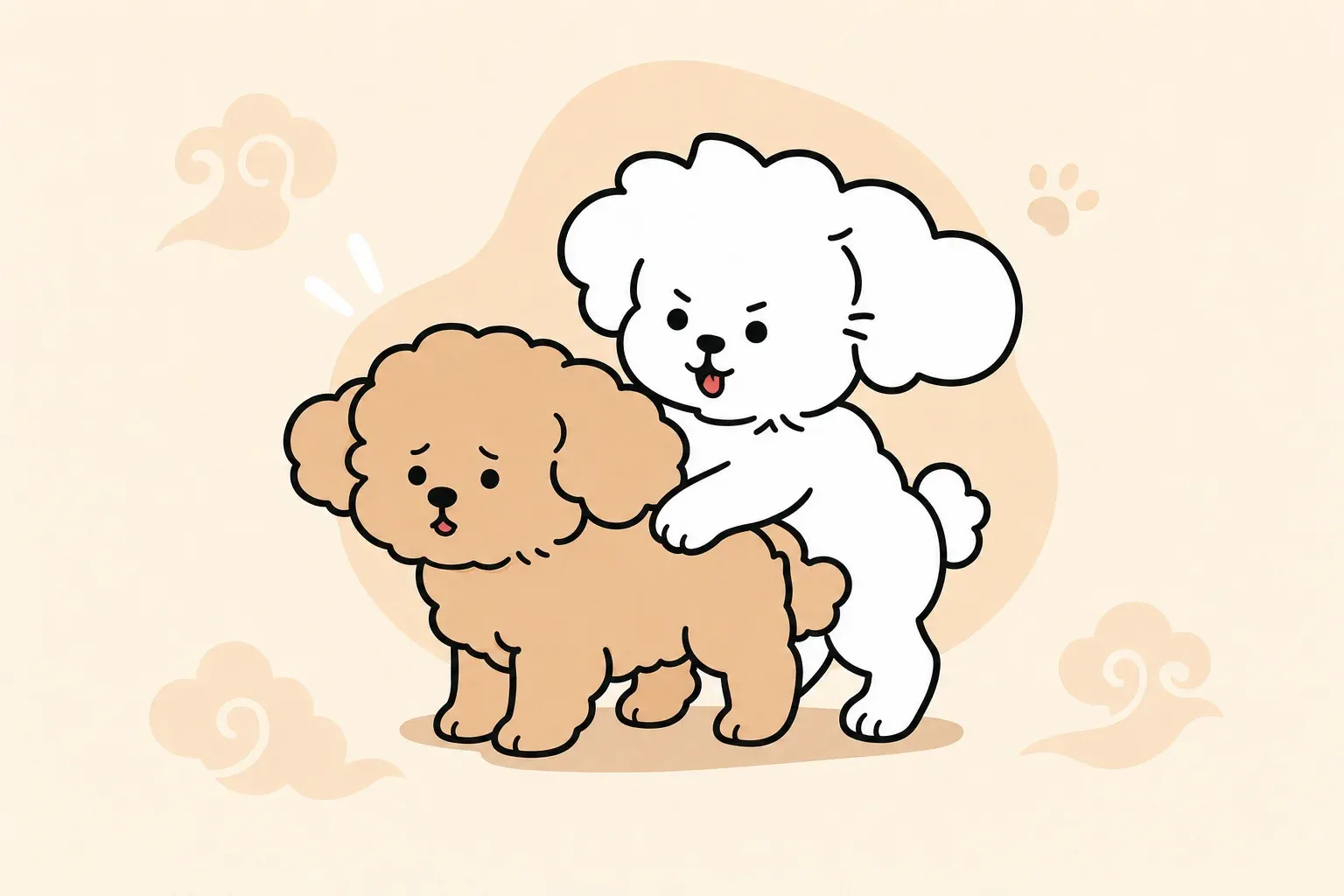
Mounting is one of the behaviors dog owners are most embarrassed by and least sure how to handle. If your dog humps other dogs, visitors, or the sofa cushions, you are not alone — and you have not failed as an owner. The behavior is common, well-studied, and in most cases, addressable with the right approach.
What trips people up is starting with the wrong explanation. Most mounting has nothing to do with sex, and almost none of it is about dominance. Understanding why your dog hump is actually happening is the essential first step, because the correct response depends entirely on the cause.
This guide covers all of it: what mounting actually is, the five real reasons dogs do it, what modern science says about the dominance theory, when mounting signals a health problem, how the behavior varies by age and sex, and a concrete step-by-step plan for stopping it.
What Is Mounting? (It’s Not Always What You Think)
Mounting — also called humping — is a coordinated motor behavior in which a dog clasps another dog, a person, an object, or empty air with its forelimbs and performs pelvic thrusting. The same neural circuitry underlies both sexual and non-sexual mounting, which is why the behavior looks identical regardless of its actual motivation.
That similarity is the source of most owner confusion. Seeing a dog mount another dog or a person immediately reads as sexual behavior, which triggers embarrassment or concern. But the motor pattern and the underlying motivation are separate things. A dog humping a pillow at 3 in the afternoon after a long play session is almost certainly not experiencing sexual arousal — it is releasing pent-up physical energy through a familiar motor routine.
The ASPCA and most veterinary behaviorists characterize mounting as a normal behavior that becomes a problem only when it is frequent, directed at inappropriate targets, or interfering with social interactions. The goal is not to eliminate an instinct, but to redirect a habit.
Why Do Dogs Hump? The 5 Real Reasons
Identifying which of these five drives is active in your dog is the most useful thing you can do before deciding how to respond. In many cases, the answer is more than one.
Overexcitement and Overstimulation
This is the most common cause in companion dogs. When a dog becomes intensely aroused — by a visitor arriving, a dog park visit, rough play, or a high-energy interaction — its nervous system needs an outlet. Mounting is a physical release valve.
Observable pattern: mounting occurs specifically during or immediately after exciting events. The dog may also show other arousal signals — panting, jumping, barking, inability to settle, hard eyes. Once the excitement fades, the mounting usually stops without intervention. If overexcitement is a recurring issue, addressing overall arousal thresholds makes a significant difference.
Stress and Anxiety Response
Counterintuitively, mounting can be a stress-displacement behavior. When a dog encounters a situation that creates conflict or anxiety — an unfamiliar dog, a crowded environment, an unpredictable social interaction — it may mount as a way of discharging tension.
Observable pattern: mounting occurs in ambiguous social situations rather than clearly positive ones. The dog may appear conflicted — ears back, low tail, brief mounting rather than sustained. If stress and anxiety are underlying patterns for your dog, the mounting is a symptom rather than the primary problem.
Play Behavior and Social Interaction
Young dogs and socially confident adults sometimes use mounting as a play bid or during roughhousing. This is especially common in play-deprived dogs or those that did not complete normal social development.
Observable pattern: mounting is directed at known dogs during active play. The target dog typically has the opportunity to correct or disengage. Problems arise when the mounting dog ignores correction signals, in which case it reflects poor social reading rather than play intent. Dog socialization training addresses the underlying communication gaps.
Hormonal Drives (Intact Dogs)
Sexually intact male dogs have significantly elevated testosterone levels, which increases the likelihood of mounting directed at females in estrus. This is the version most people expect. However, even intact dogs mount for all of the non-sexual reasons above, and the hormonal component is often less dominant than owners assume.
Observable pattern: persistent mounting directed toward intact females, especially seasonal increases. Marking, roaming interest, and reactivity to other males may co-occur. If indoor marking is also increasing alongside mounting, see the guide on stopping dog marking in the house for cause-specific correction strategies. The relationship between hormones and mounting is discussed further in the neutering section below.
Attention-Seeking (Learned Behavior)
This cause is almost entirely owner-created, unintentionally. The first time a puppy or dog mounts a person, the natural human response is animated — laughing, gasping, pushing the dog away, saying its name. From the dog’s perspective, mounting just produced a highly interesting response from the person it most wants attention from.
Over time, the dog learns that mounting reliably generates interaction. Even negative attention — being pushed, scolded, or physically removed — can reinforce the behavior in attention-hungry dogs.
Observable pattern: mounting is specifically directed at the owner or particular people, often when the owner is distracted (on a phone, working), and the dog’s everyday needs for interaction may be inconsistently met.
The Dominance Myth: What Science Actually Says
The idea that dogs mount to assert dominance over other dogs or their owners was mainstream advice for decades. It is no longer consistent with how behavioral scientists understand dog social behavior.
The “alpha dog” or “dominance hierarchy” model was imported from early wolf research, which has since been substantially revised even within wolf biology. Applying it to domestic dogs created further problems. A landmark 2009 paper by Bradshaw, Blackwell, and Casey in the journal Animal Cognition examined whether domestic dogs organize their social relationships around stable, linear dominance hierarchies and found the evidence unsupportive. Dog social relationships are contextual, fluid, and highly individual — not structured around consistent rank.
The American Veterinary Society of Animal Behavior’s position statement on humane dog training explicitly states that dominance theory-based interventions — which include alpha rolls, physical confrontation, and punishment for “asserting dominance” — carry real risks of increasing anxiety and aggression, and are not grounded in current behavioral science.
What this means practically: if your dog mounts, responding by physically pinning it, staring it down, or using other “dominance-based” corrections is not only unlikely to work — it may worsen the underlying state driving the behavior. The evidence-based approach focuses on the actual cause (excitement, stress, habit) and addresses that directly.
When Mounting Signals a Health Problem
In most dogs, mounting is behavioral rather than medical. However, there are scenarios where a physical problem is the primary driver, and these are worth ruling out before investing in a purely behavioral approach.
Urinary Tract Infections and Prostate Issues
Irritation or inflammation in the urogenital area can trigger compulsive licking, scooting, and mounting behavior as a response to physical discomfort. UTIs are common in both male and female dogs. In intact or previously intact male dogs, prostate enlargement or prostatitis can cause similar behavioral signs.
If mounting appears suddenly in a dog with no history of the behavior, is accompanied by frequent urination, accidents in the house, or visible discomfort when urinating, a urinary health evaluation should be the first step — not a training intervention.
Skin Irritation or Allergies
Persistent skin irritation in the perianal or inguinal area — from allergies, contact dermatitis, or parasite infestation — can cause a dog to repeatedly mount objects or surfaces as a way of relieving itching. The dog is essentially self-treating the itch with friction.
Observable signs alongside the mounting: licking or chewing the groin area, rubbing along carpet or furniture, visible redness or skin changes in the area. If you observe these alongside mounting, a dermatology-focused vet visit is appropriate.
When to See the Veterinarian
Schedule a vet evaluation if:
- Mounting appears suddenly in an adult dog with no history of the behavior
- The dog also shows urinary symptoms (straining, accidents, blood in urine)
- The dog is licking or chewing the groin or perianal area excessively
- The behavior appears compulsive — the dog cannot be interrupted and returns immediately despite redirection
- The dog appears distressed rather than excited during the behavior
Who Humps? Age, Gender, and Breed Differences
Most competitors cover mounting as if it applies uniformly to all dogs. In practice, the profile — and therefore the appropriate response — varies significantly by age, sex, and hormonal status.
When Do Puppies Start Mounting?
Puppies can begin mounting as early as 6 to 8 weeks of age, well before puberty. At this age it is almost entirely a play behavior — part of how young dogs explore physical interaction with littermates. It has no sexual component and no social significance beyond “this is a thing I do when I’m excited.”
Between approximately 4 and 6 months, mounting often decreases temporarily as puppies enter a more exploratory developmental phase. It typically increases again at puberty — roughly 6 to 9 months in small breeds, 9 to 12 months or later in large and giant breeds — due to the hormonal surge that accompanies sexual maturation.
The key point for puppy owners: early mounting is normal. The habits established now — whether the dog learns to redirect, or learns that mounting gets attention — determine how the behavior develops in adulthood.
Why Do Female Dogs Hump?
Mounting behavior in female dogs surprises many owners because it is less discussed, but it is entirely normal. Female dogs mount for all the same non-sexual reasons as males: excitement, stress relief, play, and attention-seeking.
Hormonal cycles add a layer. Some females mount more frequently during or just after estrus. Spayed females may also mount, particularly if the behavior was established before spaying or if it serves a primarily non-hormonal function.
Research published in the Journal of Veterinary Behavior has found that mounting is not significantly less common in female dogs than in males when non-hormonal motivators are considered. Gender is a less reliable predictor of the behavior than individual history and arousal patterns.
Why Does My Neutered or Spayed Dog Still Hump?
This is one of the most searched questions on this topic, and the answer is worth explaining in detail.
Neutering and spaying reduce — but do not eliminate — the hormonal component of mounting. Research published in the Journal of the American Veterinary Medical Association found that castration reduced mounting behavior in approximately 60-70% of male dogs. However, “reduced” is not “eliminated,” and the remaining 30-40% showed little to no change.
There are two main explanations. First, if mounting behavior was learned and reinforced before the procedure, the habit persists independently of the hormonal substrate. Second, the adrenal glands continue to produce low levels of sex hormones after gonadal removal, which can maintain a reduced but non-zero hormonal drive.
For dogs whose neuter or spay procedure did not resolve mounting, the approach shifts entirely to behavioral modification rather than expecting a physiological fix.
Senior Dogs and Mounting Behavior
New-onset mounting in a senior dog — particularly one that did not mount much earlier in life — warrants veterinary attention. Cognitive changes associated with canine cognitive dysfunction can disinhibit behaviors that were previously suppressed through learning. A senior dog that begins mounting in ways inconsistent with its history should be evaluated for cognitive and medical contributors rather than treated as a purely behavioral issue.
Existing mounting habits in senior dogs can be addressed with the same behavioral techniques used in adults, though response may be slower and expectations should account for any concurrent health conditions.
How to Stop Dog Mounting: Step by Step
There is no single intervention that works for all dogs because the behavior has multiple causes. The following protocol addresses the most common scenarios and can be adapted based on what is driving the behavior in your specific dog.
Interrupt and Redirect (The Core Technique)
This is the foundation of every mounting intervention, regardless of cause. The goal is to interrupt the behavior at its earliest observable point and replace it with an incompatible behavior.
Step 1: Identify the pre-mounting signals. Most dogs show a recognizable sequence before mounting — increased proximity, body stiffening, a fixed gaze, pawing at the target. Learning to read these early signals in your dog allows you to intervene before the behavior is fully engaged. The dog body language guide covers these arousal and pre-behavioral signals in detail.
Step 2: Use a calm, neutral interrupter. The moment you see the pre-mounting sequence, give a clear, low-key cue — a single word like “off,” a brief hand clap, or your dog’s name. Do not use an angry or excited tone. Either amplifies the arousal state driving the behavior.
Step 3: Redirect immediately. As soon as the dog disengages from the target, give it something else to do — a sit, a down, a toy interaction, or a brief sniff game. The redirection must happen within 1 to 2 seconds of disengagement to create the behavioral association.
Step 4: Reinforce the alternate behavior. Mark and reward the incompatible behavior (sitting, engaging with a toy) with calm praise or a treat. You are teaching the dog that disengaging and redirecting produces a reward; this competes with the previous pattern.
Address the Root Cause
Interruption alone addresses the symptom. Addressing the root cause reduces how often interruption is needed.
- Excitement-driven mounting: Lower the overall arousal level at trigger points. Teach a structured greeting routine so that visitor arrivals involve a calm sit rather than a free-for-all. Increase physical and mental exercise to reduce the buildup of undischarged energy.
- Stress-driven mounting: Identify the social or environmental stressors — crowded dog parks, over-handling by strangers, unpredictable household routines. Reduce exposure while building the dog’s coping capacity through systematic desensitization.
- Attention-seeking mounting: Provide richer, more predictable attention through play and training sessions, so the dog is not chronically attention-deprived. Simultaneously ensure that mounting produces zero attention — not even negative attention.
Manage the Environment
For dogs that mount specific objects obsessively (blankets, stuffed animals), the simplest first step is removing access to those items. For dogs that mount specific people, managing greetings — putting the dog behind a gate until it settles, asking visitors to turn their backs and ignore the dog on entry — reduces the trigger intensity.
Management is not a substitute for training, but it prevents the behavior from being practiced and reinforced while training is underway. Every repetition of an unwanted behavior strengthens the neural pathway; limiting practice matters.
Training Cues That Help (Leave It, Sit, Come)
Three basic obedience behaviors are the practical toolkit for interrupting mounting:
- “Leave it” — teaches the dog to disengage from any target on cue. Build this in low-distraction settings first, then generalize.
- “Sit” — an incompatible behavior. A dog cannot mount while in a solid sit-stay. Proactive sits at the moment a trigger arrives (visitor comes in, dog park gate opens) prevent the mounting sequence from starting.
- “Come” — allows you to call the dog away from the target and to you, immediately followed by a rewarded behavior. Particularly useful at dog parks.
What NOT to Do (Why Punishment Backfires)
Physically pushing the dog off, kneeing it in the chest, grabbing the scruff, or using aversive tools to interrupt mounting are counterproductive for most of the underlying causes.
For excitement-driven mounting: physical confrontation raises arousal and often intensifies the behavior in the moment, or redirects it into play-fighting with you.
For stress-driven mounting: punishment adds another aversive layer to a situation the dog is already finding difficult, which increases stress and worsens the underlying state.
For attention-seeking mounting: any physical interaction — even forceful removal — can function as the exact reinforcer the dog was seeking.
The one scenario where a firm interrupter has some rationale is urgent safety — a large dog mounting a small child or a fearful dog. Even then, the goal is to separate the animals or people calmly and quickly, then address the situation properly. Repeated physical punishment does not create lasting behavioral change.
Common Scenarios and What to Do
Dog Humps Other Dogs at the Park
This is the scenario that creates the most social friction. One dog mounting another persistently despite correction signals — or an owner who does not notice or does not intervene — creates real conflict risk.
What to do: If your dog mounts at the park, keep a closer eye on the pre-mounting signals than on the actual mounting. Call your dog back to you before the behavior starts rather than after. Practice a strong recall and a default sit at your side. If another dog is clearly distressed by your dog’s mounting and your dog is not responding to the other dog’s corrections, leave the park. Repeated unsupervised practice with an unwilling target trains the behavior in, regardless of other intervention.
Watch for situations where the target dog’s distress is subtle — a freeze, a whale eye, a flattened body — rather than an obvious snap or yelp. Some dogs tolerate mounting passively without enjoying it, and persistent mounting of an unwilling dog can escalate.
Dog Humps Visitors or Family Members
This is the most embarrassing version for most owners. The visit-arrival situation concentrates every trigger: excitement, novelty, a new person who does not know not to make a fuss.
What to do: brief visitors in advance. Ask them to enter without making eye contact or physical contact with your dog until the dog is settled. Practice the arrival scenario with known helpers repeatedly in training sessions — the more times the arrival routine produces calm behavior, the weaker the excitement-to-mounting association becomes. A baby gate in the hallway gives the dog a visual connection to the arrival while preventing jumping and mounting during the peak arousal window.
Dog Humps Blankets, Pillows, or Toys
Object mounting is almost entirely self-stimulatory behavior — the dog has learned that mounting a particular object provides physical satisfaction or a reliable calming outlet. It is most common in dogs that were not neutered or spayed before puberty, but persists in many neutered dogs and some females.
What to do: remove the specific objects if the behavior is frequent. Providing more physical exercise and structured play can reduce the drive behind it. If the behavior is brief and infrequent and not directed at people or other dogs, it may fall within a range that most behaviorists consider acceptable to manage rather than eliminate. If it is compulsive — the dog cannot be interrupted and returns immediately — a veterinary behaviorist evaluation is appropriate.
References
- 1. Mounting and Masturbation – ASPCA
- 2. Why Does My Dog Hump? – AKC
- 3. AVSAB Position Statement on Humane Dog Training
- 4. Dominance in Domestic Dogs – Animal Cognition (Bradshaw et al., 2009)
- 5. Behavioral Effects of Ovariohysterectomy in Bitches – Journal of Veterinary Behavior
- 6. Effects of Castration on Problem Behaviors in Male Dogs – JAVMA
FAQ
Will neutering stop my dog from humping?
Is mounting a sign of dominance?
At what age do dogs start humping?
Why does my dog only hump one specific person?
Why does my dog hump the air?
Related Articles
[2026] Dog Neutering and Spaying Guide: Timing, Cost, Pros, Cons, and Recovery
The complete dog neutering guide for 2026: breed-size timing tables, cost breakdown by weight, day-by-day recovery timeline, evidence-based pros and cons, and weight management after surgery.
4 Common Mistakes That Make Your Dog's Hyperactivity Worse
Learn how to calm a hyperactive dog by avoiding 4 common mistakes. Covers a 4-step calming protocol, zoomies vs hyperactivity, and breed-specific tips.
Bringing Home a New Puppy? The Complete Socialization Training Guide You Need
Learn the science behind puppy socialization windows, get a week-by-week timeline, and discover safe pre-vaccination methods with a practical category-based checklist.