 Cirius Petpedia
 Transform Your Indoor Cat's Behavior and Health by Redesigning Their Play Environment
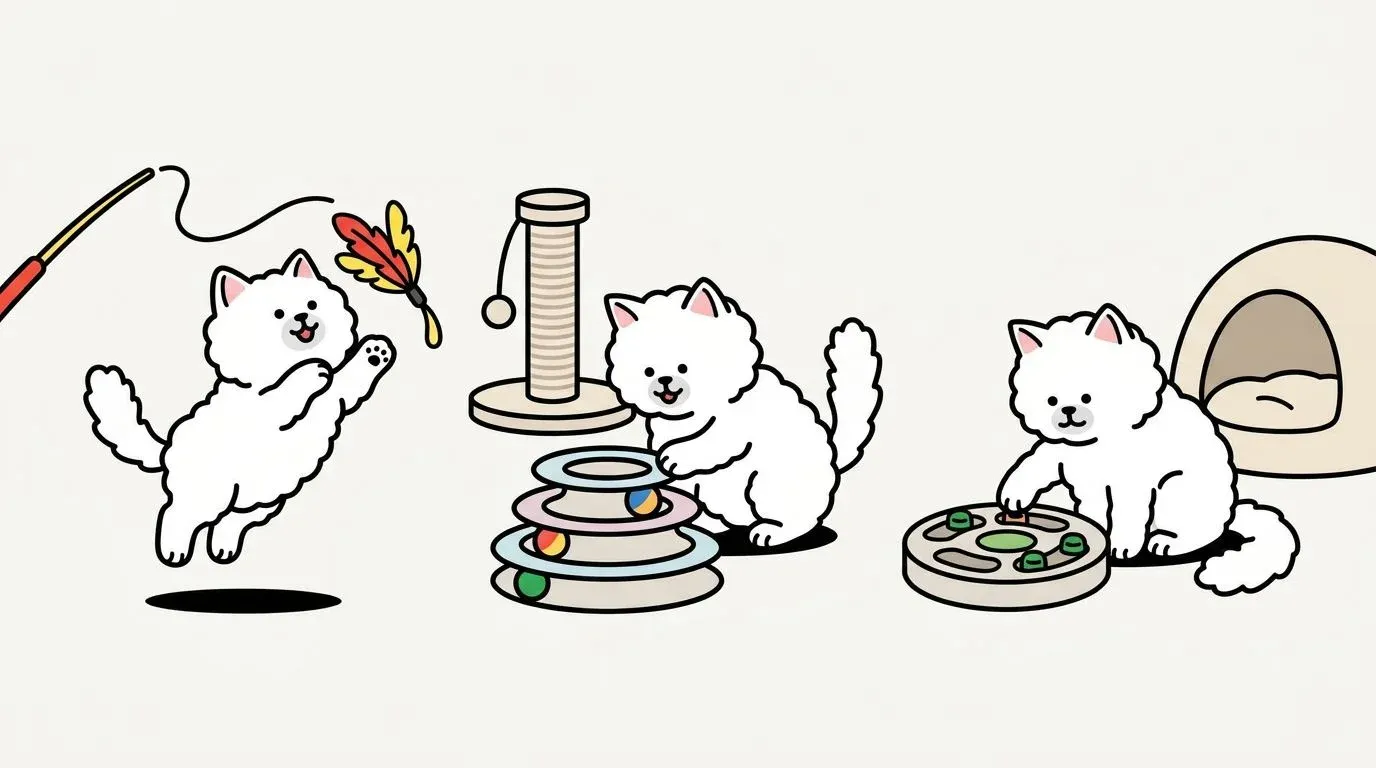
If your cat has started racing through the house at odd hours, vocalizing without obvious cause, or scratching furniture more than usual, the behavior is rarely a personality flaw. These are often the first signs that your cat’s behavioral needs are going unmet.
The biggest constraint indoor living places on a cat is not limited space—it is the absence of opportunities to express instinctive behaviors: hunting, territorial patrol, and exploration. This guide applies the AAFP (American Association of Feline Practitioners) and ISFM (International Society of Feline Medicine) Five Pillars of a Healthy Feline Environment framework to help you build a complete indoor cat enrichment plan, from play session design to behavior monitoring.
Why Environmental Enrichment Is Essential for Indoor Cats
The Behavioral Impact of Indoor-Only Living
In the wild, cats attempt 8 to 12 hunts per day and patrol territories spanning several kilometers. Indoor cats have almost no opportunity for either. Research from the Ohio State University Indoor Cat Initiative shows that indoor cats living in unstimulating environments experience what behavioral scientists call “frustration of natural behaviors”—a state in which unmet needs express themselves as physical symptoms.
The consequences are well-documented: higher rates of feline lower urinary tract disease (FLUTD), stress-related overgrooming, increased aggression, and weight gain from inactivity. The critical point is that floor space alone does not solve the problem. Cats need an environment that is both predictable enough to feel safe and varied enough to stay interesting. A thoughtfully arranged small apartment outperforms a bare large house every time.
What Enrichment Changes: Stress, Obesity, and Problem Behaviors
Ellis et al. (2013) published the foundational AAFP/ISFM Feline Environmental Needs Guidelines, defining five core resources—the Five Pillars—that indoor cats require for psychological and physical health:
- A safe place: A retreat the cat can access without interference
- Multiple separated resources: Food, water, litter, and play areas kept distinct from one another
- Opportunity for play and predatory behavior: Interactive play and foraging
- Positive, consistent, and predictable human social interaction: Contact initiated on the cat’s terms
- An environment that respects the cat’s olfactory, visual, and auditory needs: Sensory variety within a stable base
When all five pillars are adequately addressed, indoor cats show measurable reductions in stress-related disease, increased voluntary activity, and lower frequencies of cat overgrooming and destructive behaviors. Buffington (2002) demonstrated that environmental resource improvements alone—without any medication—reduced stress-related illness events in indoor cats.
Designing Play Around Your Cat’s Hunting Instinct
The Hunting Sequence: Stalk-Chase-Pounce-Capture-Eat
Cat play is not random movement. Every effective cat hunting game indoor activates what ethologists call the predatory sequence: five linked behavioral phases that, when completed in order, produce a neurochemically satisfied cat. Understanding this sequence explains why some toys produce sustained engagement while others are ignored after thirty seconds.
| Phase | Behavioral features | What activates it |
|---|---|---|
| Stalk | Slow environmental scan, crouching, scent investigation | Hidden food, novel objects to investigate |
| Chase | Body lowered, following a moving target | Erratically moving wand toy |
| Pounce | Muscle tension, tail-tip flick, hindquarter wiggling | Sudden directional change in prey |
| Capture | Front paws and teeth engage target | Appropriately sized, grippable kick toy |
| Eat | Release of tension, grooming begins | Small food reward immediately after play |
The sequence must reach completion. When play ends abruptly before capture and eat, the cat remains in a state of aroused frustration—which is why some cats seem more agitated, not calmer, after a play session that stops too soon. Completing the eat phase is what closes the neurological loop.
Choosing the Right Play for Each Stage
Mapping specific toy types to hunting sequence phases produces more effective cat hunting games indoor than offering a pile of toys and hoping one works.
Stalk phase: Scatter a small portion of the meal or a few treats in different locations around the room (scatter feeding). Add cardboard boxes or a crinkle tunnel so the cat searches for “prey” in concealed spaces.
Chase and pounce phases: Wand toys are the most effective tool here. The key technique is moving the toy erratically—brush it along the floor, pause, change direction suddenly, then briefly disappear behind furniture. This mimics small prey behavior. Maintain the cat’s focus by varying speed; moving too fast or too predictably breaks engagement.
Capture phase: A kick toy—a firmly stuffed plush object the cat can grab with its front paws and kick with its back legs—completes the physical capture experience. This phase matters: skipping it leaves the pounce tension unresolved.
Eat phase: End every play session by setting the toy still and offering a small food reward. This is the single most important structural element of a play session—the reward that signals “hunt successful” to your cat’s nervous system.
Spatial Enrichment: Vertical Space and Hiding Spots
Cat Tree and Shelf Placement Principles
Cats are simultaneously predators and prey animals. Their evolutionary history created a strong preference for elevated observation posts—height provides both surveillance advantage and escape from ground-level threats. This is why a cat tree positioned correctly transforms the spatial experience of an indoor environment.
Placement guidelines that actually affect usage:
- Height: Cats prefer positions close to the ceiling. Structures under 120 cm (about 4 feet) see significantly less use than taller alternatives
- Location: Place near a window or in the room where the family spends the most time. Structures tucked in unused corners remain empty
- Stability: One wobble or tip incident is enough to permanently deter use. Verify the base is solid before the cat’s first climb
- Multiple routes: Provide at least two paths from floor to the highest point. In multi-cat homes, a single route allows one cat to block access entirely
Floating wall shelves are an effective indoor cat exercise alternative when floor space is limited—they use vertical volume the cat would not otherwise access.
Creating Hiding Spots and Observation Points
Hiding spots are not optional extras. Buffington’s research directly connects access to retreat spaces with reduced incidence of stress-induced illness. A hiding spot provides the psychological safety that allows a cat to lower its baseline stress level between active periods.
Effective hiding spot design:
- Small enough that the cat fills the space (snugness, not roominess, provides comfort)
- Entrance on one side only, with a solid back wall
- At least one hiding option at floor level and one elevated
- In households with multiple cats: provide one more hiding spot than the number of cats
Window perches or sills fitted with a stable shelf function as an entirely different kind of enrichment—the “cat TV” effect. A bird feeder mounted just outside the window dramatically increases the activity and variety of what the cat observes, providing hours of visual stimulation at no ongoing cost.
Sensory Stimulation: Sight, Sound, and Smell
Setting Up a Window Watching Station
Window observation delivers continuous visual stimulation without requiring any toys or human involvement. The setup is straightforward: a stable perch or shelf at window height, a secure screen that holds against an excited cat’s weight, and ideally a bird feeder or plant pot with moving foliage visible from outside.
Placing the feeder within two to three meters of the glass maximizes the cat’s visual resolution of bird detail. Rotating feeder positions periodically keeps the view novel. For apartments without access to outdoor feeders, nature documentaries or bird-watching videos played on a screen near floor level can provide a partial substitute—though live movement outside a real window produces significantly stronger engagement.
Catnip and Olfactory Enrichment
Olfaction is the cat’s second most powerful sense after vision, and olfactory enrichment is one of the most accessible indoor cat boredom solutions available to owners. Catnip (Nepeta cataria) contains nepetalactone, which binds to feline olfactory receptors and triggers a transient euphoric response lasting 5 to 15 minutes.
The response rate is approximately 50 to 70 percent—it is genetically determined, so a non-reacting cat is not deficient in any way. For cats that do not respond to catnip, silver vine (Actinidia polygama) is the most evidence-supported alternative. A 2017 study by Bol et al. found that over 75 percent of catnip nonresponders reacted positively to silver vine, making it worth keeping in any enrichment toolkit.
Practical olfactory enrichment methods:
- Offer fresh catnip or silver vine two to three times per week (daily use can reduce sensitivity through habituation)
- Fill a clean sock with dried catnip and knot the end to create an inexpensive kick toy
- Rotate novel scents into the play area—a pinecone, a piece of bark, or dried herbs the cat has not encountered before
Sound-Based Toy Options
Cats are tuned to detect the high-frequency sounds produced by small prey animals—mice, birds, and insects. Toys that crinkle, squeak, or produce irregular sounds exploit this sensitivity. The key word is “irregular”: a toy that makes the same sound on every contact loses novelty within minutes. Toys that respond differently depending on how the cat bats them—crinkle balls, hollow plastic balls with internal rattles, battery-operated toys with variable movement patterns—maintain interest longer.
Playing ambient audio of bird calls or insect sounds at low volume near a window observation station can also contribute to cat stress relief for some cats. Because individual responses vary, introduce sound enrichment gradually and monitor the cat’s body language for signs of anxiety rather than interest.
Food Enrichment: Eating Like a Hunter
Puzzle Feeders and Snuffle Mats
Placing food in a bowl and watching a cat consume it in three minutes completes the eat phase of the hunting sequence, but it skips everything that precedes it. Food enrichment—specifically cat puzzle feeder use—extends the foraging behavior that the hunt would naturally have provided, making mealtime part of the enrichment program rather than separate from it.
A structured difficulty progression prevents frustration and builds the cat’s confidence with puzzle feeding:
| Level | Description | Introduction method |
|---|---|---|
| Beginner | Shallow-groove slow feeder replacing the standard bowl | Use for every meal from day one |
| Intermediate | Rolling ball feeder—food dispensed as the ball moves | Introduce after 1 to 2 weeks with the beginner feeder |
| Advanced | Multi-layer puzzle requiring the cat to lift covers or slide panels | Only introduce once the cat engages readily with intermediate level |
Starting too high on the difficulty scale is the most common mistake. A cat that cannot figure out the puzzle in the first few attempts will disengage and may refuse to use the feeder entirely. Always begin at beginner level.
Snuffle mats—fabric mats with dense loops or pockets in which food is hidden—specifically activate the stalk and sniff phases. They are particularly well-suited for lower-energy cats, seniors, and cats recovering from illness who still benefit from cognitive engagement.
Treat Hiding Games
The simplest and most flexible food enrichment approach requires nothing but treats and imagination: hide small amounts of food in multiple locations throughout the home and let the cat find them. The key variable is unpredictability. The same three hiding locations used every day lose their novelty within a week.
Effective rotation strategies:
- Use five to seven locations per session, but change the selection each time
- Vary height: floor level, shelf level, inside a cardboard box, on top of a cat tree platform
- Introduce new structures occasionally—a fresh cardboard box with a hole cut in the side becomes a new exploration problem
Treat hiding also directly addresses indoor cat weight management without requiring portion reduction. Distributing the same daily caloric amount across multiple hidden locations increases activity naturally—the cat must move to earn the calories rather than standing still at a bowl.
Making the Most of Interactive Play Sessions
Ideal Play Duration and Frequency
The recommended guideline for interactive play is 15 to 30 minutes per day divided into two to three sessions. The division matters. A single 30-minute session is physiologically demanding and often ends before the cat’s interest peaks, while three 10-minute sessions align with the natural rhythm of short, intense hunting attempts that define feline predatory behavior.
Timing recommendations that improve response rates:
- Morning session: Shortly after waking, before breakfast—this mimics the dawn hunt that precedes a meal
- Evening session: Before the evening meal, when cats are naturally more active
- Midday session (if schedule allows): Useful for high-energy cats, especially younger adults
Cats’ activity peaks in early morning and late evening. Scheduling sessions against this circadian pattern produces noticeably better engagement than sessions at midday.
The Art of Ending a Play Session
How a session ends is as important as how it begins. Stopping abruptly—putting the toy away while the cat is still in chase mode—leaves the cat in an unsatisfied, aroused state. The behavioral consequence is often increased vocalization, redirected aggression, or intensified zoomies after the session rather than calm rest.
A properly structured session ending:
- Over the final five minutes, progressively slow the toy’s movement and bring it closer to the ground
- Allow the cat to successfully capture the toy (let it win)
- Hold the toy still, simulating a defeated prey animal
- Remove the toy from sight and immediately offer a small food reward or scheduled mealtime
- Observe the cat begin grooming—this indicates the nervous system has transitioned from alert-hunt mode to the post-meal relaxation phase
Once this sequence becomes habitual, you will find the cat settles reliably after sessions rather than remaining stimulated.
Tracking Results: How to Measure Enrichment Success
Environmental enrichment is not a one-time setup—it is an ongoing process that requires observation to be effective. Changes typically begin appearing two to four weeks after consistent implementation. The following table provides observable benchmarks:
| Metric | Before enrichment | Expected change after 2-4 weeks |
|---|---|---|
| Voluntary activity | Sleeps most of the day | Spontaneous exploration increases |
| Sleep pattern | Irregular; active at 3 AM | More stable; active during day |
| Problem behaviors | Furniture scratching, excessive vocalization | Reduced frequency |
| Appetite | Overeating or disinterest | Regular, calm eating pattern |
| Weight | Gradual upward trend | Stable or declining |
| Grooming pattern | Focused on one area (possible overgrooming) | Distributed across whole body |
Two-week progress checklist:
- Cat approaches toys spontaneously at least once per day without prompting
- Puzzle feeder or snuffle mat used actively at mealtime
- Cat occupies a new vertical or observation space (top of cat tree, window perch) not used before
- Frequency of specific problem behaviors has declined
- Cat initiates contact with human family members more often
If two to four weeks of consistent enrichment produce no measurable change—or if problem behaviors worsen—the root cause may not be environmental. Stress with a medical or social component (a new pet, a neighboring outdoor cat visible through windows, a change in household routine) requires a different approach. Consult with a veterinarian or a veterinary behaviorist to rule out underlying conditions.
Finally, rotation is essential for long-term effectiveness. Cats respond to novelty. The same setup maintained indefinitely becomes wallpaper. Swap toy locations every week, introduce one new element per month, and rotate puzzle feeders between difficulty levels. Enrichment that is regularly refreshed keeps working; enrichment that stagnates stops working—usually within two to three weeks.
FAQ
How long should I play with my indoor cat each day?
What if my cat doesn't respond to catnip?
What are the best toys for a cat left home alone?
How do I manage enrichment in a multi-cat household?
Do senior cats still need environmental enrichment?
Related Articles
Dog Lethargy Causes: When Slowing Down Signals More Than Just Aging
Learn how to distinguish normal dog tiredness from true lethargy, identify dog lethargy causes by age, and know which signs need emergency vet care.
Veterinary Guide to Cat Overgrooming: Causes, Treatment, and When to Worry
Cat overgrooming causes range from allergies to anxiety. This vet-backed guide covers diagnosis, body-area mapping, treatment options, and when to see a doctor.
Does Your Senior Dog Have Dementia? A Veterinary Guide to Canine Cognitive Dysfunction
Learn the 7 DISHAAL domains to assess dog dementia symptoms at home, understand evidence-based treatment options, and know when to call your vet.
Dog Noise Phobia Treatment: Thunder and Fireworks Guide
Step-by-step guide to treating dog noise phobia from thunder and fireworks. Desensitization protocol, tool comparisons, and when to see a vet.
Is Your Dog in Pain? 7 Subtle Signs Most Owners Miss
Learn the 7 behavioral signs your dog is in pain that are easy to overlook, how to tell acute from chronic pain, and what to do before your vet visit.
Dog Separation Anxiety Guide: Symptoms, Training, and Help
Learn how to identify dog separation anxiety symptoms, follow a vet-backed step-by-step training plan, and know when medication or a specialist is needed.
Dog Walk Refusal: Is It Behavior or Hidden Joint Pain?
Dog walk refusal may signal arthritis, hip dysplasia, or IVDD. Use our 10-point checklist to tell behavioral causes from joint pain—and what to do next.
If Your Dog Won't Stop Barking: Type-by-Type Training Guide
Stop dog barking by identifying the type. 5 types, targeted training protocols, and realistic timelines — evidence-based guide for dog owners.
How to Start Nose Work with Your Dog: A Step-by-Step Beginner's Guide
Learn how to start nose work with your dog using a 5-stage progressive protocol. From palm treat finds to outdoor scent detection — start today with no special equipment.