 Cirius Petpedia
 Cat Meowing at Night: 3 Common Responses That Make It Worse
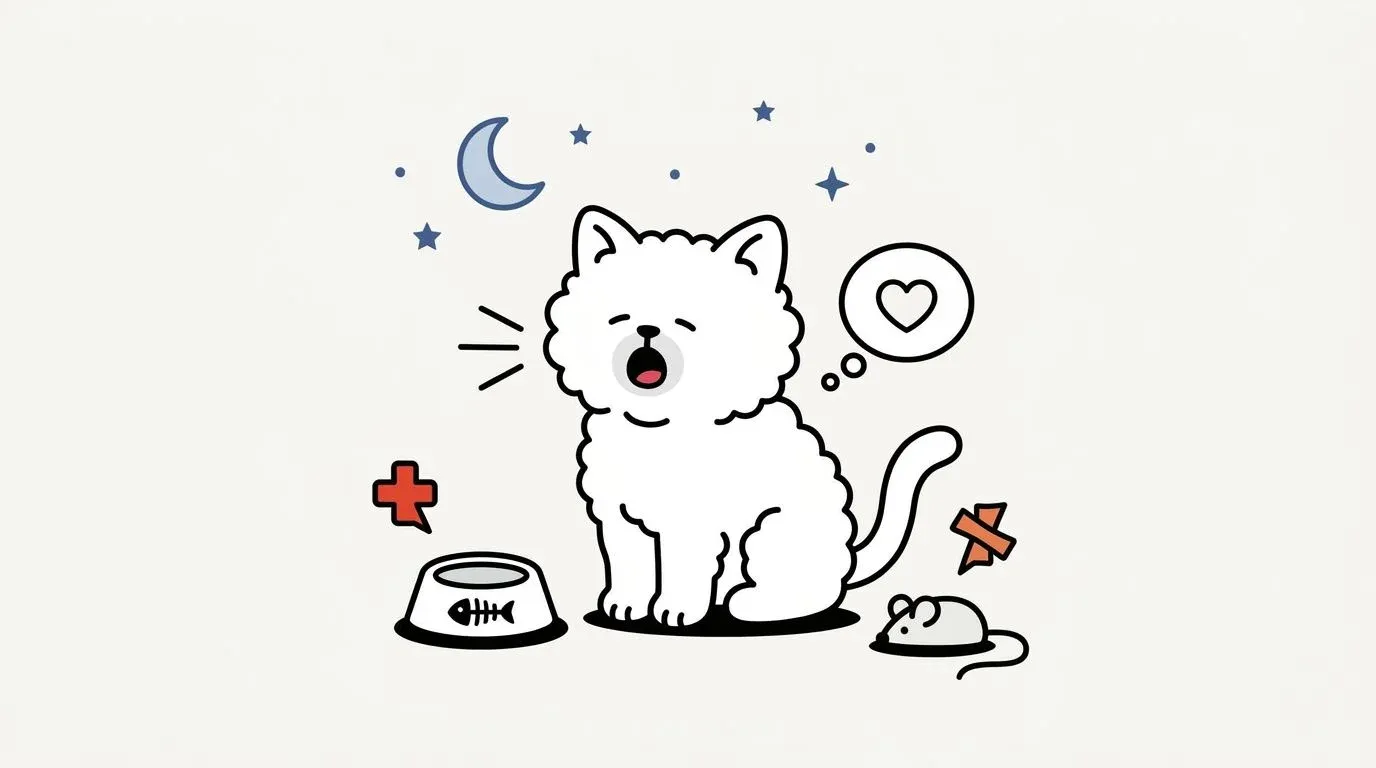
It is 2 a.m. and your cat is at it again—pacing outside the bedroom door, releasing a sound somewhere between a foghorn and an opera solo. You have tried everything: getting up to feed them, telling them firmly to stop, even briefly opening the door just to get five more minutes of sleep. Nothing has worked. If anything, the meowing has gotten worse.
That is not a coincidence. The most common instinctive responses to a cat crying at night are the same ones that train the cat to cry louder and longer. Understanding why requires a brief look at behavioral science—and then a practical four-step evening routine that breaks the cycle for good.
The Real Cost of a Cat That Won’t Stop Meowing at Night
Sleep Deprivation and Its Ripple Effects
Chronic sleep disruption is not a minor inconvenience. Research consistently links fragmented sleep to reduced concentration, elevated cortisol levels, impaired immune function, and mood dysregulation. When your cat meowing at night wakes you repeatedly, you are accumulating what sleep researchers call “sleep debt”—a deficit that does not fully resolve with a single night of catch-up rest.
For many cat owners, nighttime vocalization also creates secondary stress: the frustration of feeling powerless against a small animal, the anxiety of waking a partner or housemate, and the guilt of being irritated at a pet they genuinely love. Acknowledging that this problem has real consequences—for both you and your relationship with your cat—is the appropriate starting point.
Multi-Cat Households and Chain Reactions
In homes with more than one cat, nighttime vocalization is especially disruptive. One cat’s meowing often triggers a chain response: a second cat wakes, vocalizes in return, then a third investigates. The social dynamics of multi-cat households add an additional layer—cats may vocalize to establish territorial boundaries, solicit grooming, or signal anxiety about shared resources. What started as one cat’s behavior can escalate into full chorus within a week if it goes unaddressed.
3 Common Responses That Actually Reinforce Night Meowing
This is the section most articles skip, and it is the most important one. Before you can fix your cat’s nighttime meowing, you need to understand why your current responses are likely making it worse.
Feeding When They Cry Teaches Them to Cry More
Imagine this sequence: your cat meows at 3 a.m., you shuffle to the kitchen and fill their bowl, the meowing stops, and you go back to sleep. From your perspective, you solved the problem. From your cat’s perspective, something very different happened: meowing produced food.
This is textbook operant conditioning—specifically, positive reinforcement. The cat performed a behavior (meowing), which was followed by a rewarding outcome (food), which increases the probability that the cat will repeat that behavior under similar conditions. You have not taught your cat that nighttime is for sleeping. You have taught them that nighttime is when meowing gets results.
The solution is not to stop feeding your cat at night. It is to decouple feeding from vocalization—specifically, to ensure the cat is never fed as a response to meowing. Feeding on a schedule (rather than on demand) removes the cat’s ability to use vocalization as a food-production tool.
Yelling or Punishing Creates a Fear-Stress Cycle
The second common mistake is responding with punishment—shouting “no,” spraying water, or making a loud noise. The intention is to communicate that meowing is unwelcome. The actual effect is more complicated.
Intermittent punishment creates anxiety, and anxious cats are more likely to vocalize—particularly cats whose night meowing is already driven by stress or environmental insecurity. More importantly, even a negative response is still a response. For a cat that is meowing to get attention, being shouted at confirms that meowing is an effective strategy for generating owner engagement. The behavior continues; now it also comes with fear attached.
Why Total Cold-Turkey Ignoring Isn’t Always the Answer
Complete extinction—ignoring the behavior entirely until it disappears—is behaviorally sound in theory. In practice, it has a complication: the extinction burst.
When a previously reinforced behavior stops producing results, animals (and humans) do not immediately give up. They try harder first. Your cat, accustomed to meowing eventually producing attention or food, will initially meow louder, longer, and more insistently when you stop responding. This spike in behavior—the extinction burst—can last several days and is intense enough to cause many owners to give in, which resets the entire process.
Ignoring is the right long-term response, but it works best when paired with a proactive strategy that addresses the root cause—so the cat is less motivated to vocalize in the first place.
Why Your Cat Is Really Active at Night: 5 Actual Causes
Effective treatment requires accurate diagnosis. Cats meow at night for distinct reasons, and the right intervention depends on which cause is actually driving the behavior.
Crepuscular Instinct: Your Cat Isn’t Nocturnal
This point matters enough to state clearly: cats are crepuscular, not nocturnal. Crepuscular animals are most active at dawn and dusk—the low-light periods that historically gave wild cats a hunting advantage over prey that was active during the day and predators that relied on daylight.
Your cat’s 9 p.m. energy surge—what cat owners often call “the zoomies” or FRAP (frenetic random activity period)—is not misbehavior. It is the natural peak of the feline activity cycle. When that energy peak arrives in a low-stimulation environment with nothing to hunt, it expresses itself as vocalization, racing around the apartment, or knocking things off shelves. The goal of any nighttime intervention is to channel this predictable energy spike—not to suppress it, which is neurologically impossible.
Unspent Daytime Energy
Cats living in under-stimulating environments accumulate behavioral energy across the day. An indoor cat that spends 14 hours in an unchanging environment with minimal interaction arrives at their crepuscular activity window carrying that entire day’s worth of pent-up drive. The quality and consistency of daytime enrichment directly affects how intense the evening energy peak becomes.
This is why owners often notice that days when their cat had more interaction—playtime, new toys, visitors—result in quieter nights. It is not coincidence.
Hunger and Feeding Schedule Issues
A common setup in many households is a single large morning feeding, leaving the cat genuinely hungry by 10 p.m. Hunger is a direct motivator for vocalization—and unlike attention-seeking meowing, hunger-driven meowing has a physiological basis that makes it harder for the cat to inhibit.
Shifting to two meals per day (morning and evening, with the evening meal timed strategically) or adding a portion-controlled late-evening feeding can significantly reduce food-driven night calling. This is also relevant to weight management—restructuring feeding schedules often improves both nighttime behavior and caloric intake regulation simultaneously.
Mating Drive and Hormonal Changes
Intact (unspayed/unneutered) cats experience hormonal cycles that produce intense, often distressing vocalization. A female cat in heat yowls for a biological reason—she is driven to call for a mate. A male cat that detects a female in heat can respond with equally intense, persistent calling. This is one of the most common and easily resolved causes of cat crying at night: spaying or neutering eliminates the hormonal driver in the vast majority of cases.
If your cat is intact and has recently started night vocalizing, this should be considered the most probable cause and addressed before behavioral interventions are attempted.
Pain or Illness as a Hidden Trigger
This cause is the one that most list-format articles mention briefly and then move past. It deserves more weight. In cats over 10 years old, sudden-onset nighttime vocalization—especially yowling rather than meowing—is one of the recognized early signs of several medical conditions:
- Hyperthyroidism: elevated thyroid hormone increases restlessness, vocalization, and nighttime activity
- Hypertension (high blood pressure): often secondary to kidney disease or hyperthyroidism, causes neurological symptoms including disorientation
- Cognitive Dysfunction Syndrome (CDS): the feline equivalent of dementia, producing confusion, disorientation, and vocalization—particularly at night when reduced light worsens spatial disorientation
- Arthritis or chronic pain: discomfort that a cat manages during active daytime hours may become more apparent at night when they cannot distract themselves
A previously quiet cat that begins yowling at night without obvious environmental changes warrants a veterinary evaluation before any behavioral program is started.
The 4-Step Evening Routine to Quiet Nighttime Meowing
This routine is built around a behavioral principle called the “hunt-eat-groom-sleep” cycle—the natural sequence a cat follows after a successful hunt in the wild. Replicating this sequence in the evening aligns your cat’s biology with your sleep schedule.
Step 1: Interactive Hunt Play (15–20 Minutes)
Begin around 30 to 45 minutes before your target bedtime. Use a wand toy that simulates prey movement—erratic, unpredictable motion low to the ground, with occasional retreats and pauses. The goal is genuine physical exertion, not passive observation. Your cat should be actively leaping, stalking, and pouncing.
The hunt sequence matters. A realistic prey simulation follows a pattern: slow movement to attract attention, quick retreat to trigger chase, momentary stillness, then capture. End the session by letting the cat “catch” and hold the toy—this completes the hunt sequence and provides psychological closure. A play session that ends abruptly with the toy being put away leaves the cat in an aroused, unfulfilled state.
Fifteen to twenty minutes of real engagement is sufficient. The quality of the hunt simulation matters more than the duration.
Step 2: Meal Right After Play
Immediately after the play session ends—while the cat is still breathing hard and beginning to settle—provide the evening meal. This is the “eat” phase of the cycle, and timing it directly after play is the most important part of the routine.
A cat that eats a satisfying meal following physical exertion moves naturally into rest. The physiological response to a full stomach—reduced metabolic rate, mild drowsiness—supports the transition to sleep. This timing is why the routine works when feeding alone does not: the meal follows the hunt rather than responding to vocalization.
Step 3: Grooming Wind-Down
After eating, cats naturally groom. This self-grooming phase is not optional behavior—it is a post-meal behavioral routine so deeply embedded that most cats will perform it regardless of environmental cues. You can support this phase with gentle brushing, if your cat tolerates it, which deepens the calming effect and reinforces positive association with the pre-sleep period.
During this wind-down window, reduce environmental stimulation: dim overhead lights, lower TV volume, avoid sudden movements. You are signaling the transition from active to rest mode, matching what your cat’s body is already doing.
Step 4: Sleep Environment Setup
The final step is ensuring your cat has a physically comfortable, safe, and warm sleep location. Cats prefer elevated spots with a clear sightline, or enclosed spaces that provide a sense of security—a covered cat bed in a corner, a cat tree shelf with a soft insert, or a dedicated basket placed higher than floor level.
Warmth is particularly important. Cats have a higher baseline body temperature than humans and seek warm resting spots. A self-warming mat or a bed placed in a sunlit area (if using morning as the active period instead) reduces nighttime restlessness driven by thermal discomfort.
Consistency of location matters. A cat that knows where its sleep spot is does not need to patrol and vocalize. Establishing the spot before the problem becomes entrenched is ideal; once a pattern of nighttime meowing is established, it takes 7 to 14 nights of the full routine before the behavior reliably declines.
Environmental Tweaks for Calmer Nights
The four-step routine addresses behavior; the environment determines how sustainable the results are.
Cat Wheels and Puzzle Feeders
A cat wheel (a large exercise wheel designed for cats) is one of the most effective tools for households where owners cannot always commit to a 20-minute interactive play session. Well-conditioned cats use them spontaneously, especially during the crepuscular activity window. The energy expenditure reduces the intensity of the evening energy peak.
Puzzle feeders serve a dual function: they slow eating (relevant for cats that vomit after fast eating) and they add cognitive engagement to meals. Replacing a portion of the evening meal with a puzzle feeder extends the hunt-to-eat sequence and keeps the cat mentally occupied during the wind-down period.
Should You Close the Bedroom Door?
Closing the bedroom door is a reasonable boundary—but it creates a specific vocalization trigger if the cat has previously had bedroom access and the change is sudden. If you intend to close the bedroom door, do it gradually (closing progressively earlier in the evening over one to two weeks) rather than abruptly.
If your cat currently has full bedroom access and is meowing while in the room, the problem is different—it is not separation-driven, but likely energy-driven or attention-seeking, and the evening routine is the primary intervention.
Pheromone Diffusers: What Works and What Doesn’t
Feline facial pheromone analogs (the category includes Feliway Classic and similar products) have peer-reviewed evidence supporting their use in reducing anxiety-related behaviors in cats. They work by mimicking the pheromones cats deposit when they rub their cheeks against objects in their environment—a marking behavior associated with familiarity and safety.
Where they help: stress-driven vocalization, multi-cat tension, and adjustment to new environments. Where they do not help: attention-seeking meowing with no underlying anxiety, and hunger-driven night calling. A diffuser used correctly—placed in the cat’s sleep area, replaced on schedule—is a reasonable adjunct to behavioral interventions when stress appears to be a contributing factor. It is not a substitute for addressing the root behavioral cause.
Red Flags: When Night Crying Means a Vet Visit
Most cat meowing at night has behavioral causes that respond to the routine above. Some does not. These signs indicate that a veterinary evaluation should happen before or alongside any behavioral program.
Sudden Onset in a Previously Quiet Cat
If your cat has lived with you for years without significant night vocalization and the behavior appears suddenly—over days or a week rather than gradually—this pattern strongly suggests a medical cause. Behavior-driven night meowing typically develops gradually as the cat learns that vocalization gets results. Sudden onset has a different profile and requires a different diagnostic approach.
Accompanied by Appetite or Litter Box Changes
Night vocalization combined with any of the following warrants prompt veterinary attention:
| Accompanying sign | Possible conditions to rule out |
|---|---|
| Increased thirst and urination | Diabetes, kidney disease, hyperthyroidism |
| Decreased appetite or weight loss | Hyperthyroidism, cancer, dental pain |
| Changes in litter box habits | Urinary tract disease, constipation, arthritis |
| Apparent confusion or disorientation | Cognitive Dysfunction Syndrome, hypertension |
| Vocalization with no obvious trigger in senior cats | Pain, neurological change, CDS |
The important clinical point is that cats are highly effective at masking pain and illness during active hours. Nighttime—when the cat is less stimulated and less able to distract itself—is often when signs of underlying illness first become apparent to owners. Night crying that appears “out of nowhere” in a healthy adult cat, especially one over 8 years old, is a signal worth taking seriously.
If you suspect your cat’s nighttime behavior might have a stress component beyond simple energy management, the principles covered in our guide to cat stress relief and home care can help you assess and address underlying anxiety. And if you notice stress-related behaviors extending beyond nighttime—such as excessive licking or grooming—overgrooming in cats may be occurring as a parallel outlet.
The most durable solution to cat meowing at night is not a product and is not a one-time fix. It is the consistent application of a routine that works with your cat’s biology rather than against it. The crepuscular activity peak will happen every evening—the only question is whether it is channeled into play and a satisfying meal, or expressed as two hours of vocalization while you lie awake trying to ignore it.
Start with the evening routine for seven consecutive nights before evaluating results. Most owners notice a meaningful improvement within that window. If you do not, review whether the play session is producing genuine physical exertion (not just brief interest), whether the meal is landing within 10 minutes of play ending, and whether there are any medical signs worth discussing with a veterinarian.
FAQ
Why does my cat only meow at night and not during the day?
Will ignoring my cat's nighttime meowing eventually make it stop?
At what age do cats start meowing more at night?
Should I let my cat into the bedroom at night?
Can pheromone diffusers help reduce cat meowing at night?
Related Articles
Dog Lethargy Causes: When Slowing Down Signals More Than Just Aging
Learn how to distinguish normal dog tiredness from true lethargy, identify dog lethargy causes by age, and know which signs need emergency vet care.
Veterinary Guide to Cat Overgrooming: Causes, Treatment, and When to Worry
Cat overgrooming causes range from allergies to anxiety. This vet-backed guide covers diagnosis, body-area mapping, treatment options, and when to see a doctor.
Does Your Senior Dog Have Dementia? A Veterinary Guide to Canine Cognitive Dysfunction
Learn the 7 DISHAAL domains to assess dog dementia symptoms at home, understand evidence-based treatment options, and know when to call your vet.
Dog Noise Phobia Treatment: Thunder and Fireworks Guide
Step-by-step guide to treating dog noise phobia from thunder and fireworks. Desensitization protocol, tool comparisons, and when to see a vet.
Is Your Dog in Pain? 7 Subtle Signs Most Owners Miss
Learn the 7 behavioral signs your dog is in pain that are easy to overlook, how to tell acute from chronic pain, and what to do before your vet visit.
Dog Separation Anxiety Guide: Symptoms, Training, and Help
Learn how to identify dog separation anxiety symptoms, follow a vet-backed step-by-step training plan, and know when medication or a specialist is needed.
Dog Walk Refusal: Is It Behavior or Hidden Joint Pain?
Dog walk refusal may signal arthritis, hip dysplasia, or IVDD. Use our 10-point checklist to tell behavioral causes from joint pain—and what to do next.
If Your Dog Won't Stop Barking: Type-by-Type Training Guide
Stop dog barking by identifying the type. 5 types, targeted training protocols, and realistic timelines — evidence-based guide for dog owners.
Transform Your Indoor Cat's Behavior and Health by Redesigning Their Play Environment
Use the AAFP/ISFM Five Pillars framework to build a science-backed indoor cat enrichment plan—from hunting sequence play design to sensory stimulation and behavior monitoring.
How to Start Nose Work with Your Dog: A Step-by-Step Beginner's Guide
Learn how to start nose work with your dog using a 5-stage progressive protocol. From palm treat finds to outdoor scent detection — start today with no special equipment.
How to Introduce Cats: A Step-by-Step Guide From Isolation to Harmony
Learn how to introduce cats using a proven 5-step protocol with clear timeline ranges, age and sex strategies, and a failed-introduction recovery plan.
Dog Coprophagia: Why Dogs Eat Poop and How to Stop It
Dog coprophagia affects 1 in 6 dogs. Learn the three types, their distinct causes, evidence-based correction protocols, and why most deterrents don't work.
How to Crate Train Your Dog: A Step-by-Step Guide from First Introduction to Calm Alone Time
Learn how to crate train a dog with a 5-step protocol, age-based time limits, and troubleshooting for crying, crate aversion, and accidents.
Loose Leash Walking Training: 5 Steps to Stop Dog Pulling
Stop your dog pulling on walks with this 5-stage loose leash walking training guide — from indoor introduction to real-world heel, with troubleshooting.
Is Your Dog Guarding More Than Just the Food Bowl? Types of Resource Guarding and How to Fix Them
Dog resource guarding goes beyond food bowls. Learn the 4 types, a severity assessment framework, and type-specific training protocols to stop guarding safely.
Bringing Home a New Puppy? The Complete Socialization Training Guide You Need
Learn the science behind puppy socialization windows, get a week-by-week timeline, and discover safe pre-vaccination methods with a practical category-based checklist.