 Cirius Petpedia
 Dog Hydrotherapy: 4 Ways Water Therapy Rebuilds Joint Strength
Water covers roughly 60% of a dog’s body by weight — and it turns out that same water, when used therapeutically, can do something dry-land exercise cannot: let a dog work their muscles hard while removing most of the load from painful joints.
Dog hydrotherapy has moved well beyond the “swim your dog in the creek” approach. Today it encompasses two distinct clinical modalities — the underwater treadmill and therapeutic swimming — each with specific indications, protocols, and measurable outcomes. Yet most online guides either give a surface-level overview or focus narrowly on one condition or one type of facility.
This guide covers the full picture: the biomechanics that make water therapy effective, which dogs are strongest candidates and why, what a structured program looks like from first assessment through discharge, and what you can realistically do at home. Where studies exist, the data is cited.
What Is Canine Hydrotherapy?
Canine hydrotherapy (also called aquatic therapy or therapeutic aquatic exercise) is the therapeutic use of water to facilitate rehabilitation, strengthen muscles, and reduce pain in dogs. It is delivered under the supervision of a trained professional — typically a certified canine rehabilitation therapist (CCRT) — and is most effective when prescribed and monitored as part of a comprehensive rehabilitation plan.
Buoyancy, Resistance, and Hydrostatic Pressure — How Water Protects Joints
Three physical properties of water create the therapeutic environment:
Buoyancy counteracts gravity. When a dog stands in water at shoulder depth, buoyancy reduces the effective weight bearing on the limbs by approximately 60–91%, depending on water depth. A 60-pound dog entering water up to the hip joint experiences the equivalent of carrying just 6–24 pounds — a relief that allows movement that would otherwise be impossible or extremely painful on dry land.
Resistance is about 12–15 times greater in water than in air. Every step the dog takes activates muscles to push against that resistance, producing strengthening effects comparable to progressive resistance exercise on land — without the joint impact.
Hydrostatic pressure is the uniform pressure exerted by water on all immersed surfaces. This pressure supports soft tissue, reduces swelling (edema), and stimulates sensory receptors in the skin and joints. The sensory input supports proprioception (the body’s awareness of joint position), which is often impaired after surgery or in dogs with chronic joint disease.
Underwater Treadmill vs. Therapeutic Swimming: When to Choose Which
These two modalities share the same medium but serve different purposes.
| Feature | Underwater Treadmill (UWTM) | Therapeutic Swimming (Pool) |
|---|---|---|
| Primary goal | Controlled gait re-education, weight bearing | Range of motion, cardiovascular fitness |
| Weight bearing | Present but reduced by buoyancy | Minimal |
| Therapist control | High (speed, water depth, incline) | Moderate |
| Best for | Post-surgical rehab, neurological cases, gait disorders | ROM restoration, low-impact conditioning |
| Risk profile | Lower (enclosed, controlled) | Higher for water-fearful or weak swimmers |
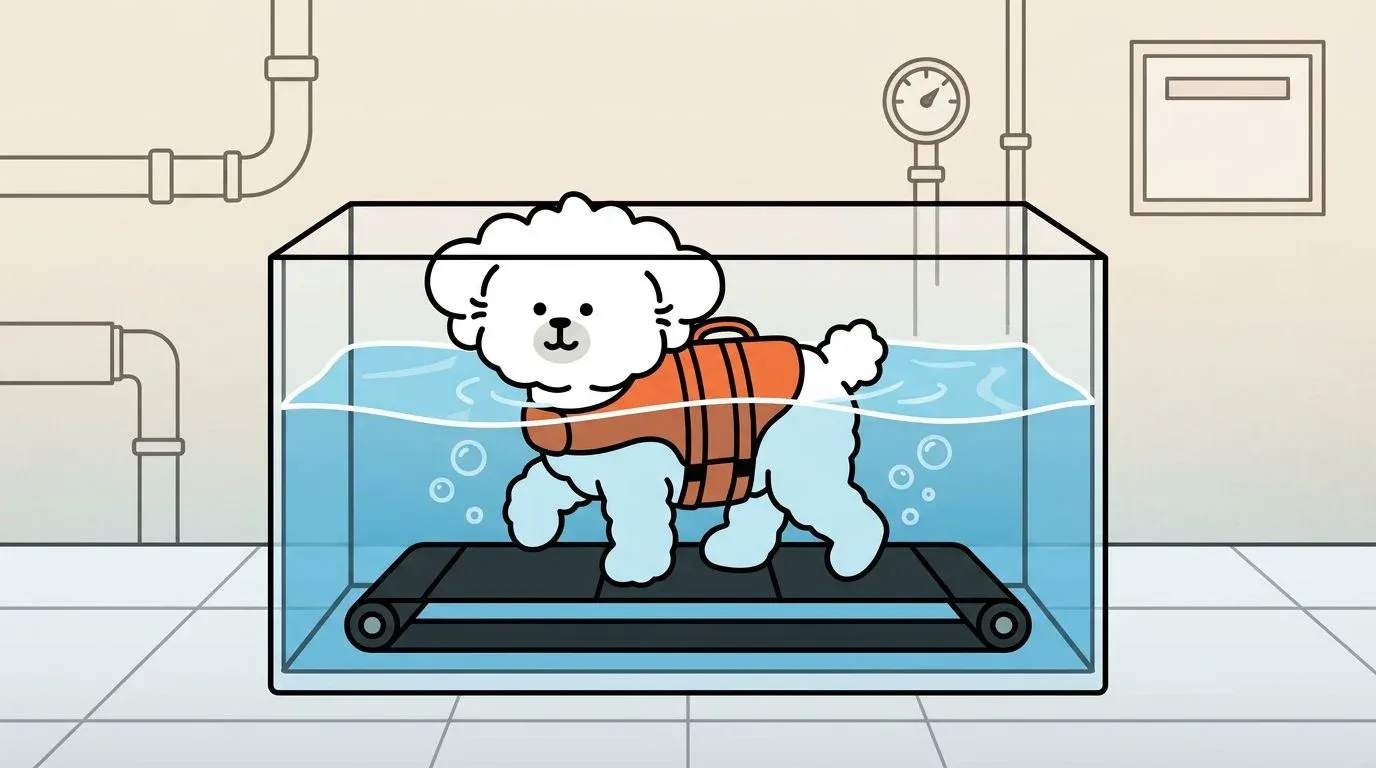
The underwater treadmill (UWTM) places the dog inside a sealed chamber that fills with temperature-controlled water. The treadmill belt moves at a set speed while the therapist adjusts water depth to fine-tune the percentage of body weight the dog bears. This precision makes UWTM the preferred choice for post-surgical cases, neurological conditions, and any situation where gait pattern correction is the goal.
Therapeutic swimming is more appropriate for dogs that need maximum unweighting — such as those with severe hip dysplasia or advanced arthritis — and for cardiovascular conditioning. Dogs must be competent, calm swimmers, and therapist-to-patient ratio must remain high for safety.
Which Dogs Benefit from Hydrotherapy?
Hydrotherapy is not a single intervention. Understanding which modality fits which condition helps owners set realistic expectations before the first session.
Post-Surgical Recovery (ACL/CCL, Patellar Luxation, TPLO)
Orthopedic surgery creates a challenge: the dog needs movement to rebuild muscle and prevent scar tissue adhesions, but the healing tissues cannot tolerate the impact of normal land exercise. Hydrotherapy resolves this tension.
After cranial cruciate ligament repair (TPLO or TTA procedures) or post-surgical rehabilitation for joint procedures, water therapy typically begins once the incision is fully healed — usually 1–2 weeks after suture removal, with the operating surgeon’s clearance. Early aquatic therapy has been shown to reduce muscle atrophy, maintain joint range of motion, and shorten the return-to-function timeline compared with rest alone.
For patellar luxation rehabilitation exercises, the underwater treadmill allows the quadriceps and hamstrings to be loaded progressively without the patellar compression forces that accompany land-based stair climbing or jumping. This is particularly valuable in Grade III–IV patellar luxation cases that require surgical correction.
Chronic Joint Conditions: Arthritis, Hip Dysplasia, IVDD
Dogs with canine osteoarthritis face a chronic management challenge: they need regular exercise to maintain muscle mass and joint health, but exercise on hard surfaces accelerates cartilage wear and causes pain flares. Hydrotherapy provides a sustainable middle ground.
In a 2021 study published in Frontiers in Veterinary Science, dogs with chronic elbow osteoarthritis who completed 6 weeks of aquatic treadmill therapy showed significant improvements in ground reaction force measurements (an objective indicator of limb use) compared with control groups. Dogs with hip dysplasia benefit similarly, with water therapy reducing compensatory gait patterns that otherwise place excessive load on the lumbar spine.
For intervertebral disc disease (IVDD), hydrotherapy can facilitate neurological recovery by providing sensory feedback through hydrostatic pressure and allowing limb movement in dogs with partial weakness — though this requires careful assessment by a rehabilitation specialist to avoid contraindicated positions.
Overweight Dogs Who Cannot Exercise on Land
Excess body weight is both a cause and a consequence of reduced activity in joint-compromised dogs. A dog in pain moves less; reduced movement causes weight gain; additional weight accelerates joint damage. This cycle is difficult to break with land exercise alone.
The relationship between dog obesity and joint health is well-established — every extra pound of body weight adds approximately 4–5 pounds of force through the joints during normal locomotion. Hydrotherapy allows overweight dogs to exercise at therapeutic intensity without the joint loading that would occur on land, providing a bridge to weight loss and improved baseline fitness.
Senior Dogs: Muscle Maintenance and Balance Training
In senior dogs, the progressive decline in muscle mass known as sarcopenia (age-related muscle atrophy) compounds the effects of arthritis and reduces overall functional ability. Hydrotherapy addresses both components simultaneously: the resistance of water strengthens remaining muscle fibers, while hydrostatic pressure and the unstable water surface challenge the dog’s balance and proprioceptive systems.
The warmth of hydrotherapy water (typically 78–86°F / 26–30°C) also provides direct pain relief through thermotherapy effects — vasodilation increases blood flow to joints and muscles, reducing stiffness before exercise begins.
The Science-Backed Benefits of Dog Water Therapy Rehabilitation
Muscle Strengthening Without Joint Stress
The biomechanical case for aquatic exercise is straightforward. Working against water resistance at 12–15 times the resistance of air means that even low-speed movements generate significant muscle activation. Electromyographic studies in canine rehabilitation research show that underwater treadmill walking at appropriate speeds activates the hindlimb musculature at levels comparable to land treadmill exercise — but with dramatically reduced peak vertical ground reaction forces (impact loading on joints).
This combination is clinically significant: the muscle-building stimulus is preserved while the joint-damaging stimulus is removed.
Improved Range of Motion
Joint range of motion (ROM) decreases with pain, inflammation, and disuse. After surgery or during arthritis flares, dogs instinctively guard painful joints, gradually losing mobility. The warm water environment in aquatic therapy reduces protective guarding by decreasing pain signals, while the fluid movement required by swimming or treadmill walking takes joints through a wider ROM than a dog would voluntarily use on land.
Studies in canine rehabilitation consistently report improved passive and active ROM measurements following structured aquatic therapy programs, with effects most pronounced in the hip and elbow joints.
Pain Relief and Inflammation Reduction
Multiple mechanisms contribute to pain relief during and after hydrotherapy:
- Thermotherapy: Warm water dilates blood vessels, increasing oxygen delivery to inflamed tissues and accelerating removal of metabolic waste products.
- Gate control effect: Tactile stimulation from water movement activates sensory nerve fibers that compete with and partially block pain signal transmission (the same principle as rubbing a bumped elbow).
- Endorphin release: Aerobic exercise in any medium increases endogenous opioid levels, providing systemic pain modulation.
For dogs managing chronic pain with canine arthritis symptoms, this multi-mechanism pain relief is one of the most valued clinical outcomes of aquatic therapy.
Cardiovascular Fitness and Weight Management
Swimming and underwater treadmill work at therapeutic speeds elevate heart rate into training zones comparable to moderate-intensity land exercise. For dogs whose land exercise is severely limited by joint pain, hydrotherapy may be the only modality through which they can achieve cardiovascular conditioning. Improved cardiovascular fitness supports overall metabolism, contributes to weight management, and improves stamina for daily activities.
What to Expect During a Hydrotherapy Session
Initial Assessment and Treatment Planning
A responsible hydrotherapy program does not begin in the water. Before the first aquatic session, a certified rehabilitation therapist conducts a comprehensive physical evaluation that typically includes:
- Orthopedic and neurological examination
- Gait analysis (often recorded on video)
- Joint range of motion measurements
- Muscle mass assessment (often using tape measurements or visual scoring systems)
- Pain assessment and behavioral scoring
This assessment establishes baseline values against which progress will be measured, and it informs the specific prescription: modality (treadmill vs. swimming), water depth, speed, session duration, and frequency. Owners should bring veterinary records, recent radiographs if available, and a completed health history form.
A Typical Session: Warm-Up, Exercise, Cool-Down
A standard hydrotherapy session follows a structured progression:
Warm-up (5 minutes): For treadmill sessions, the dog enters the chamber and the water fills to the prescribed depth. The belt begins at low speed, allowing the dog to acclimate to the environment and begin warming up joints and muscles. For pool sessions, gentle supported movement in shallow water serves the same purpose.
Active exercise (15–20 minutes): The therapist adjusts treadmill speed and, if needed, water depth to achieve the target workload. The therapist continuously monitors the dog’s gait pattern, breathing, fatigue signs, and comfort level. Breaks are incorporated as needed. For swimming sessions, the therapist supports the dog through the water and guides direction.
Cool-down (5 minutes): Belt speed decreases and the water level is lowered. The dog exits and is thoroughly dried (hypothermia risk is real, especially in short-coated or small breeds). The therapist notes observations and discusses progress with the owner.
Total facility time including drying and owner communication is typically 45–60 minutes per session.
Frequency and Duration Guidelines
| Phase | Typical Frequency | Program Duration |
|---|---|---|
| Acute rehabilitation (post-surgery) | 3x per week | 4–6 weeks |
| Subacute / transition | 2x per week | 4–6 weeks |
| Maintenance (chronic conditions) | 1x per week or biweekly | Ongoing |
Most structured rehabilitation programs run 8–12 weeks, with reassessment at 4-week intervals. Progress measurements (ROM, muscle mass, gait scores) determine whether frequency increases, decreases, or the protocol changes.
Owners should note that response varies considerably. Some dogs show measurable gait improvement within 3–4 sessions; dogs with severe muscle atrophy or advanced arthritis may require 6–8 sessions before functional gains become apparent at home. Patience and consistent attendance are more predictive of outcomes than any single session.
Safe Water Activities You Can Try at Home
Professional hydrotherapy is the gold standard, but structured at-home water activities can serve as valuable supplementation between clinic visits — or as entry-level rehabilitation for dogs in areas without accessible facilities.
Step-by-Step Introduction to Water
Equipment needed: A well-fitting canine life jacket (not optional for safety), water thermometer, non-slip surface, and a calm, shallow water environment.
Step 1 — Acclimation without water. Let the dog investigate the life jacket, pool, or bathtub over several sessions before introducing water. Reward calm, curious behavior.
Step 2 — Shallow wading. Fill a child’s pool or use a calm, shallow natural water source to a depth of just a few inches — enough for the dog’s paws to get wet but no deeper. Walk the dog through this water on leash at a relaxed pace. Target water temperature: 78–86°F (26–30°C). Cold water (below 70°F) causes muscle guarding and negates therapeutic benefit.
Step 3 — Progressive depth increase. Over multiple sessions (days to weeks, not hours), increase water depth incrementally. Observe the dog’s gait for signs of discomfort or overexertion. Stop and return to shallower water if limping worsens.
Step 4 — Supported swimming (optional). For dogs comfortable in water up to shoulder depth, brief supported swimming with the owner’s hands under the dog’s abdomen provides gentle full-body exercise. Session duration: 2–5 minutes initially, maximum 10 minutes for fit dogs.
Water temperature matters more than most owners realize. Cold water causes muscles to contract protectively, increasing joint compression and negating most therapeutic benefits. Always use a thermometer.
Precautions and Contraindications
At-home water exercise is appropriate for many dogs, but certain conditions require professional oversight or make aquatic exercise inadvisable:
Contraindications (water exercise should not be attempted):
- Open wounds, suture sites, or active skin infections
- Uncontrolled cardiac disease or severe respiratory compromise
- Active seizure disorder (drowning risk if seizure occurs in water)
- Uncontrolled infectious disease (systemic illness)
- Fever
Conditions requiring veterinary clearance before starting:
- Any dog within 2 weeks of surgery
- Known cardiac murmur or arrhythmia
- Severe spinal cord compression
For dogs combining hydrotherapy with other modalities, near-infrared therapy for dogs is frequently used alongside aquatic therapy — NIR applied before sessions helps warm deep tissues and improve circulation, while at-home NIR therapy devices offer a practical option for between-session pain management.
Life jackets are non-negotiable for at-home water activities regardless of the dog’s swimming ability. A dog in pain or post-surgery can fatigue rapidly and unexpectedly.
FAQ
How much does dog hydrotherapy cost?
Is hydrotherapy safe for all dog breeds?
How soon after surgery can a dog start hydrotherapy?
What if my dog is afraid of water?
How do I find a certified canine hydrotherapy facility?
Related Articles
Cat Spring Shedding: 5 Vet-Backed Steps to Control the Fur
Cat spring shedding explained: why it happens, how to tell normal from abnormal, and 5 vet-backed steps to manage fur and prevent hairballs.
Dog Joint Surgery Recovery: A Vet-Based Week-by-Week Rehab Guide
Dog joint surgery recovery guide covering TPLO, patellar luxation, hip surgery, and disc surgery. Week-by-week rehab timeline and home care protocols.
Red Light Therapy for Dogs at Home: A Science-Based Safety Guide
Learn how red light and near-infrared therapy works for dogs, what the research actually shows, and how to use it safely at home — with dosimetry guidance.
Luxating Patella Exercises for Dogs: A Grade-by-Grade Home Rehab Guide
Grade-specific exercises for dogs with luxating patella — from foundation moves for Grade I-II to aquatic alternatives. Includes reps, sets, and a safety checklist.
How Near-Infrared Therapy Works for Dogs
Discover how near-infrared (NIR) therapy helps relieve joint pain and inflammation in dogs through scientific mechanisms.
Senior Dog Joint Care Guide
A comprehensive guide to maintaining joint health and managing pain in aging dogs.
How to Safely Restart Your Dog's Activity After Winter: A Spring Joint Care Guide
Spring dog joint care guide: assess winter deconditioning, follow a 4-week progressive activity plan, and spot warning signs before they become injuries.