 Cirius Petpedia
 How Near-Infrared Therapy Works for Dogs
What Is Near-Infrared Light?
Near-infrared (NIR) light occupies the portion of the electromagnetic spectrum just beyond the red end of visible light, spanning wavelengths from approximately 700 to 1400 nanometers. Unlike ultraviolet radiation, which damages biological tissue, or X-rays, which pass through the body largely unimpeded, near-infrared light interacts constructively with living cells. It penetrates through the skin and underlying tissue layers to reach muscles, tendons, joint capsules, and bone surfaces.
The term “near-infrared therapy” (also called photobiomodulation or low-level light therapy) describes the therapeutic application of this light. Devices emit NIR wavelengths — most commonly in the 800 to 1100 nm range — at controlled power levels. The light is absorbed by specific molecular targets within cells, triggering a cascade of biological responses that reduce pain and inflammation while promoting tissue repair.
This is not a new idea. The physiological effects of specific light wavelengths on tissue have been studied since the 1960s, and the body of peer-reviewed research now spans thousands of studies across human medicine, veterinary medicine, and basic cell biology.
How NIR Therapy Works: The Mechanism
Cellular Energy Production
The primary target of near-infrared light within cells is cytochrome c oxidase, an enzyme embedded in the inner membrane of the mitochondria — the cell’s energy-producing organelles. Cytochrome c oxidase plays a central role in the electron transport chain, the process by which cells convert oxygen and nutrients into ATP (adenosine triphosphate), the molecule that powers virtually every cellular function.
In damaged, inflamed, or aging tissue, mitochondrial function is suppressed. Nitric oxide — a molecule produced in greater quantities under inflammatory conditions — binds to cytochrome c oxidase and blocks its activity, essentially reducing the cell’s energy output at precisely the moment when energy is most needed for repair.
Near-infrared light at the right wavelengths displaces nitric oxide from cytochrome c oxidase, restoring the enzyme’s activity. The result is a measurable increase in ATP production. Cells with restored energy output function better: they repair damaged proteins more efficiently, maintain ion gradients that support proper signaling, and mount more effective anti-inflammatory responses.
Improved Blood Flow and Microcirculation
NIR therapy promotes the release of nitric oxide into the local vasculature (blood vessels), where — unlike its inhibitory role in mitochondria — it acts as a potent vasodilator. Blood vessels in the treated area relax and widen, increasing blood flow to the tissue.
This enhanced microcirculation serves multiple purposes. It delivers more oxygen and nutrients to tissues undergoing repair. It clears metabolic waste products, including inflammatory mediators, from the local environment. It also reduces the localized tissue hypoxia (oxygen deficit) that often develops in chronically inflamed joints, where swelling compresses small blood vessels and restricts flow.
Reduction of Inflammation
Chronic inflammation in joints involves a complex network of pro-inflammatory signaling molecules including prostaglandins, interleukins (particularly IL-1 and IL-6), tumor necrosis factor-alpha (TNF-alpha), and reactive oxygen species. NIR therapy modulates several points in this network.
It reduces nuclear factor kappa B (NF-kB) activation, a master regulator of inflammatory gene expression. It decreases the production of pro-inflammatory prostaglandins. It upregulates antioxidant defenses, neutralizing the reactive oxygen species that damage cartilage, synovial membranes, and surrounding soft tissue. Multiple studies in animal models have demonstrated measurable reductions in joint inflammation markers following NIR therapy.
Pain Signal Modulation
Beyond its anti-inflammatory effects, NIR therapy directly influences pain signaling. It reduces the sensitivity of nociceptors — the sensory nerve endings that detect and transmit pain signals — in treated tissue. It also promotes the release of endorphins and enkephalins, the body’s endogenous pain-relieving compounds.
Central sensitization — the phenomenon where the central nervous system becomes hypersensitized to pain signals after prolonged chronic pain — is partly addressed by NIR therapy’s effect on peripheral pain signal input. By reducing the volume of pain signals arriving from the treated joint, it helps prevent and partially reverse this amplification.
Scientific Research and Evidence
The evidence base supporting photobiomodulation in veterinary medicine continues to grow. Several key findings are relevant to the most common applications in dogs:
A 2018 study published in Photomedicine and Laser Surgery evaluated NIR therapy in dogs with hip osteoarthritis and found statistically significant reductions in lameness scores and owner-assessed pain scores compared to sham treatment. Dogs receiving active NIR therapy also showed improved range of motion in treated joints.
Research on post-surgical rehabilitation in dogs has consistently shown faster return to weight-bearing and reduced wound healing times when NIR therapy is incorporated into post-operative protocols. This is particularly relevant for dogs recovering from orthopedic procedures such as patellar luxation repair or cruciate ligament surgery.
Studies in the veterinary rehabilitation literature have documented NIR therapy’s effectiveness in managing chronic spinal pain, tendon injuries, and muscle soreness — conditions frequently co-occurring with joint disease in aging dogs.
In human medicine, systematic reviews and meta-analyses of photobiomodulation for osteoarthritis have found meaningful reductions in pain scores and improved physical function, providing strong mechanistic support for the effects observed in canine clinical studies.
Target Areas for Dogs
NIR therapy can be applied to any joint or soft tissue region, but several areas are particularly relevant given the most common orthopedic conditions in dogs:
Knee (stifle) joint: Dogs with patellar luxation or cruciate ligament disease benefit from NIR therapy applied to the medial and lateral aspects of the knee. The treatment addresses secondary inflammation and provides pain relief both before surgical intervention and during post-operative recovery.
Hips: Hip dysplasia and hip osteoarthritis are among the most common sources of chronic pain in dogs, particularly in large breeds. NIR therapy applied over the hip joints helps reduce inflammatory mediators within the joint capsule and improves mobility.
Spine and lumbar region: Intervertebral disc disease (IVDD) and spondylosis deformans (bony bridging of vertebrae) cause significant pain and mobility restriction. Spinal NIR therapy sessions reduce muscle tension, decrease spinal inflammation, and support nerve function.
Elbows: Elbow dysplasia is a common developmental condition in large breeds. NIR therapy over the elbow joint reduces pain and swelling, complementing other management strategies.
Shoulders: Bicipital tenosynovitis and shoulder osteoarthritis respond well to NIR therapy, particularly in active working or sporting dogs.
Multiple joints: Many older dogs have arthritis in several joints simultaneously. Systematic rotation through affected areas during daily sessions provides cumulative benefit across the whole musculoskeletal system. See our Dog Arthritis Symptoms and Management guide for the broader arthritis management context.
How to Use NIR Therapy at Home
The practical application of NIR therapy at home requires attention to a few key variables: wavelength, power density (irradiance), treatment duration, and frequency. For a step-by-step protocol covering device selection, dosimetry calculations, and treatment zone positioning, see the red light therapy for dogs at home guide.
Wavelength selection: Effective photobiomodulation requires wavelengths in the range of 800 to 1100 nm. Devices operating outside this range (including many consumer “red light” devices operating at 630 to 660 nm) have less tissue penetration and reduced mitochondrial impact, particularly for deeper structures like hip joints.
Contact vs. non-contact application: Devices designed for skin contact deliver energy more efficiently, minimizing scatter losses at the air-skin interface. For dogs with thick coats, parting the fur to ensure skin contact significantly improves energy delivery to underlying tissue.
Treatment area: Position the device directly over the affected joint. Move slowly across the treatment area rather than holding the device stationary over a single point. This distributes the energy more evenly across the joint and surrounding soft tissue.
Duration: Each treatment area typically requires 15 to 30 minutes. Dogs with multiple affected joints benefit from sequential treatment of each area, though session length should be practical for both the dog and the owner.
Frequency: For acute or sub-acute conditions, daily sessions are recommended. For chronic maintenance, once or twice daily sessions sustain the anti-inflammatory benefit. Consistency matters more than intensity — regular moderate sessions outperform occasional intensive ones.
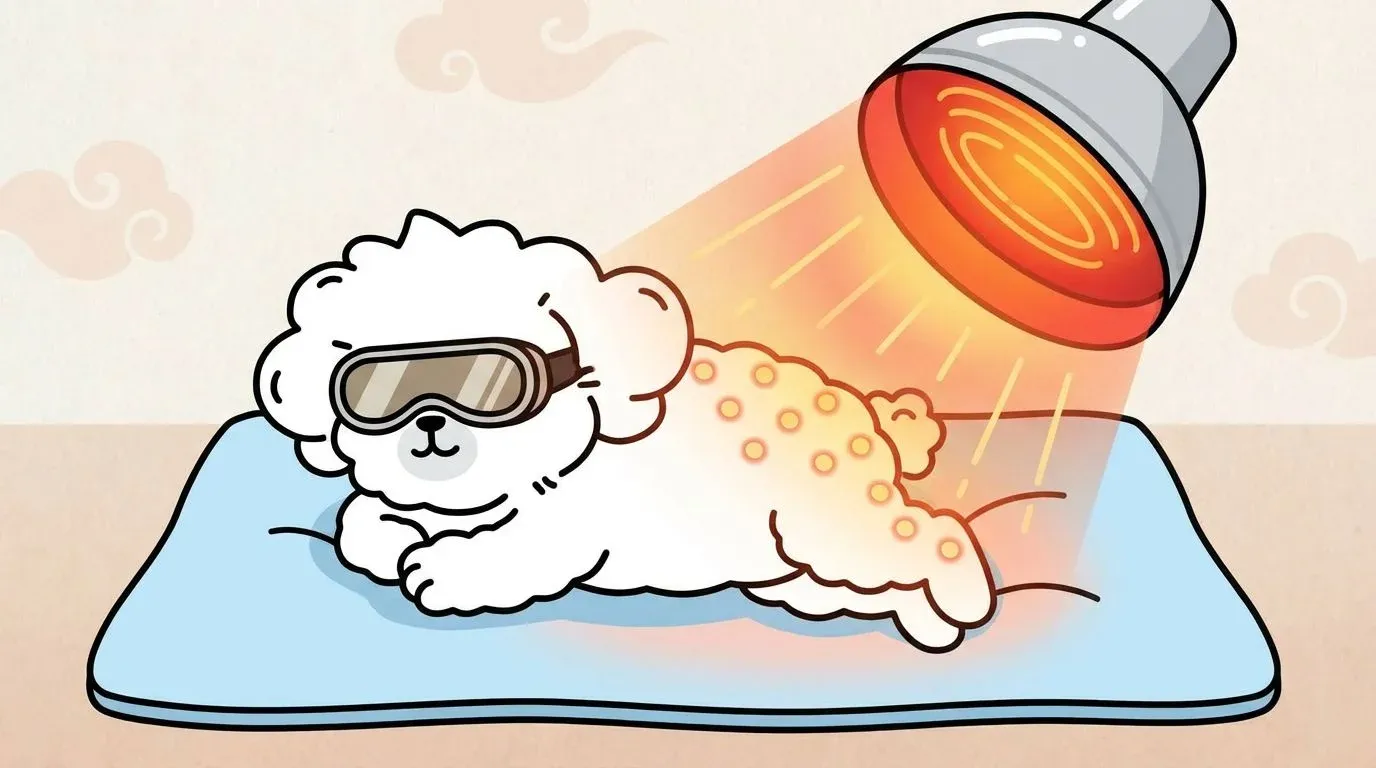
Positioning: Most dogs accept NIR therapy readily, especially with a comfortable surface to lie on. Sessions can coincide with rest periods or calm times during the day. Starting with shorter sessions allows the dog to acclimate to the device before progressing to full treatment duration.
Expected Benefits
Dogs receiving consistent NIR therapy for joint conditions typically show improvement across several dimensions:
- Reduced pain: less vocalization during joint manipulation, decreased guarding behavior, greater willingness to bear weight
- Improved mobility: longer and more confident strides, faster rising from rest, willingness to use stairs or navigate previously avoided terrain
- Reduced swelling: visible and palpable reduction in joint swelling around affected areas over the first two to four weeks
- Reduced medication dependence: some dogs managed on long-term NSAIDs achieve equivalent pain control with lower medication doses when NIR therapy is added, reducing drug-related organ stress
- Better sleep quality and mood: dogs in less chronic pain sleep more restfully and re-engage with family interactions and play
Individual responses vary. Dogs with moderate osteoarthritis or post-surgical joint inflammation typically respond most clearly. Dogs with very advanced joint disease may show subtler improvements, though even partial pain relief significantly improves quality of life in this population.
Precautions
NIR therapy has an excellent safety profile when used correctly. The following precautions apply:
Eye protection: Never direct NIR light toward the eyes — of the dog or the operator. NIR wavelengths are invisible, so the pupillary light reflex does not protect against retinal exposure. Use blocking goggles or keep the device directed away from the face.
Avoid active infection: Do not apply NIR therapy over areas with active skin infection or open infected wounds. The increased blood flow promoted by NIR therapy can theoretically support bacterial growth in infected tissue.
Cancer caution: Avoid treating directly over known tumor sites. The growth-promoting cellular effects of NIR therapy have not been fully characterized in the context of malignancy.
Implants: Metal surgical implants do not pose a safety risk with NIR therapy — the light energy is absorbed at the cellular level and does not heat metal implants meaningfully. This is relevant for dogs that have undergone orthopedic surgery.
Pregnancy: Avoid applying NIR therapy over the abdomen of pregnant dogs as a precaution, given limited data.
Cirius Pet NIR Therapy Products
Cirius Pet has developed NIR therapy devices designed specifically for the anatomy and coat characteristics of companion animals. The devices operate at validated therapeutic wavelengths with calibrated power output to ensure effective tissue penetration without risk of thermal injury.
The design prioritizes practical home use: devices are lightweight, quiet, and suitable for use while the dog rests comfortably. Treatment protocols are developed in consultation with veterinary rehabilitation specialists and are calibrated for the most common joint conditions in dogs, including those addressed throughout this site.
For dogs managing arthritis, recovering from orthopedic surgery, or entering the senior life stage with emerging joint stiffness, integrating NIR therapy into a comprehensive joint care plan addresses pain and inflammation at a biological level that supplements — and in some dogs partially replaces — the need for pharmaceutical intervention.
For a broader view of how NIR therapy fits into a complete approach to aging dog health, see our Senior Dog Joint Care Guide. For owners evaluating nutritional support alongside NIR therapy, the dog joint supplement guide provides an evidence-graded breakdown of which ingredients have genuine clinical support.
FAQ
Is near-infrared therapy safe for dogs?
How long should each session last?
When will I see results from NIR therapy?
Related Articles

6 Reasons Your Dog Smells Bad and How to Fix Each One
Wondering why does my dog smell bad? Learn the 6 most common causes of dog body odor—from ears to anal glands—and get a practical fix for each one.

Dog Poop Color Chart: What Each Color Means and When to See a Vet
Complete dog poop color chart covering brown, black, red, yellow, grey, and green stool—plus consistency, mucus, and smell to pinpoint what's wrong.

How to Clean Dog Eye Discharge: Color Guide and Care
Dog eye discharge explained by color—clear, yellow, green, brown. Step-by-step cleaning guide, breed-specific tips, and when to see the vet.