 Cirius Petpedia
 Luxating Patella Exercises for Dogs: A Grade-by-Grade Home Rehab Guide
Your dog gets a luxating patella diagnosis. The vet explains the grade, maybe mentions surgery options, and then you go home wondering: what can I actually do today to help?
For many dogs — particularly those at Grade I or Grade II — the answer includes a structured home exercise program. The quadriceps, hamstrings, and hip muscles surrounding the knee work as a dynamic brace. Strengthen them, and the joint becomes more stable even when the groove is too shallow to hold the patella perfectly. That’s the core logic behind conservative management for a luxating patella.
This guide gives you a grade-matched exercise program: specific movements, reps, sets, and frequency you can start using at home. It also tells you exactly when to stop and call the vet.
Before anything else: read this guide with your veterinarian. Use it as a starting point for a conversation, not a replacement for one.
Understanding Patellar Luxation and Exercise
Why Muscle Strengthening Matters for a Luxating Patella
The patella (kneecap) sits in a groove at the end of the femur and is held in position by a combination of bony architecture and soft tissue — the quadriceps tendon above and the patellar ligament below. When the groove is too shallow or the bony landmarks are slightly misaligned, the patella slips to the inside (medial luxation, by far the most common in small breeds) or outside of the leg.
Here’s where exercise becomes relevant: the quadriceps muscles, when strong, pull the patella upward through the groove and reduce lateral drift. The hip abductors and external rotators stabilize the entire limb alignment, taking stress off the knee. Studies in canine rehabilitation consistently show that muscle mass around an unstable joint is one of the most modifiable protective factors for dogs managed conservatively. A 2020 review in the Journal of Veterinary Rehabilitation noted that targeted strengthening was a core pillar of non-surgical patellar luxation protocols, particularly for Grades I and II.
For the complete picture of what causes luxation and how grades are determined, see our comprehensive guide to patellar luxation in dogs.
Before You Start: Get Your Vet’s Clearance
Not every grade is appropriate for home exercise — and the exercises appropriate for a Grade I dog are different from those for a Grade III. This matters a lot:
- Grade I: Conservative management including exercise is generally appropriate as the primary approach. The patella returns to the groove on its own and symptoms are minimal.
- Grade II: Exercise is often appropriate, particularly in younger dogs or when the owner wants to trial conservative management before surgery. Vet guidance on which exercises are safe is essential.
- Grade III-IV: Surgery is usually recommended. Exercise may play a role post-operatively during formal rehabilitation, but home-directed strengthening before surgical correction can sometimes worsen symptoms. Do not use this program for Grade III or IV without explicit veterinary approval.
Ask your vet these specific questions before starting:
- What grade is my dog’s luxation?
- Is conservative management appropriate for this dog, or is surgery the recommended path?
- Are there any movements I should avoid given this dog’s specific anatomy?
- Should I work with a certified canine rehabilitation therapist (CCRT)?
Setting Up for Safe Exercise
Creating a Non-Slip Exercise Area
Flooring is not a small detail. A dog with a luxating patella on a slippery floor is being asked to stabilize an already unstable joint while fighting for traction — that’s how flare-ups happen. Before your first session:
- Clear a space at least 6×6 feet on carpet, yoga mat, rubber mat, or non-slip rug
- If you exercise outdoors, choose a flat, dry grass surface or a textured concrete path
- Avoid tile, hardwood, and linoleum for the duration of exercises
- Check that the mat doesn’t slide or bunch under the dog’s weight
Equipment You’ll Need
The good news: this program requires almost no special equipment. For most exercises you need:
| Item | Purpose |
|---|---|
| Non-slip mat or carpet | Safe footing for all exercises |
| High-value treats (small, soft) | Luring body position without jarring movements |
| Treat pouch or small bowl | Keeps your hands free |
| Firm cushion or folded yoga mat | Elevated surface for balance work |
| Leash | Controlled movement in incline work |
| Watch or phone timer | Tracking hold durations |
Cavaletti rails (Step 2 exercises) can be improvised with pool noodles laid on the floor or smooth dowels balanced across low books. No need for specialized equipment.
Assessing Your Dog’s Current Condition
Before each session, spend 60 seconds observing your dog’s baseline:
- Does the dog bear weight evenly on all four legs when standing?
- Is there any swelling around the knee compared to the other leg?
- Does the dog seem reluctant to extend the affected leg?
- Has there been a skipping episode in the last 24 hours?
If the dog is already showing active signs of pain or just had a luxation episode, skip that day’s exercise session. Rest is part of the program. A brief warm-up — a slow 5-minute leash walk — before any strengthening work helps increase blood flow to the joint and reduces injury risk.
Step 1: Foundation Exercises (Grade I-II)
These three exercises form the backbone of conservative management. They’re safe, low-impact, and directly target the muscle groups that stabilize the stifle (knee). Start here regardless of fitness level. Spend at least two weeks on this phase before progressing.
Sit-to-Stand (Puppy Squats)
What it does: The sit-to-stand is the canine equivalent of a squat. It activates the quadriceps and hip extensors through a controlled range of motion — the exact muscles that hold the patella in its groove. Canine rehabilitation protocols from institutions like the University of Tennessee’s Veterinary Teaching Hospital list this as a foundational strengthening exercise for patellar instability.
How to do it:
- Ask your dog to sit squarely (both hips down, not leaning to one side). If your dog always sits with weight on one side, gently reposition. A lopsided sit shifts load asymmetrically.
- Lure the dog to a standing position using a treat held at nose height, moving slowly forward and slightly upward — not to the side. The movement should be a smooth, controlled rise.
- Once fully standing (all four feet bearing weight), pause for 2 seconds.
- Ask for a sit again. Repeat.
Prescription:
- Sets: 2-3
- Reps per set: 8-10
- Rest between sets: 60 seconds
- Frequency: Once daily, 5 days per week
Tip: If the dog repeatedly sits with the affected leg extended to the side, try placing a low barrier (rolled towel) on that side to encourage a square sit. A wide, asymmetric sit reduces loading on the recovering limb.
Three-Leg Balance Holds
What it does: Lifting one limb forces the dog to recruit stabilizer muscles in the remaining three legs. When you lift the unaffected hind leg, the affected hind leg and its surrounding musculature must work harder to maintain balance. This is a targeted method for loading the affected limb in a controlled way.
How to do it:
- Stand your dog on the non-slip mat.
- Gently lift the unaffected hind leg a few inches off the ground and hold it up (or ask a helper to hold it).
- The dog now bears weight on the affected hind leg, both front legs, and the unaffected front leg.
- Hold for 10-15 seconds. Allow the dog to rest all four feet, then repeat.
- As the dog grows stronger (after 1-2 weeks), increase holds to 20-30 seconds.
Prescription:
- Sets: 2
- Holds per set: 5
- Hold duration: 10-15 seconds (working toward 30 seconds)
- Frequency: Once daily, 5 days per week
Caution: If the dog struggles significantly to maintain position or shows distress, reduce hold time. This exercise should feel challenging but controlled. Never force the dog to maintain a position it’s actively fighting.
Passive Range of Motion Stretches
What it does: Passive range of motion (PROM) keeps the joint mobile without requiring active muscle work from the dog. For a dog that has been compensating with an abnormal gait, PROM helps prevent muscle shortening and maintains full joint mobility. It’s also an opportunity to assess the joint’s response — does the knee move freely, or is there resistance?
How to do it:
- Have the dog lie on a padded surface on their side, affected leg up.
- Support the leg with both hands — one hand at the thigh, one near the lower leg.
- Slowly flex (bend) the knee toward the dog’s body, moving to the point of natural resistance (not beyond). Hold gently for 5 seconds.
- Slowly extend (straighten) the leg to the point of natural resistance. Hold for 5 seconds.
- Move continuously through the comfortable range without forcing the end range.
Prescription:
- Repetitions: 10-15 complete flex-extend cycles
- Sessions per day: 1-2
- Frequency: Daily, 7 days per week (PROM is gentle enough for daily use)
What to feel for: Smooth, consistent movement through the range. Crepitus (a grinding or crackling sensation) is common in dogs with some cartilage change and is not a reason to stop on its own. Resistance, guarding, or pain response at the same point in the range on multiple occasions is worth reporting to your vet.
Step 2: Intermediate Strengthening
Introduce these exercises after 2-3 weeks on the foundation program, provided your dog is tolerating Step 1 comfortably with no worsening of symptoms. These exercises increase neuromuscular demand — the dog’s nervous system and muscles must coordinate more complex patterns of movement.
Figure Eights and Slow Circles
What it does: Walking in a curved path requires the dog to shift weight side-to-side and engage hip stabilizers asymmetrically. The curved path creates a gentle lateral load — training the abductors and rotators that help keep the patella centered. Figure eights are a staple of small-animal rehabilitation programs because they can be adjusted easily (tighter curve = more challenge).
How to do it:
- Place two objects (water bottles, shoes, small cones) on the mat, roughly 3-4 feet apart.
- Leash the dog and walk them slowly in a figure-eight pattern around the two objects.
- Maintain a pace slow enough that the dog takes deliberate steps — not an ambling walk.
- Complete 3 full figure-eight passes as one repetition.
Prescription:
- Sets: 3
- Reps (passes): 3 figure eights per set
- Rest between sets: 60-90 seconds
- Frequency: 3-4 times per week
Progression: As your dog builds strength, gradually tighten the spacing between objects (increasing the arc of the curve) over several weeks.
Incline Walking (Hill Work)
What it does: Walking uphill increases the recruitment of the quadriceps and hip extensors more than flat-ground walking. A 2019 study in Veterinary and Comparative Orthopaedics and Traumatology confirmed that uphill treadmill gait in dogs significantly increased hind limb muscle activation compared to level walking, supporting its use in post-operative and conservative rehabilitation programs.
How to do it:
- Choose a gentle, grassy incline — a slope of roughly 10-15 degrees is sufficient. Avoid steep hills, especially on slippery surfaces.
- Walk the dog slowly on a short leash up the incline. The focus is controlled, deliberate stepping — not aerobic exercise.
- Walk down the same slope slowly. The descent works the eccentric (lengthening) muscle action and is equally valuable.
- Rest on flat ground for 60 seconds between passes.
Prescription:
- Passes per session: 5-8 (up and back = 1 pass)
- Frequency: 3 times per week
- Session length: 5-8 minutes total of incline work
If no hill is available: A folded yoga mat or a ramp board for dogs achieves a similar muscle recruitment pattern indoors.
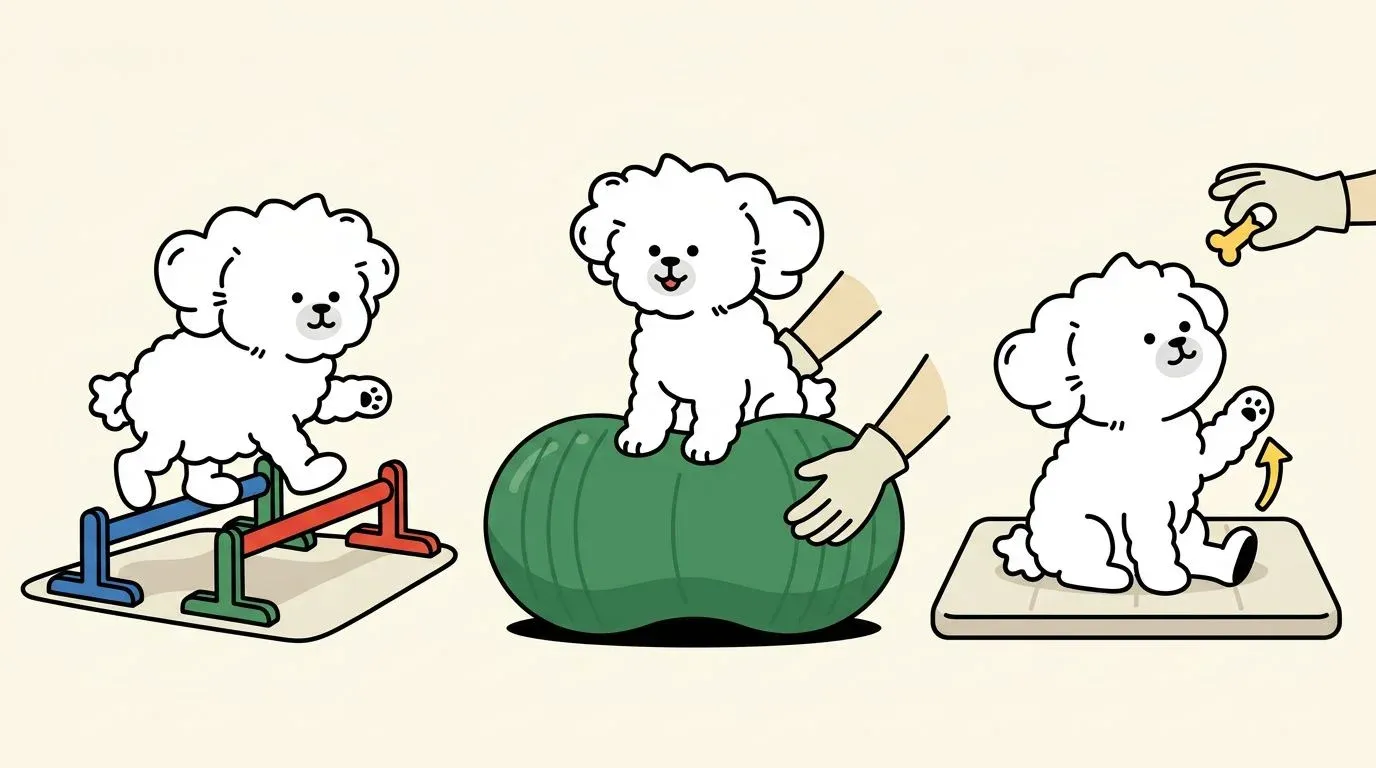
Cavaletti Rail Walking
What it does: Cavaletti rails are low obstacles placed at regular intervals that the dog must step over — originally a horse training tool adapted for canine rehab. Stepping over rails forces conscious limb placement, increases hip and knee flexion angles, and requires the dog to slow down and think through each step. They’re particularly effective for dogs that have learned to compensate with altered gait patterns.
How to do it:
- Lay 4-6 pool noodles, dowels, or lightweight poles on the floor in a straight line, spaced roughly one of your dog’s body lengths apart (approximately 12-18 inches for small breeds).
- Walk the dog over the rails on a loose leash at a slow, deliberate pace.
- The goal is clean, high-stepping footfalls — the dog lifting each paw consciously over each rail. If your dog scatters the rails or rushes through, slow the pace further.
Prescription:
- Passes per session: 4-6 (one full traverse of all rails = 1 pass)
- Sets: 2-3
- Frequency: 3-4 times per week
Progression: Begin with the rails flat on the floor. As the dog steps confidently, raise each rail by placing it on low books or foam blocks (2-3 inches of height) to increase hip and knee flexion further.
Step 3: Aquatic Exercise Options
Benefits of Hydrotherapy for Luxating Patella
Water-based exercise occupies a unique position in canine rehabilitation because buoyancy reduces the compressive load on joints while resistance trains muscles. A dog exercising in water bears only a fraction of its body weight on the affected limb, which means it can move through a greater range of motion and work muscles more thoroughly than on land — without the pain or impact that sometimes limits land-based exercise.
For dogs with luxating patella, the primary benefits of hydrotherapy are:
- Reduced joint loading: Buoyancy decreases compressive force at the stifle, allowing pain-free movement through the full range of motion
- Improved muscle recruitment: Water resistance engages muscle groups throughout the stroke that are difficult to isolate in land exercises
- Gait normalization: Underwater treadmill therapy in particular promotes a more symmetrical, normal gait pattern — particularly useful for dogs that have developed compensatory movement habits
- Cardiovascular fitness without joint stress: Especially useful for overweight dogs where land exercise worsens symptoms
Hydrotherapy in a clinical setting (underwater treadmill at a veterinary rehabilitation center) is the most controlled and effective option. If your dog has been diagnosed with luxating patella and you’re committed to conservative management, asking for a referral to a certified canine rehabilitation therapist is worth pursuing.
Home Alternatives (Bathtub Walking, Shallow Pool)
Formal hydrotherapy isn’t always accessible. These home approaches provide a meaningful portion of the benefit at low or no cost:
Bathtub walking: Fill a bathtub or large plastic tub to a water level that reaches just above your dog’s elbows when standing. The water should be comfortably warm — approximately 90-95°F (32-35°C). Support the dog with a non-slip mat or folded towel on the tub floor. Encourage slow walking back and forth or small circles for 5-10 minutes. The resistance and buoyancy combination is gentle enough for Grade I-II dogs.
Kiddie pool / shallow garden pool: An inflatable kiddie pool filled to 6-8 inches of water gives a small dog room to walk slowly while working against water resistance. Conduct these sessions in warm weather and monitor the dog’s energy and tolerance carefully. Keep initial sessions short (3-5 minutes) and increase gradually.
Swimming (supervised): Dogs that are comfortable swimmers can swim in a pool or calm natural water (avoiding currents). Keep sessions brief and always remain within arm’s reach. Active swimming is more demanding than shallow-water walking, so start with 2-3 minutes and build slowly. Dogs in a pain flare or that are unsteady on the affected leg should not be asked to swim without professional supervision.
| Method | Ideal For | Session Length | Frequency |
|---|---|---|---|
| Underwater treadmill (clinic) | All grades, especially post-op | 15-20 min | 1-2x per week |
| Bathtub walking | Grade I-II, small breeds | 5-10 min | 3-4x per week |
| Kiddie pool walking | Grade I-II, warmer months | 5-10 min | 3-4x per week |
| Supervised swimming | Comfortable swimmers only | 2-5 min to start | 2-3x per week |
Red Flags: When to Stop Exercising
Every exercise session should be preceded by a quick condition check and followed by a brief observation period. The goal is to work the muscles without overloading a vulnerable joint.
Signs Your Dog Is in Pain During Exercise
Stop the session immediately if you observe:
- Sudden non-weight bearing: The dog completely lifts the affected leg and refuses to put it down
- Audible pain response: Yelping, whimpering, or crying during an exercise movement
- Flinching or snapping: The dog pulls away sharply, looks at the leg, or snaps when you touch or manipulate the area
- Significant asymmetry worsening: The dog shifts markedly more weight onto the front legs or the unaffected hind leg compared to the start of the session
- Sustained holding of the leg mid-session: If the dog held the leg for a step or two at the start of a session and this becomes constant during the session, stop
- Swelling after exercise: Visible or palpable swelling around the knee joint after completing exercises
A mild fatigue effect — the dog lying down after finishing the reps, or being less enthused at the end of the session — is normal. Distress during the exercises is not.
If a single session causes increased limping that persists more than 30 minutes post-exercise, reduce the exercise volume (fewer sets or reps) at the next session. If the worsening persists beyond 24 hours, pause the program and call your vet.
When to Return to the Veterinarian
Schedule a veterinary recheck if:
- The dog’s grade appears to have progressed (the leg is locking up more frequently or staying displaced longer than before)
- Lameness is now present even after exercise ends rather than just during it
- You notice muscle atrophy (visibly smaller thigh muscle) on the affected side
- The dog is increasingly reluctant to rise from rest, climb steps, or engage in normal daily activity
- A luxation episode occurred that required you to manually reposition the leg
- The dog has had two or more lameness flare-ups in a single week
Patellar luxation can progress from a manageable Grade II to a Grade III over months — particularly in active dogs, overweight dogs, or dogs with significant underlying skeletal deformity. Regular rechecks (every 3-4 months for conservatively managed cases) allow the vet to assess whether the current approach is still appropriate. Secondary arthritis is a common comorbidity worth monitoring; you can learn more about recognizing arthritis as a comorbidity.
For older dogs managing luxating patella alongside the general challenges of aging joints, the overall joint care for aging dogs guide provides a framework for integrating this exercise program into a broader senior care routine.
Some owners also incorporate near-infrared therapy alongside their exercise program. Applied after sessions, it supports muscle recovery and local circulation around the knee joint, and can be used consistently at home between veterinary visits.
A structured, consistent exercise program won’t eliminate luxating patella — but it gives you something real and actionable to do for your dog between vet visits. The dogs that do best with conservative management are the ones whose owners show up consistently: daily sit-to-stands, regular balance work, slow and deliberate hill walks. That daily investment in muscle strength is the closest thing to a brace your dog’s knee has.
Start with two weeks of foundation work. Reassess with your vet. Progress thoughtfully.
FAQ
Can exercises cure my dog's luxating patella?
How often should I do these exercises with my dog?
My dog hops on three legs sometimes but seems fine otherwise — should I still do these exercises?
Is hydrotherapy really necessary, or can I skip it?
What is the difference between passive range of motion and stretching?
Related Articles
Senior Dog Joint Care Guide
A comprehensive guide to maintaining joint health and managing pain in aging dogs.
How to Safely Restart Your Dog's Activity After Winter: A Spring Joint Care Guide
Spring dog joint care guide: assess winter deconditioning, follow a 4-week progressive activity plan, and spot warning signs before they become injuries.
How Near-Infrared Therapy Works for Dogs
Discover how near-infrared (NIR) therapy helps relieve joint pain and inflammation in dogs through scientific mechanisms.
Red Light Therapy for Dogs at Home: A Science-Based Safety Guide
Learn how red light and near-infrared therapy works for dogs, what the research actually shows, and how to use it safely at home — with dosimetry guidance.