 Cirius Petpedia
 How to Massage Your Dog's Joints: A Step-by-Step Home Guide for Every Condition
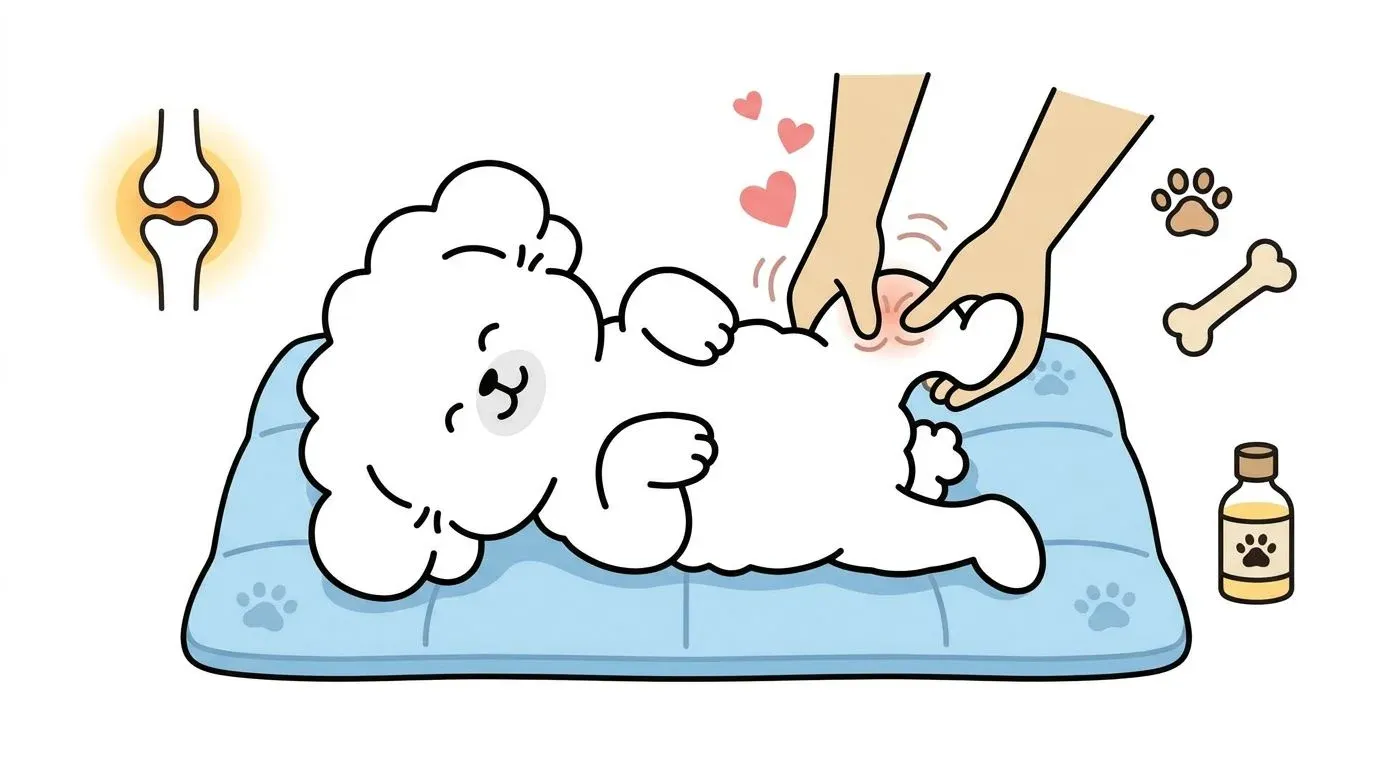
Your Labrador wakes up from a nap and takes three steps before her back legs find their rhythm. Your German Shepherd gets to the park, does one lap, then plants himself in the shade. You know something is wrong, and you want to do something about it between vet visits.
Dog joint massage is one of the most practical, evidence-supported home interventions available to you. A 2021 study of 527 dogs published in canine rehabilitation literature found that manual therapy—including massage—significantly reduced caregiver-reported pain scores in dogs with musculoskeletal conditions. But the benefits depend entirely on using the right technique on the right tissue at the right time.
This guide gives you a joint-by-joint, condition-specific protocol you can follow at home. It covers every major technique, the safety rules you must know before you start, and how to integrate massage with other therapies to get the most out of each session.
Why Joint Massage Matters for Your Dog
The Science Behind Canine Joint Massage
Massage does not repair cartilage or reverse the bone changes of degenerative joint disease. What it does—reliably and measurably—is address the secondary tissue damage that makes joint conditions so uncomfortable.
When a joint is chronically painful, the surrounding muscles go into a protective state called guarding. The muscles shorten, tighten, and restrict movement. That restricted movement feeds back into the joint, reducing synovial fluid circulation and accelerating wear. Massage interrupts this cycle by:
- Increasing local blood flow, which delivers oxygen and nutrients to muscle fibers while clearing inflammatory metabolites
- Stimulating mechanoreceptors in muscle and fascia, which modulates pain signals at the spinal cord level (the gate control mechanism)
- Triggering endorphin and serotonin release, which produces the visible relaxation response you will see in your dog within minutes of a well-executed session
- Improving passive range of motion by reducing myofascial adhesions that form when muscles are chronically shortened
Research in veterinary rehabilitation consistently shows improvements in gait symmetry, stride length, and activity levels in dogs receiving regular manual therapy alongside standard medical treatment.
Why You Should Never Massage the Joint Directly
This is the single most important rule in canine massage, and it is one most online guides either bury or skip entirely.
The joint capsule, cartilage, and synovial fluid are delicate structures. Direct pressure on an inflamed joint can compress already-irritated synovial tissue, increase intra-articular pressure, and worsen pain. The goal of joint massage is to treat the muscles, tendons, and fascia around the joint, not the joint itself.
Think of it as working the frame, not the window. You release the tight muscles that are pulling the joint out of optimal alignment and restricting its movement. The joint benefits indirectly.
The only exception is passive range of motion (PROM) exercises, in which you gently move the limb through its natural arc—a technique covered in detail in Step 5 below.
Signs Your Dog Needs Joint Massage
Your dog cannot tell you they are stiff, but their body communicates it clearly. Common indicators that massage may help include:
- Reluctance to rise after resting, especially first thing in the morning
- Stiffness that loosens up after a few minutes of movement
- Reduced stride length or altered gait on one or more limbs
- Visible muscle asymmetry (one side noticeably less developed)
- Sensitivity when touched near the hips, shoulders, or spine
- Decreased enthusiasm for activities they previously enjoyed
For a detailed breakdown of pain-related behavior in dogs, see recognizing pain behavior signs in dogs.
Before You Start: Safety Checklist
When NOT to Massage Your Dog
Massage is beneficial in chronic, stable conditions. It can cause harm in acute or unstable situations. Do not perform joint massage if your dog has any of the following:
| Condition | Why to Avoid |
|---|---|
| Acute inflammation (hot, swollen joint) | Massage increases blood flow and can worsen swelling |
| Recent surgery (within 2 weeks unless cleared by vet) | Risk of disrupting healing tissue or incision sites |
| Undiagnosed fracture or suspected bone injury | Manipulation can worsen displacement |
| Active infection or open wound near the area | Risk of spreading infection |
| Fever or systemic illness | Dog needs rest, not stimulation |
| Confirmed cancer in the area | Massage over tumors can theoretically promote spread |
| Thrombosis or cardiovascular instability | Increased circulation may be contraindicated |
When in doubt, call your vet before starting. If your dog has just been diagnosed with hip dysplasia and you are unsure of the current inflammatory state, get clearance first.
How to Prepare for a Massage Session
Setting and timing matter as much as technique.
Choose the right moment. Massage 20–30 minutes after light activity (a short walk), when muscles are warm and your dog is calm but not exhausted. Avoid immediately after heavy exercise or a meal.
Set the environment. A quiet room, low lighting, and a non-slip surface (yoga mat or carpet) help your dog relax. Turn off loud TVs and keep other pets out.
Wash your hands. Dry, clean hands give you better feedback through the tissue and reduce infection risk if your dog has any skin abrasions.
Check your dog’s baseline. Spend 30 seconds observing your dog before you touch them. Note which leg they favor, whether they are panting, and how they hold their posture. This baseline helps you track progress over weeks.
Gather what you need. Your hands, a towel to kneel on, and optionally a small amount of unscented oil for friction reduction if your dog has very short or sparse coat. High-value treats for reward.
5 Essential Massage Techniques for Dog Joints
These five techniques form the complete toolkit for canine joint massage. Each serves a distinct physiological purpose. Learn all five—you will use different combinations depending on the condition and joint you are targeting.
Effleurage: Gentle Gliding Strokes
What it does: Warms up tissue, spreads synovial fluid along fascial planes, calms the nervous system, and assesses tissue tension. Always the first and last technique in any session.
How to perform:
- Place both hands flat on the muscle belly, fingers together, with light contact—roughly the pressure you would use to smooth a wrinkled piece of fabric.
- Glide your hands slowly along the length of the muscle, always moving toward the heart (proximally on limbs).
- Maintain consistent speed: about one full stroke every 3–4 seconds.
- After each stroke, return with slightly less pressure before repositioning.
Pressure: 1–2 out of 10. You should feel the skin moving slightly over the underlying muscle, but no tissue compression.
Duration: 1–2 minutes per region as a warm-up; return to effleurage for 30–60 seconds between other techniques.
Breed adaptation: For large breeds (Labrador, Golden Retriever), use the full palm and slightly more surface area. For smaller breeds, use two or three fingers instead of the full hand.
Petrissage: Muscle Kneading
What it does: Breaks up myofascial adhesions, improves circulation within the muscle belly, releases chronic muscle tension. The core technique for working tight, guarding muscles.
How to perform:
- Position your thumbs and fingers around the muscle belly (not over bone).
- Gently lift the muscle tissue slightly away from the bone, then compress and release in a rhythmic kneading motion—similar to working bread dough.
- Work in small sections, moving along the muscle length.
- Never pinch the skin; the movement should engage the muscle layer.
Pressure: 3–5 out of 10. You should feel the muscle moving under your hands. If your dog tenses or looks back at you, reduce pressure.
Duration: 30–60 seconds per muscle group. Repeat 2–3 times.
Common mistake: Moving too fast. Slow, deliberate kneading (one cycle every 2–3 seconds) is more effective than rapid superficial squeezing.
Friction Massage: Circular Pressure
What it does: Targets specific adhesion points, tendon insertions, and areas of chronic tension. Highly localized technique used after the area is warmed with effleurage and petrissage.
How to perform:
- Identify a specific tight point using the pad of your thumb or index finger.
- Apply firm, small circular pressure—the skin should move with your finger, not slide under it.
- Work in circles approximately the size of a dime.
- After 10–15 seconds, move to an adjacent point.
Pressure: 4–6 out of 10. This technique reaches deeper tissue and should produce a mild “working” sensation, not pain.
Duration: 10–15 seconds per point, 3–5 points per session per region.
Important: Never apply friction directly over a bony prominence, a lymph node, or a joint line. Stay on muscle and tendon tissue.
Compression: Gentle Press and Release
What it does: Stimulates proprioceptors and mechanoreceptors, reduces hypertonic (overly contracted) muscle tone, and prepares tissue for range of motion work.
How to perform:
- Place the palm or heel of your hand over the belly of a large muscle group (quadriceps, hamstrings, trapezius).
- Apply steady downward pressure—slow enough that it takes 3 seconds to reach full depth.
- Hold for 5–10 seconds.
- Release slowly over 3 seconds.
- Move to the next position, overlapping slightly.
Pressure: 3–5 out of 10. The muscle should soften and “give” under your hand within a few seconds of holding pressure.
Duration: 3–5 compressions per muscle group.
Best for: Large muscle masses in large-breed dogs. Less applicable to small breeds due to limited muscle bulk.
Passive Range of Motion (PROM) Exercises
What it does: Maintains joint flexibility, prevents contracture, stimulates synovial fluid production, and preserves neuromuscular memory during recovery. Particularly important for post-surgical dogs.
How to perform:
- Support the limb proximal and distal to the joint (e.g., one hand above the stifle/knee, one below).
- Slowly flex the joint until you feel gentle resistance—do not force past this point.
- Hold for 3–5 seconds.
- Slowly extend back to the neutral position.
- Repeat 5–10 repetitions per joint.
Speed: Extremely slow. A full flex-and-extend cycle should take 8–10 seconds.
Stop immediately if: Your dog vocalizes, pulls the leg away sharply, or shows any other pain response.
Range: Only move within the joint’s comfortable, current range. Do not attempt to increase range aggressively—this takes weeks of consistent, gentle work.
Condition-Specific Massage Protocols
The techniques above are the tools. These protocols tell you which tools to use, in what order, and at what intensity for your dog’s specific condition.
Arthritis (Degenerative Joint Disease)
Arthritis produces chronic inflammation, cartilage breakdown, and secondary muscle compensations that develop over months or years. Dogs with arthritis typically present with diffuse muscle tension throughout the limbs and back rather than one focal problem area.
Primary target muscles: Quadriceps, hamstrings, iliopsoas, and paraspinal muscles (lumbar region for hind-end arthritis); supraspinatus and infraspinatus (shoulder arthritis in forelimbs).
Protocol:
- Effleurage over the full limb and back — 2 minutes
- Petrissage on quadriceps and hamstrings — 45 seconds each
- Effleurage return — 30 seconds
- Compression on large muscle masses — 3–4 cycles
- PROM for each affected joint — 5 repetitions each
- Final effleurage — 1 minute
Intensity: Keep at 2–4 out of 10. Arthritis often involves chronic low-grade inflammation; aggressive pressure worsens symptoms.
Frequency: Daily, 8–12 minutes per session.
NSAID note: Many dogs with arthritis are on veterinarian-prescribed NSAIDs. Massage complements this treatment by addressing muscle guarding that medication does not directly resolve. Do not discontinue NSAIDs without veterinary direction.
What to avoid: Direct pressure on any joint that feels warm or appears swollen. Skip that joint for the day and consult your vet if swelling persists.
Hip Dysplasia
Hip dysplasia causes laxity and eventually degenerative changes in the hip joint, leading to significant compensatory muscle loading in the hindquarters, lower back, and sometimes the forelimbs (as dogs shift weight forward).
Primary target muscles: Gluteal group, hamstrings, iliopsoas, quadratus lumborum, and the paraspinal erector spinae along the lumbar spine.
Protocol:
- Begin with 2 minutes of broad effleurage from lower back through hindquarters to hock
- Petrissage on the gluteal muscles — 60 seconds each side
- Effleurage — 30 seconds
- Friction massage along tendon insertions at the greater trochanter (bony prominence of the hip) — avoid pressing on the trochanter itself; work 1–2 cm lateral to it
- Petrissage on hamstrings — 45 seconds each
- Compression on lumbar paraspinals — 4 cycles
- Hip PROM: support the femur, gently flex and extend the hip through a comfortable arc — 8 repetitions each side
- Final effleurage — 90 seconds
Key difference from arthritis protocol: Spend more time on the gluteal and lumbar musculature. Hip dysplasia creates severe compensatory strain in these areas that is often more immediately uncomfortable than the hip joint itself.
Frequency: Daily to every other day. 10–15 minutes per session for large breeds.
Breed note: Golden Retrievers, Labrador Retrievers, and German Shepherds are among the most commonly affected breeds. Their larger muscle mass means you can apply slightly more pressure (3–5 range) than in smaller breeds.
Patellar Luxation
Patellar luxation is more common in small and toy breeds. The kneecap periodically slips out of its groove, creating compensatory tension in the quadriceps and medial thigh muscles that pull the patella out of alignment.
Primary target muscles: Quadriceps (especially the vastus medialis), iliopsoas, and sartorius.
Protocol:
- Effleurage along the full hindlimb — 90 seconds
- Petrissage on quadriceps belly — 45 seconds, working proximal to distal
- Gentle friction along the lateral quadriceps tendon (not over the patella)
- PROM for the stifle: flex and extend through the comfortable range — 5–8 repetitions
- Final effleurage — 60 seconds
Critical caution: Never attempt to manually reposition a luxated patella. If the kneecap is visibly out of place during a session, stop massage to that limb and contact your vet.
Intensity: 2–3 out of 10 maximum. Small breed musculature is more delicate.
Frequency: 5–8 minutes, once daily.
Post-Cruciate Ligament Surgery Rehab
Following TPLO or TTA surgery for a cruciate ligament tear, massage plays a critical role in managing muscle atrophy, reducing adhesion formation around the surgical site, and maintaining mobility in the non-operated joints.
Important: Do not begin post-surgical massage without clearance from your veterinary surgeon or a certified canine rehabilitation therapist (CCRT). The timeline below assumes you have that clearance.
Phase 1 (Days 14–28 post-surgery):
- Effleurage only, well away from the surgical site — 3–5 minutes
- Gentle PROM for the stifle — 5 repetitions, minimal range only
- Focus on maintaining comfort and reducing global muscle guarding
Phase 2 (Weeks 4–8):
- Add petrissage to the quadriceps and hamstrings as cleared by your rehab vet
- Expand PROM range gradually
- Begin addressing compensatory tension in the contralateral (opposite) limb, which has been overloaded
Phase 3 (Weeks 8+):
- Full protocol as tolerated, with gradually increasing intensity
- Add compression
- Maintain contralateral limb work throughout
For a complete post-surgical recovery framework, see dog joint surgery rehabilitation.
Joint-by-Joint Massage Guide
Front Legs: Shoulder, Elbow, and Wrist
Shoulder (glenohumeral joint): The supraspinatus, infraspinatus, and subscapularis muscles are the primary targets. These muscles attach along the scapula (shoulder blade) and stabilize the shoulder through all movement.
- Position your dog in lateral recumbency (lying on their side) or standing
- Effleurage from neck down to elbow: 90 seconds
- Petrissage on supraspinatus (the muscle that runs along the top of the shoulder blade): 45 seconds
- Friction along the supraspinatus tendon insertion where it meets the humerus: 10 seconds, 3 points
- PROM: cradle the elbow with one hand and the wrist with the other; slowly flex and extend the shoulder through its range — 5 repetitions
- Effleurage return: 45 seconds
Elbow (cubital joint): The triceps and biceps are the prime movers. Triceps tension is common in dogs compensating for shoulder problems.
- Petrissage on the triceps mass (back of the upper arm): 45 seconds
- Gentle friction along the lateral and medial collateral ligament areas (on either side of the elbow, not on the olecranon)
- PROM: one hand on upper arm, one on the forearm; flex and extend — 5 repetitions
Wrist/carpus: This joint is less commonly massaged but relevant in dogs with diffuse forelimb arthritis.
- Gentle effleurage only along the forearm muscles
- PROM with very small range: 5 repetitions
- No petrissage or friction directly at this joint
Large breed adaptation: Use full-hand effleurage and 4-finger petrissage. Apply 3–4 out of 10 pressure on the shoulder musculature.
Small breed adaptation: 2–3 finger effleurage, 2-finger petrissage. Keep all pressure at 2–3 out of 10.
Hind Legs: Hip, Knee, and Ankle
Hip: Follow the hip dysplasia protocol for the gluteal and lumbar approach. For dogs without dysplasia, simplify to:
- Effleurage over hindquarters: 90 seconds
- Petrissage on gluteal muscles: 45 seconds each side
- PROM: support the femur; flex the hip bringing the knee toward the belly, then extend — 5–8 repetitions
- Effleurage: 45 seconds
Knee/stifle: The quadriceps, hamstrings, and popliteus are the key muscles. This is the most clinically important joint to work around in dogs with cruciate disease and patellar luxation.
- Effleurage along the full hindlimb before targeting the stifle: 90 seconds
- Petrissage on the quadriceps belly (above the knee): 45 seconds
- Petrissage on the hamstring group (behind the knee and upper thigh): 45 seconds
- Friction along the lateral and medial retinaculum (tissue on either side of the patella, not over it): 10 seconds, 3 points
- PROM: flex and extend the stifle — 5–8 repetitions
- Effleurage: 45 seconds
Ankle/tarsus: Relevant in dogs with diffuse arthritis or post-surgery.
- Effleurage along the crus (lower leg): 60 seconds
- PROM: flex and extend the hock — 5 repetitions
- No friction or petrissage directly at the ankle joint
Spine and Surrounding Muscles
Spinal massage addresses the paraspinal muscles running along either side of the vertebral column. These are chronically overloaded in most dogs with hind-end joint disease as they compensate for reduced hind-limb function.
Technique:
- Position your dog standing or in sternal recumbency (lying on sternum)
- Place your thumbs on either side of the spine, fingers spread over the ribcage or hip
- Apply gentle effleurage from neck to tail: 2 full strokes
- Petrissage on the epaxial (paraspinal) muscles—the muscle bands running parallel to the spine: 60 seconds from shoulders to lumbar region
- Compression on the lumbar muscles (lower back): 4–5 cycles, 3–4 out of 10 pressure
- Return effleurage: 90 seconds
Critical rule: Never apply downward pressure directly on the vertebrae. Keep all pressure on the muscle tissue lateral to the spine. This is especially important in dogs with suspected or confirmed disc disease.
Building a Massage Routine
Duration and Frequency
| Dog’s Situation | Session Length | Frequency |
|---|---|---|
| Arthritis, stable | 8–12 min | Daily |
| Hip dysplasia | 10–15 min | Daily to every other day |
| Post-surgical (early phase) | 3–5 min | As directed by rehab vet |
| Post-surgical (later phase) | 8–12 min | Daily |
| Senior dog, preventive | 8–10 min | 3–4x per week |
| Young dog, maintenance | 5–8 min | 2–3x per week |
These are starting guidelines. Adjust based on your dog’s response. If they sleep well, move more freely the next day, and approach massage sessions willingly, you are on the right track. If they seem stiff or reluctant the day after, reduce duration and intensity.
The Warm-Up, Massage, Cool-Down Protocol
Every session should follow this three-part structure regardless of which specific protocol you are using:
Warm-Up (2 minutes) Full-body effleurage, light pressure, both sides. This is not optional—cold tissue responds poorly to deeper work and is at higher risk of micro-injury.
Massage (5–12 minutes) Condition-specific protocol as detailed above. Progress from effleurage to petrissage to friction/compression, then return to effleurage between techniques.
Cool-Down (1–2 minutes) Return to full-body light effleurage. End with a few slow strokes along the back and hindquarters. The cool-down signals the session is ending and helps maintain the relaxation response.
Adapting for Senior Dogs and Post-Surgery Recovery
Senior dogs (7+ years for large breeds, 10+ for small breeds):
- Reduce pressure by one point across all techniques
- Shorten sessions by 20–30%
- Allow more rest time between regions
- Watch for fatigue signals: heavy blinking, yawning, shifting weight
For a comprehensive approach to senior dog joint health, massage fits into a broader management plan that includes nutrition, appropriate exercise, and regular veterinary monitoring.
Post-surgery recovery:
- Follow your veterinary rehabilitation specialist’s protocol precisely
- Do not skip the contralateral limb—compensatory overloading is a real and underrecognized problem
- Keep a daily log of what you did, how your dog responded, and any changes in gait or behavior to report at follow-up appointments
Boosting Massage Results
Heat and Cold Therapy
Heat before massage: A warm compress (not hot) applied to the target area for 5–10 minutes before massage dilates local blood vessels, increases tissue extensibility, and makes muscle easier to work. Use a warm, damp towel wrapped in a dry cloth to prevent skin irritation. Ideal for chronic stiffness before a morning session.
Cold after massage (if needed): If massage produces any redness or warmth in the treated area, a cold pack wrapped in a thin cloth applied for 5–8 minutes reduces secondary inflammation. Not routinely needed but useful after first sessions or if you worked more deeply than usual.
When to use cold instead of heat: During acute flare-ups—joints that feel warm to the touch, appear swollen, or are causing obvious pain—ice is appropriate before any other intervention, and massage should be postponed.
For a deeper look at at-home NIR light therapy as a complementary approach alongside massage, that resource covers the evidence and practical protocols.
Combining with Joint Supplements
Massage addresses muscle and fascia; supplements work at the joint level. The two work through different mechanisms and genuinely complement each other.
Glucosamine and chondroitin support cartilage matrix synthesis. Multiple studies show modest but consistent benefits in dogs with osteoarthritis when used consistently over 4–8 weeks.
Omega-3 fatty acids (EPA and DHA from marine sources) reduce the production of pro-inflammatory prostaglandins. Omega-3 supplementation for dog joints is one of the most evidence-supported nutritional interventions for canine joint disease.
Collagen peptides provide building blocks for connective tissue repair. Research in veterinary populations is growing; see collagen supplementation for dog joint health for current evidence.
Introduce any new supplement gradually and under veterinary guidance, particularly if your dog is on NSAIDs (drug-nutrient interactions exist).
Synergy with Hydrotherapy
Hydrotherapy for dog joint care—specifically underwater treadmill therapy—addresses what massage cannot: active muscle strengthening through resistance exercise. The buoyancy of water reduces joint loading while allowing full range of motion and building the muscle mass needed to stabilize compromised joints.
The ideal combination is massage before or after hydrotherapy sessions:
- Massage before: reduces myofascial tension and prepares tissue for active work
- Massage after: addresses any residual tightness from the exercise session and accelerates recovery
How to Tell If the Massage Is Working
Positive Response Signs
Watch for these indicators during and after sessions:
During massage:
- Audible sighing or slow exhale when you hit a tight spot correctly
- Visible muscle “melting” under your hands—a palpable softening and heaviness
- Lowered head and relaxed jaw
- Slower blinking or closed eyes
- Leaning into your touch rather than pulling away
In the 24–48 hours following massage:
- Easier rising from rest (reduced warm-up stiffness)
- More fluid gait, particularly in the first few steps
- Greater willingness to engage with walks or play
- Sleeping more deeply and longer than usual (normal in first few sessions)
Over 2–4 weeks:
- Measurable increase in stride length or symmetric gait (you can record short videos on the same surface each week to compare)
- Reduced sensitivity to touch near the affected joints
- Sustained improvement in activity level rather than just the day of massage
Warning Signs to Stop
Stop the session immediately and contact your vet if you observe:
- Vocalization (whining, yelping) in response to touch
- Growling or snapping—this is communication, not aggression; your dog is in pain
- Muscle trembling or shaking in the area being worked
- Visible swelling that develops during or after a session
- Unusual skin warmth or redness in the treated area that does not resolve in 20 minutes
- Limping that is worse after a session than before
Long-Term Improvement Indicators
Track these metrics over 4–6 weeks of consistent massage:
- Gait symmetry: Film your dog walking away from you on a flat surface weekly. Are both hind legs pushing off equally?
- Rise time: How many attempts does it take to stand from lying down? How long does initial stiffness last?
- Activity duration: How far can your dog walk before showing fatigue or reluctance?
- Touch sensitivity: Can you gently palpate near the affected joints without a flinch response?
- Muscle mass: In the affected limb, is the muscle bulk maintained or increasing?
If you are not seeing any improvement in these indicators after 3–4 weeks of consistent, correctly performed massage, consult with your vet. Your dog may need a modified treatment plan, additional diagnostics, or a referral to a certified canine rehabilitation therapist (CCRT).
FAQ
Can I massage a dog with arthritis?
How often should I massage my dog's joints?
Can regular massage replace surgery or medication?
My dog resists being touched. How do I start?
Are massage oils safe for dogs?
Related Articles
Cat Spring Shedding: 5 Vet-Backed Steps to Control the Fur
Cat spring shedding explained: why it happens, how to tell normal from abnormal, and 5 vet-backed steps to manage fur and prevent hairballs.
Dog Hydrotherapy: 4 Ways Water Therapy Rebuilds Joint Strength
Discover how dog hydrotherapy uses buoyancy and resistance to rebuild joint strength. Covers underwater treadmill vs pool therapy, who benefits, session expectations, and safe at-home options.
Dog Joint Surgery Recovery: A Vet-Based Week-by-Week Rehab Guide
Dog joint surgery recovery guide covering TPLO, patellar luxation, hip surgery, and disc surgery. Week-by-week rehab timeline and home care protocols.
Red Light Therapy for Dogs at Home: A Science-Based Safety Guide
Learn how red light and near-infrared therapy works for dogs, what the research actually shows, and how to use it safely at home — with dosimetry guidance.
Luxating Patella Exercises for Dogs: A Grade-by-Grade Home Rehab Guide
Grade-specific exercises for dogs with luxating patella — from foundation moves for Grade I-II to aquatic alternatives. Includes reps, sets, and a safety checklist.
How Near-Infrared Therapy Works for Dogs
Discover how near-infrared (NIR) therapy helps relieve joint pain and inflammation in dogs through scientific mechanisms.
Senior Dog Joint Care Guide
A comprehensive guide to maintaining joint health and managing pain in aging dogs.
How to Safely Restart Your Dog's Activity After Winter: A Spring Joint Care Guide
Spring dog joint care guide: assess winter deconditioning, follow a 4-week progressive activity plan, and spot warning signs before they become injuries.