 Cirius Petpedia
 Dog Summer Cooling Mistakes That Lead to Heat Stress Indoors
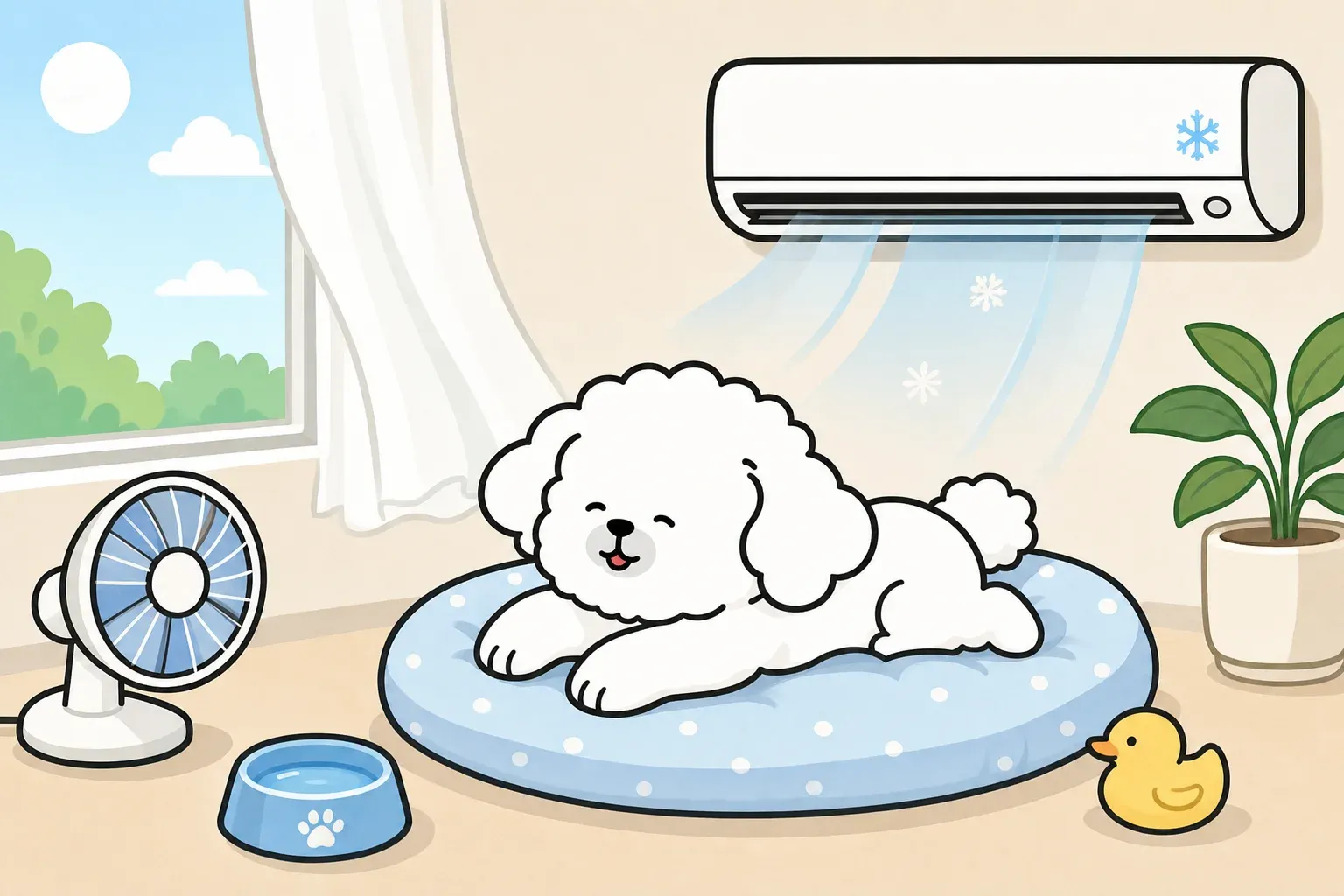
Most dog owners think summer heat is an outdoor problem. Open a window, skip the afternoon walk, and everything is fine indoors—right? Not quite. A 2023 survey by the American Kennel Club found that a significant portion of heat-related incidents in pets occur inside the home, often because owners underestimated how quickly indoor temperatures climb or assumed running the AC meant the temperature was safe for their dog.
Indoor cooling is not just about turning on the AC. Breed physiology, humidity, airflow direction, and what happens during the hours you are away all determine whether your dog is genuinely comfortable or quietly struggling. This guide covers the full picture: the science, the numbers, the products, and the daily habits that together keep dogs safe from July through September.
Why Indoor Temperature Matters More Than You Think
On a 95°F (35°C) day, a closed room with single-pane windows and no ventilation can reach 110°F (43°C) within two hours—even with no direct sunlight. Dogs rely almost entirely on panting to shed heat, a process that becomes less effective as humidity rises and ambient temperature approaches body temperature (around 101°F–102.5°F / 38.3°C–39.2°C).
How Dogs Regulate Body Temperature Differently
Humans sweat across the entire skin surface. Dogs sweat only from their paw pads and nose, so panting—exchanging hot air from the lungs with cooler ambient air—is the primary cooling mechanism. When the indoor air itself is warm and humid, this exchange becomes inefficient. The body temperature rises, blood flow redirects to the skin, and without effective heat dissipation, core temperature can reach dangerous levels (above 104°F / 40°C) faster than most owners expect.
This is why a dog can appear relaxed on the couch at noon and show signs of heat stress by 2 p.m. simply because the room warmed up while you were at work.
Breeds and Ages Most Vulnerable to Indoor Heat
Not every dog handles indoor heat the same way. Vulnerability is shaped by anatomy, coat, age, and body condition:
| Risk Category | Examples | Key Reason |
|---|---|---|
| Brachycephalic (flat-faced) | Bulldogs, Pugs, French Bulldogs, Boston Terriers | Restricted airway reduces panting efficiency |
| Heavy double coats | Huskies, Malamutes, Chow Chows, Samoyeds | Coat insulates against heat loss |
| Senior dogs (7+ years) | All breeds | Reduced cardiovascular efficiency |
| Puppies (under 6 months) | All breeds | Immature thermoregulation |
| Overweight dogs | All breeds | Excess fat acts as insulation |
| Short-nosed giant breeds | Dogue de Bordeaux, Cane Corso | Combined brachycephalic and size risk |
Dogs in the senior category are particularly worth noting. Aging reduces the body’s ability to detect and respond to temperature shifts, meaning a senior dog may not pant noticeably even when overheating. If you have a senior dog, check out this senior dog summer routine guide for age-specific adjustments.
Ideal AC Temperature Settings for Dogs
The most common question from dog owners in summer is simple: what should my thermostat say? The honest answer is that it depends—but the ranges are narrow enough to be actionable.
Temperature Guide by Breed Type
The American Veterinary Medical Association (AVMA) does not publish a single universal safe temperature for dogs, but veterinary guidelines and thermal physiology research converge on the following ranges:
| Breed Profile | Comfortable Range (°F) | Comfortable Range (°C) |
|---|---|---|
| Standard healthy adult (medium to large) | 75–80°F | 24–27°C |
| Brachycephalic breeds | 72–76°F | 22–24°C |
| Heavy-coated arctic breeds | 68–75°F | 20–24°C |
| Senior dogs (7+) | 72–77°F | 22–25°C |
| Puppies (under 6 months) | 72–78°F | 22–26°C |
These ranges assume normal humidity. In high-humidity conditions (above 60%), drop the target temperature by 2°F–3°F (1°C–2°C) because humid air impairs panting efficiency directly.
One practical note for US households: if you have central air conditioning, set the thermostat to 76°F–78°F (24°C–26°C) as a baseline. For window or portable units cooling a single room, verify the room temperature with a separate thermometer—unit output and room temperature often differ by 3°F–5°F.
Humidity Sweet Spot: Why 40–60% Matters
Temperature alone does not capture comfort. The heat index—how temperature and humidity combine to feel—is just as relevant for dogs as it is for people. At 80°F and 70% relative humidity, the felt temperature is closer to 88°F. For a dog whose panting is already less efficient in warm air, that gap is significant.
Target indoor relative humidity between 40% and 60%. Below 40%, mucous membranes dry out, which can irritate airways—especially in brachycephalic dogs. Above 60%, evaporative cooling through panting drops off sharply.
A basic indoor hygrometer (humidity gauge) costs under $15 and gives you real-time data. Many smart thermostats display humidity. If your home runs consistently above 60% RH in summer, a standalone dehumidifier in the room where your dog rests is worth considering.
Airflow Direction and Fan Speed Tips
Air conditioning cools the air but does not distribute it evenly. Cold air sinks; warm air stratifies near the ceiling. Dogs rest at floor level, which is actually an advantage—cooler air naturally settles there—but stagnant pockets of warm air can still form in corners.
A few practical adjustments:
- Point ceiling fan blades counterclockwise in summer to push air downward and create a cooling breeze at floor level.
- Add a box fan or tower fan at your dog’s resting level, aimed across the room rather than directly at them. Constant direct airflow can dry out the eyes and nose.
- Keep interior doors open to allow air circulation between rooms. Closing off rooms can trap heat unevenly.
- Avoid positioning beds directly under AC vents. Cold air blasting continuously onto one spot is uncomfortable and can cause cold stress (more on this below).
Leaving Your Dog Home Alone in Summer
The hours your dog spends alone are the highest-risk window. Without you to observe behavior or adjust the environment, a malfunctioning thermostat or an unexpectedly hot afternoon can escalate quickly.
AC Settings Checklist for When You’re Away
Before leaving on any summer day when the outdoor temperature will exceed 85°F (29°C):
- Set thermostat to no higher than 78°F (26°C)—lower for brachycephalic or senior dogs
- Confirm the AC is functioning before you leave (feel air from vents)
- Close curtains or blinds on south- and west-facing windows to block afternoon sun
- Leave multiple fresh water bowls in different rooms (not just one)
- Remove any items that block airflow around vents or fans
- Check that no dog bed is positioned directly under or against a vent
- If using a smart thermostat, verify remote monitoring is active on your phone
A temperature monitor with mobile alerts (many smart plugs offer this feature) adds a useful safety net. If the indoor temperature rises above your set threshold, you receive a notification and can act—call a neighbor, contact a pet sitter, or adjust remotely.
Timer vs Continuous: When Each Makes Sense
Some owners use a programmable timer to run the AC only during peak heat hours (typically 11 a.m.–4 p.m.) as a cost-saving measure. This approach works for dogs with medium or light coats in homes that do not heat up quickly. For brachycephalic breeds, heavy-coated dogs, seniors, or homes in direct sunlight, continuous operation on hot days is the safer choice.
The concern with timers is re-heating. If the AC is off from 8 a.m.–11 a.m. and the outdoor temperature rises to 95°F (35°C), interior temperatures in a sealed home can jump 10°F–15°F in that window—faster than the AC can compensate once it restarts.
If cost is a concern, set the thermostat to 80°F (27°C) during off-peak hours rather than turning the unit off entirely. This keeps the room from overheating while reducing runtime.
Power Outage Backup Cooling
Power outages during heat waves are rare but not unlikely in summer. A basic preparation plan:
- Battery-powered fan stored in an accessible location (provides airflow without electricity)
- Pre-frozen water bottles or ice packs in the freezer—wrap in a thin towel and place near (not under) your dog
- Identification of a nearby cool destination: a pet-friendly business, friend’s home, or air-conditioned vehicle
- Veterinary contact information easily accessible for the responsible adult (pet sitter, neighbor) if you are not home
Within 30–60 minutes of a power outage on a hot day, begin active cooling measures rather than waiting to see whether power returns.
Cooling Products Compared
The market for dog cooling products has expanded considerably, and the differences between product types are meaningful. Choosing the wrong type for your dog’s situation can mean spending money on something they ignore.
Gel Mats vs Elevated Beds vs Aluminum Pads
| Product Type | How It Works | Best For | Limitations |
|---|---|---|---|
| Pressure-activated gel mat | Gel absorbs body heat on contact, self-recharges when not in use | Most dogs, moderate heat | Loses effectiveness after 15–30 min continuous use; can puncture |
| Elevated mesh/cot bed | Air circulates under the body; no direct cooling agent | Dogs that overheat from mattress warmth; outdoor patios | Does not actively cool; less effective in still, hot air |
| Aluminum plate | Metal conducts heat away from the body; requires no charging | Dogs that seek out tile floors; highly efficient in cool rooms | Cold to the touch initially; less portable; can feel too cold in AC rooms |
For typical US homes with central AC running at 76°F–80°F (24°C–27°C), an elevated mesh bed positioned away from direct vent airflow is often sufficient. In homes without AC or on days when the system is struggling to keep up, a gel mat or aluminum plate provides meaningful additional relief.
One practical test: place the mat in your dog’s usual resting spot for 30 minutes before they use it. If they choose it spontaneously, it is working. If they avoid it entirely, the texture or surface may be uncomfortable for that individual dog.
Cooling Vests and Bandanas
Cooling vests and bandanas work through evaporative cooling—the same principle as sweating. Wet the garment, wring it out, and place it on your dog. As the water evaporates, it draws heat from the surface.
When they help: during brief outdoor activity on hot days, or in non-air-conditioned spaces.
When they are less useful: in high humidity (evaporation slows), or in well-air-conditioned rooms where the dog is already comfortable.
Sizing matters. A vest that restricts movement or compresses the chest increases respiratory effort, which is counterproductive for brachycephalic dogs. If your dog is flat-faced, prioritize environmental cooling (AC, mat, fan) over garments.
Bandanas are lower risk and easier to size. A damp bandana around the neck, refreshed every 20–30 minutes, provides light evaporative relief during walks or car rides.
DIY Cooling: Frozen Towels and Ice Bottles
Improvised cooling tools are often underestimated. A few options with realistic expectations:
- Frozen damp towel: place on the belly, groin, and paws where blood vessels run close to the skin. Effective for 10–15 minutes. Refresh as needed.
- Water bottle filled with ice: wrap in a thin cloth (direct ice contact can be too cold) and place in the dog’s bed. Lasts 1–2 hours.
- Ice water in a shallow dish for paw soaking: many dogs will voluntarily stand or sit in cool water. Even brief paw cooling provides measurable body temperature reduction because paw pads are one of the few areas dogs sweat.
- Frozen Kong or lick mat: keeps the dog engaged and slightly lowers core temperature through ingesting cool food. Not a primary cooling method, but a useful addition.
These tools complement—rather than replace—environmental cooling. On days above 90°F (32°C), DIY methods alone are insufficient for extended periods.
Cold Stress vs Heat Stress: Know the Difference
One underappreciated summer risk is overcooling. Dog owners concerned about heat sometimes set the AC extremely low, only to find their dog showing distress from the opposite direction. Knowing the difference between cold stress and heat stress symptoms prevents misinterpreting one for the other.
Signs Your Dog Is Too Cold from AC
- Persistent shivering or trembling while resting
- Curling tightly into a ball, tucking the tail
- Seeking out blankets, laundry, or warm spots on furniture
- Reluctance to move, muscle stiffness on waking
- Cool ears and paws (slight coolness is normal; very cold is a warning)
If you observe these signs, raise the thermostat 2°F–3°F (1°C–2°C) and provide a fleece blanket in the resting area. Most dogs adjust quickly. If shivering persists despite a warmer room, a veterinary evaluation is appropriate to rule out underlying conditions.
Signs Your Dog Is Overheating Despite AC
Even with the AC running, dogs can overheat if the temperature is set too high, if the system is underperforming, or if the dog was already warm from recent exercise. Key warning signs:
- Rapid, heavy panting that continues even when the dog is completely at rest
- Excessive drooling or thick, ropy saliva
- Gums that appear bright red, pale, or grayish rather than healthy pink
- Restlessness, inability to find a comfortable position
- Glazed or unfocused eyes
- Seeking out the coolest tile, concrete, or shaded corner of the room
For a detailed symptom comparison and emergency action steps, see the dog heat stroke prevention guide.
When to Call the Vet
Call immediately if your dog shows any of the following:
- Body temperature above 104°F / 40°C (measured rectally)
- Vomiting or diarrhea alongside heat signs
- Collapse, inability to stand, or seizure activity
- Gums that are pale, white, or gray rather than pink
While waiting for veterinary care or transport, move the dog to the coolest available space, apply room-temperature water (not ice water—it can cause blood vessels to constrict) to the paws, groin, and neck, and offer small sips of water if the dog is conscious and able to swallow.
Do not use ice water or ice packs directly on the skin. Rapid external chilling can cause blood vessel constriction that traps heat in the body core.
Summer Indoor Cooling Daily Routine
A consistent daily structure does more than reactive measures to maintain safe indoor temperatures. The goal is to stay ahead of heat accumulation rather than responding to it.
Time-Based Temperature and Ventilation Schedule
| Time | Action |
|---|---|
| 6–8 a.m. | Open windows briefly to flush cool morning air through the house; close before outdoor temp exceeds indoor temp |
| 8–9 a.m. | Close all windows and sun-exposed blinds; AC to target temperature |
| 10 a.m.–3 p.m. | Peak heat window: avoid opening doors unnecessarily; check on dog every 1–2 hours if home |
| 4–6 p.m. | Outdoor temperature begins to drop; continue AC if indoor temp is above 78°F (26°C) |
| After 7 p.m. | Can begin ventilating again if outdoor temperature drops below 75°F (24°C) |
| Night | Most dogs are comfortable with AC set to 76°F–79°F (24°C–26°C); adjust for brachycephalic or senior dogs |
Indoor activity—any brief play, training, or movement—should be scheduled for the morning window when both outdoor and indoor temperatures are lowest. For ideas that work well within this constraint, the indoor play activities guide offers options that are appropriately low-intensity for hot weather.
Water Intake Monitoring
Heat increases water requirements substantially. A dog that normally drinks 1 oz of water per pound of body weight per day (roughly 30 mL per kilogram) may need 1.5–2x that amount on hot days. Active dogs and nursing mothers need even more.
Practical steps for hot weather hydration:
- Place multiple bowls in different rooms and floors of the house—dogs drink more when water is convenient
- Use wide, shallow bowls rather than deep narrow ones; many dogs prefer less nose submersion
- Add ice cubes to the water bowl to maintain temperature and encourage interest
- Refresh water at minimum twice daily—water sitting in a warm room loses appeal quickly
- For dogs reluctant to drink: wet food, low-sodium broth (diluted, no onion or garlic), or ice made from broth can increase fluid intake
Weight-based monitoring: a dog that is drinking adequately will produce normally colored urine (pale yellow). Dark yellow urine, infrequent urination, or dry gums suggest insufficient intake. For a complete breakdown of hydration signs, dog-specific water needs by size, and broth ice cube recipes, see the dog hydration and water intake guide.
If your dog is reluctant to drink even with encouragement, this can signal nausea, pain, or illness—not just heat preference—and warrants a veterinary check.
References
FAQ
What temperature should I set my AC for my dog in summer?
Is it safe to leave my dog alone with the AC on all day?
How do I keep my dog cool at home if I don't have AC?
What are the early signs that my dog is overheating indoors?
Can the AC make my dog too cold?
Related Articles
Dog Heat Stroke Prevention: Critical Temperature Thresholds and Warning Signs Every Owner Must Know
Learn the 4-tier temperature risk system, breed-specific vulnerabilities, pavement heat dangers, and step-by-step emergency protocol to prevent and treat dog heat stroke this summer.
How Much Water Should a Dog Drink? By Weight, Age & Season
Daily water targets by weight, dehydration self-tests, and tips for dogs that won't drink. Covers all ages, diets, and seasons.
Senior Dog Daily Routine: Morning-to-Bedtime Care Schedule
A complete senior dog daily routine: morning walks, midday enrichment, evening joint care, and bedtime setup — backed by AAHA guidelines.