 Cirius Petpedia
 Dog Keeps Jumping on People? Why It Happens and How to Train a Polite Greeting
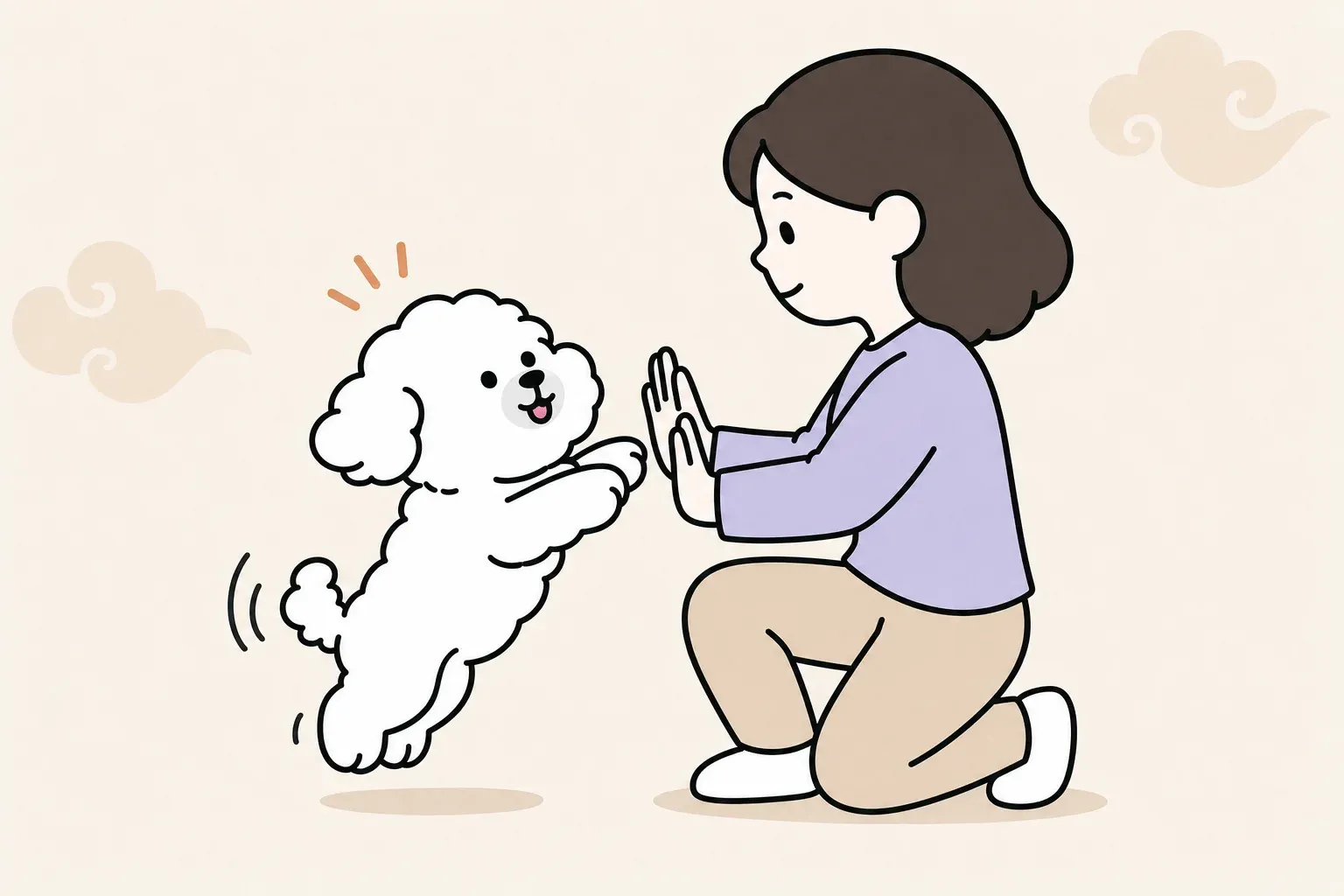
Your neighbor’s kid came over to say hello. Before you could react, your 70-pound Labrador was up on her chest, muddy paws and all. She laughed it off, but her grandmother — who visited last Thanksgiving — did not fare as well. A jumping dog is not just an embarrassing inconvenience. For a child, an elderly person, or anyone caught off balance, it is a genuine safety hazard.
If you have searched how to stop dog from jumping on people and found yourself buried in contradictory advice — some telling you to knee the dog, others saying to just ignore it — this guide cuts through the noise. You will learn why dogs jump in the first place, which corrections actually make things worse, and a four-step training protocol grounded in positive reinforcement that works for puppies, adult rescues, and the enthusiastic 90-pound German Shepherd who has been getting away with it for years.
Why Dogs Jump on People
Understanding the motivation behind the behavior is not just academic — it directly informs which training approach will work. A dog that jumps out of excitement is wired differently than one that jumps to demand attention, and the fix for each has important nuances.
It’s a Natural Greeting — Dogs Want to Reach Your Face
Puppies greet their mothers by licking around the mouth. It is a hardwired social behavior that signals submission, affection, and a request for attention or food. When your puppy tries to jump up and reach your face, they are doing exactly what instinct tells them to do — trying to make nose-to-nose contact the way they would with another dog.
The problem is obvious: humans stand upright, and a dog’s natural greeting target is roughly five feet off the ground. Jumping is the solution the dog arrives at on its own, and without intervention, it becomes a fixed habit before most owners realize there is anything to train away.
According to the AKC, this face-seeking behavior is especially persistent in social breeds — Labrador Retrievers, Golden Retrievers, Boxers, and similar dogs that were bred specifically to interact closely with people. Their drive to connect is a feature of the breed. Jumping is the bug that developed when that drive was never redirected.
Learned Behavior — Jumping Gets Attention
Here is the core behavioral reality that most advice glosses over: jumping works, and it has been working since the day your dog tried it the first time.
When a puppy jumps up and you lean down, laugh, or even push them away while making eye contact and saying “no” — you have rewarded the jump. Attention, even negative attention, is reinforcing to a social animal. The puppy learned: jump = human responds to me. That lesson gets rehearsed dozens of times every day across weeks and months until it is rock solid.
Best Friends Animal Society notes that this accidental reinforcement cycle is the single most common reason jumping persists despite owner frustration. The behavior is not defiance, stubbornness, or dominance. It is a learned communication strategy that got reinforced early and often.
Excitement Overload — When Self-Control Hasn’t Developed Yet
Beyond instinct and learned behavior, there is a third factor: arousal. When a dog is genuinely excited — when you come home after a long day, when a guest rings the doorbell, when they see a neighbor at the dog park — their impulse control goes out the window. Puppies, adolescent dogs, and high-drive adult breeds are particularly vulnerable here because their ability to regulate arousal is still developing or is constitutionally limited.
This is why the front door is a chronic flashpoint. The combination of a novel person, a novel scent, the anticipation of attention, and the owner’s own emotional response (happy to see guests, mildly anxious about the dog’s behavior) creates a perfect storm of overstimulation. The dog does not choose to jump. They are simply past the threshold where any deliberate behavior regulation is possible.
Understanding this matters because it means you cannot simply correct your way out of the problem at that moment of peak excitement. The training has to happen well before the threshold, so that the calm behavior becomes automatic even when arousal is high.
Why You Should Train Your Dog Not to Jump
Most owners already know they want to stop the behavior. But having specific, concrete reasons strengthens the motivation to train consistently — which, as you will see, is the single most important factor in success.
Safety — Risk to Children, Elderly, and Strangers
A jumping dog is a physical hazard. According to PetMD, dogs jumping on people account for a meaningful percentage of dog-related injuries that are not bites — particularly falls and impact injuries to elderly individuals and young children. A 60-pound dog launching itself at a seven-year-old or an 80-year-old is capable of causing serious harm, even without any aggressive intent.
The liability dimension is real. In many states, dog owners can be held legally responsible for injuries caused by their dog jumping on someone, regardless of whether the dog has any bite history. A pleasant, friendly dog that knocks someone down a flight of porch steps is still a legal and financial risk.
For large breeds specifically — German Shepherds, Rottweilers, Standard Poodles, Bernese Mountain Dogs — the mass and force involved means the risk scales up dramatically. A 90-pound dog jumping at full enthusiasm can deliver impact comparable to a running tackle. Training this behavior early is not optional for large dog owners.
Joint Health — How Repeated Jumping Affects Knees and Hips
There is a physical cost to the dog as well. Repeatedly launching off the rear legs and landing with full bodyweight on the front legs puts significant stress on joints that may already be predisposed to problems. In large and giant breeds, the hip and knee structures are under more strain than in smaller dogs, and behaviors that compound that load over years matter.
Repeated jumping also places stress on the stifle joint (the dog’s knee) and can accelerate wear on hip cartilage, which is particularly concerning in breeds prone to hip dysplasia. We cover this in more detail in our article on how jumping and high-impact movement affect dog joint health long-term. The short version: teaching your dog to keep four paws on the floor is as much a health decision as a behavior one.
Social Life — Making Walks and Outings Enjoyable
A dog that jumps on every person it encounters makes normal life significantly more difficult. Dog parks, neighborhood walks, trips to the pet store, visits from friends and family — all of these become sources of stress instead of enjoyment when you spend the entire time managing your dog’s front paws.
Owners of jumpy dogs commonly report avoiding social situations with their dogs altogether, which then creates under-socialization, increased arousal at rare social interactions, and a self-reinforcing cycle. Getting the jumping under control opens up your dog’s world and yours.
3 Common Corrections That Backfire
Before getting to what works, it is worth taking a hard look at the approaches that feel intuitive but reliably make things worse. If you have tried any of these, you are not alone — they are widely recommended and widely ineffective.
Kneeing the Dog in the Chest
This is probably the most persistently repeated piece of bad advice in dog training. The idea is that if you raise your knee as the dog jumps, the impact will be aversive enough to deter future jumping.
In practice, it does not work for several reasons. First, timing is nearly impossible — by the time you raise your knee, the dog is already in the air, making the connection between the behavior and the consequence unclear. Second, many dogs interpret the raised knee as part of the interaction, even as a play invitation. Third, for dogs with joint issues or puppies with developing bones, physical impact is a welfare concern. The ASPCA’s guidelines on behavior modification explicitly advise against physical corrections that could cause pain or fear, noting that these approaches can increase anxiety and erode trust without addressing the root behavior.
Stepping on Paws or Holding Them Uncomfortably
A related approach: when the dog jumps, grab their paws and hold them up, or step on their rear paws to make the position uncomfortable. The rationale is that the dog will dislike having their paws handled and stop jumping.
The problem is the same as kneeing — timing, clarity, and fallout. Dogs do not reliably connect the paw discomfort with the act of jumping, particularly if the correction comes a second or two after the jump. What they do learn is that physical interactions with you can be unpredictable and unpleasant, which is not the lesson you want to teach a dog you also need to handle, groom, and examine.
Yelling and Physical Punishment
Shouting “off,” “down,” or “no” at a jumping dog is a response that most dogs find reinforcing rather than deterring. You made eye contact. You spoke. You are animated and engaged. From the dog’s perspective, the jump produced exactly the social response they were after.
Physical punishment — pushing, swatting, or grabbing the dog — carries all of the same risks outlined by the ASPCA: it can increase fear and defensive reactivity, suppress behavior in the short term while leaving the emotional drive intact, and seriously damage the trust relationship you need for any training to function. The Bark Busters 2026 National Dog Behavior Analysis, which surveyed thousands of dog behavior cases, found that jumping was among the top five behaviors where owner attempts at physical correction were associated with no lasting improvement.
The reason all three of these approaches fail at the behavioral level is the same: they focus on the moment of the jump rather than teaching the dog what to do instead. Effective training does not suppress a behavior — it replaces it with something incompatible.
4-Step Sit-to-Greet Training Protocol
The sit-to-greet method is the gold-standard approach recommended by the AKC, ASPCA, and certified professional trainers. The logic is elegant: a dog cannot simultaneously sit and jump. By making “sit” the automatic response to an approaching person, you replace jumping with an incompatible behavior that earns attention and reward.
This protocol works because it addresses both sides of the problem — the dog’s behavior and the human response — and builds the new behavior through repetition in progressively more challenging contexts.
Step 1: Perfect the Sit Command
Before you can use “sit” as a greeting behavior, it needs to be reflexive — fast, reliable, and solid across different environments and distraction levels. If your dog’s sit is shaky or only works when you are holding a treat visibly in your hand, you need to build it up first.
Practice sit in short, high-frequency sessions of two to three minutes throughout the day. Use a variety of reinforcers — treats, praise, brief play sessions. Practice in different rooms, outside, and during mild distraction. The goal is a sit that happens within two seconds of the cue, regardless of where you are or what else is happening.
For puppies, the AKC recommends starting sit training as early as seven to eight weeks. For adult dogs learning or refreshing the behavior, expect three to seven days of consistent practice before the sit is reliable enough to use in greeting scenarios. A dog that has been jumping for years needs a thoroughly overlearned sit to compete with the well-rehearsed jumping habit.
Step 2: Door Opens = Sit
Now you begin building the association specifically at the front door — the highest-arousal jumping flashpoint in most households.
Start without guests. Pick up your keys, walk to the door, and ask for a sit before you open it. Wait for the sit. When the dog sits, open the door slightly. If the dog breaks the sit and jumps up, close the door immediately. No fuss, no correction, no eye contact — just a calm door closure. The door opening is the reward. Breaking the sit makes the reward disappear.
Repeat this until your dog is offering the sit as soon as you move toward the door — before you even ask for it. This is the goal: the dog learns that the pattern is “person at door = I sit = good things happen.” The sit becomes a default behavior driven by the dog’s own learning, not a reluctant response to a command.
This step alone takes most owners one to two weeks of daily practice, assuming they are drilling the door sequence five to ten times per session. Consistency matters more than duration.
Step 3: Practice With Family Members
Once the behavior is solid with you, it needs to be generalized to everyone in the household. This is where most training efforts stall — one family member follows the protocol and three others do not.
Gather every person who regularly interacts with the dog and walk them through the protocol. Each person needs to practice the door sequence independently, ask for the sit before any greeting, and consistently withhold attention any time four paws are not on the floor. One person allowing jumping during this phase resets weeks of work.
This is also the phase where you introduce the “four paws on the floor” rule as a household standard. Anyone who comes through the front door — family members, regular visitors, dog walkers — should know the rules. Print them out and put them on the fridge if that helps. The dog learns from what actually happens, not from what should happen.
For households with children, this step requires special attention. Kids are often less consistent with training rules, and their erratic, high-energy movements can trigger jumping even in a dog that has been doing well. Practice calm greetings specifically with children present, and teach children the proper protocol — turn your back, no eye contact, wait for the sit, then say hello.
Step 4: Generalize to Guests and Strangers
This is the hardest and most important step. Everything you have trained at home needs to transfer to people the dog has not met, in contexts that are inherently more arousing than your living room.
Start by staging practice greetings with friends or neighbors who are willing to follow instructions. Brief them in advance: when they arrive, they should stand still, avoid eye contact with the dog, and only acknowledge the dog once four paws are on the floor. If the dog jumps, they turn their back. When the dog sits, they can calmly say hello and offer a treat.
Gradually increase the challenge: guests who are less familiar to the dog, guests who arrive in more energetic ways (ringing the doorbell, arriving in a group), and eventually strangers on walks and at the dog park.
At this stage, you will also want to have the dog drag a light leash when guests arrive, so you can easily redirect without grabbing the collar. The leash is not a correction tool — it is a management tool that lets you guide the dog into position calmly.
Real-Life Scenarios and Solutions
The four-step protocol establishes the foundation. These scenario-specific strategies handle the situations where jumping problems most often persist.
When Your Dog Jumps on People During Walks
Neighborhood walks are where many owners feel most exposed. Their dog spots another person coming down the sidewalk, lunges forward, and before any training can happen, is already up on a stranger who did not sign up to participate in a training session.
The solution is to work proactively, not reactively. When you see someone approaching, ask for a sit before your dog’s arousal climbs. A dog at baseline can sit reliably; a dog at peak excitement often cannot. Distance is your friend — ask for the sit from 15 to 20 feet away, before the approaching person is close enough to spike arousal.
If the person wants to greet your dog, brief them quickly: “He’s in training — could you only pet him when he’s sitting?” Most people will comply. Bring high-value treats specifically for these moments. The goal is a sit that earns a greeting, held long enough for a proper hello, with the dog released and praised when it is over. We cover the full approach to on-leash greeting skills in our guide to loose-leash walking and greeting manners on neighborhood walks.
When Guests Arrive at Your Door
The front door scenario is where the sit-to-greet protocol does its most important work. But there is a practical gap between a clean training drill and a real guest arrival — your dog has been building arousal since they heard the car pull up.
A few management tools help bridge that gap. First, put your dog on leash before opening the door. This is not a permanent arrangement — it is a scaffold that keeps training possible during the generalization phase. Second, ask guests to wait outside for thirty seconds after ringing the bell, giving you time to get the dog into a sit before the door opens. Third, keep a treat jar near the front door so you are never scrambling to find a reward at the critical moment.
If your dog is at a level of arousal where a sit is genuinely impossible, crate the dog briefly while you greet the guest, then introduce them calmly once the initial excitement has settled. This is not giving up — it is smart management that prevents another rehearsal of the jumping behavior.
When You Come Home From Work
Coming home is a daily high-stakes greeting that often gets overlooked in training plans because it feels personal. Your dog is ecstatic to see you, and responding to that with a cold shoulder feels unkind. But here is the reality: how you handle this moment, twice a day, every day, is one of the most powerful training inputs in your dog’s life.
The protocol is simple but requires consistency: when you walk through the door, if your dog jumps, turn your back immediately. No eye contact, no speaking, no touching. When four paws hit the floor — even briefly — turn around and calmly greet. If jumping resumes, turn away again.
The key word is “calmly.” Low-arousal homecoming greetings are dramatically easier for the dog to navigate than high-energy ones. Keep your own energy quiet when you walk in. Hang up your coat. Set down your bag. Let the initial excitement peak settle before you initiate any interaction. When your dog is calm — even for five seconds — that is the moment you reward with your attention. Over weeks, the dog learns that calm behavior is what brings the good stuff, and the homecoming greeting becomes genuinely pleasant for everyone.
Large Dogs vs Small Dogs — Different Approaches
The training protocol is the same regardless of size, but the urgency and execution differ significantly. A ten-pound Chihuahua jumping on a healthy adult is mildly inconvenient. A ninety-pound Rottweiler doing the same thing is a safety incident in waiting.
For large dogs — Labradors, Golden Retrievers, German Shepherds, Bernese Mountain Dogs, Standard Poodles — the management scaffolding needs to be more robust during the training period. Leash management at the door is not optional. The threshold for “the dog is too aroused to train right now” is lower, and management tools (crate, leash, baby gate) need to be deployed more readily.
Large dog owners should also be aware of the health dimension noted above. A large breed that has been jumping heavily for years may have accrued joint stress that will need monitoring. If your dog shows any stiffness, reluctance to use stairs, or changes in movement, discuss the history with your veterinarian — repeated high-impact jumping can be a contributor to early joint wear in predisposed large breeds.
For small dogs, the risk profile is different but the training standard should still be the same. Small dogs that jump habitually on strangers can cause fear reactions, scratch skin, and become a nuisance that is harder to manage as the dog ages. “He’s tiny, it’s fine” is a rationalization that produces the same reinforcement cycle and the same outcome: a dog that jumps on everyone for life.
Troubleshooting — When Training Isn’t Working
If you have been working the protocol for several weeks and are not seeing meaningful improvement, one of these three factors is almost always the cause.
Inconsistency Among Family Members
This is the number one reason sit-to-greet training fails. The dog is learning from every single interaction, including the ones where Dad lets the dog jump because he thinks it is cute, or where the kids pet the dog when it is already in mid-leap. One person undermining the protocol does not just slow progress — it actively reinforces the jumping on a variable schedule, which research in operant conditioning consistently shows produces the most resistant habits.
The fix requires a household conversation, not more training. Every person who interacts with the dog needs to be brought into alignment. If that is not possible — for example, if a household member simply will not participate — you need to manage the dog’s access to that person during the training phase. A baby gate or tether that prevents the jump from being rehearsed in that specific context is better than allowing daily reinforcement to undermine weeks of work.
Not Enough Exercise or Mental Stimulation
A dog that is chronically under-exercised and under-stimulated carries a baseline arousal level that makes impulse control extremely difficult. Jumping in excited situations is, in part, an overflow behavior — the dog has more energy than their environment provides outlets for, and any exciting social interaction becomes an eruption.
Before concluding that the training protocol is not working, audit your dog’s daily activity honestly. Does your dog get meaningful physical exercise — not just a ten-minute bathroom trip, but actual sustained aerobic activity? Does your dog get mental stimulation — training sessions, food puzzles, sniff walks, novel environments?
For large, high-drive breeds especially, an hour of physical exercise per day is a floor, not a ceiling. A dog that has been genuinely tired by a long morning walk or a fetch session will navigate the afternoon’s greeting scenarios with significantly more self-regulation available. We cover this relationship between physical exercise, mental stimulation, and impulse control in hyperactive dogs in more detail if this factor seems relevant to your dog’s pattern.
When to Consult a Professional Trainer
Some dogs need more support than owner-led training can provide. Consider consulting a certified trainer when:
- The jumping is accompanied by mouthing, nipping, or scratching that breaks skin
- The dog is so aroused at greeting moments that no training is possible — the threshold for overwhelm is too low to work with
- You have applied the protocol consistently for six weeks with no measurable progress
- The dog is a large or giant breed and the jumping has resulted in someone being knocked down or injured
Who to look for:
- CPDT-KA (Certified Professional Dog Trainer - Knowledge Assessed): The baseline credential for professional trainers, verified through the Certification Council for Professional Dog Trainers. Appropriate for most jumping and impulse control cases. Find a directory at ccpdt.org.
- DACVB (Diplomate, American College of Veterinary Behaviorists): Appropriate when jumping is part of a broader pattern of anxiety, reactivity, or when behavioral medication may be warranted.
Look specifically for trainers who use force-free, positive reinforcement-based methods. A trainer who recommends kneeing, alpha rolls, or prong collars for a jumping problem is using methods that are contradicted by current behavioral science and are likely to create new problems while not solving the original one.
FAQ
Should I ignore my dog when they jump on me?
Yes, ignoring is the most effective first response. When your dog jumps, avoid eye contact, don’t speak, and don’t push them away. Turn your back or step away. The moment all four paws touch the floor, immediately reward with praise and treats. Even pushing your dog away counts as attention and can reinforce the behavior.
Is it too late to train an adult dog not to jump?
It’s never too late. Adult dogs may take longer because the habit is more ingrained, but positive reinforcement training works at any age. Expect 4 to 8 weeks of consistent practice for an adult dog, and make sure every family member follows the same rules.
Can I fix jumping and excited barking at the same time?
Yes. Both behaviors often stem from poor impulse control, so the same training principles apply. Sit-to-greet training builds self-control in exciting situations, and many owners find that as jumping decreases, excited barking drops too. For a full guide on managing excited barking alongside jumping, see our article on dog barking control training.
What should I do when my dog tries to jump on strangers during walks?
Keep the leash short and ask your dog to sit before they reach the other person. Only allow greetings while your dog is sitting. Ask the stranger to cooperate by only petting your dog when all four paws are on the ground. Having a solid recall command makes this even easier — our recall training guide walks through building a reliable come cue that helps in exactly these moments.
References
FAQ
Should I ignore my dog when they jump on me?
Is it too late to train an adult dog not to jump?
Can I fix jumping and excited barking at the same time?
What should I do when my dog tries to jump on strangers during walks?
Related Articles
4 Common Mistakes That Make Your Dog's Hyperactivity Worse
Learn how to calm a hyperactive dog by avoiding 4 common mistakes. Covers a 4-step calming protocol, zoomies vs hyperactivity, and breed-specific tips.
Dog Jumping Off Furniture: Why Their Joints Are Paying the Price
Every couch jump sends 2–5x body weight through your dog's joints. Learn how repeated landings cause joint damage and what to do about it.
Bringing Home a New Puppy? The Complete Socialization Training Guide You Need
Learn the science behind puppy socialization windows, get a week-by-week timeline, and discover safe pre-vaccination methods with a practical category-based checklist.